
Picture a talk show. There is a host behind a desk. A guest sits across from him. Somewhere off camera there is a band, a camera operator, a sound person, a producer whispering in an earpiece. Now shrink that whole operation down until it fits inside one teenager in a Pittsburgh bedroom. The host is Jonathan. The guest is also Jonathan. The band is a viewer vote on a website. The sound person has been fired, on camera, as a joke. And the producer whispering in the earpiece is Jonathan too, because there was never anyone else.
This is the core method, and it never really changed, from the first episode of Talking With Jon in 2002 through everything he makes now: writing, shooting, performing, editing, distributing, and promoting, all done by one person. Most shows are teams. His was a team of one wearing every hat, sometimes literally changing hats between takes. The constraint shaped the comedy the way a river shapes its banks. If you need a guest and you have no guests, you play the guest. If you need a sponsor and you have no sponsors, you invent one. If you need a band, you ask the audience to vote on a website and then you become the band's biggest fan. Limitation was not the obstacle to the show. Limitation was the show.
The guest problem, and its solution
He was thirteen, and he wanted to be a talk-show host. He said so himself, naming the shows he loved. The format he dreamed about had a shape: a monologue, a desk, and guests in chairs. The monologue and the desk were easy. A recliner could be a desk. The guests were the problem, because there were no guests. No co-host, no neighbor kid on call, nobody to sit in the other chair.
So he sat in both chairs.
The first episode opens with a self-interview. Host-Jon asks the questions. Guest-Jonathan answers them. It is the founding decision of the whole series, and it is worth slowing down to admire, because a lot of kids would have waited. They would have waited until a friend was free, or until the show could look like the real thing. He did not wait. He decided the show needed two chairs, so he filled both of them, and the audience understood the deal immediately: everything here is handmade, including the people.
Two frames from episode 1 side by side. Left: host-Jon in the host chair, asking a question. Right: guest-Jonathan in the guest chair, mid-answer. Caption: "The two chairs, one person. Host-Jon (left) interviews guest-Jonathan (right) in the first episode. The eyelines cross where the other chair would be.
There is a practical lesson hiding inside the joke. A talk show without guests is just a person talking to a camera, and a person talking to a camera can feel like a dead end. The interview gives the host something to react to. Questions create rhythm. Answers create surprises, even when you wrote both. By inventing a guest, he invented the two things every talk show runs on: structure and surprise.
The two sides of the brain
Years later, Jonathan explained what the two Jons actually were, and his explanation turns a production workaround into the show's central device. The two Jons are the two sides of the brain.
Host-Jon is the left brain. He runs the format. He asks the questions, reads the transitions, handles the sponsor jokes, keeps the show moving. He is order, logic, the part of the mind that makes lists and checks the time.
Guest-Jonathan is the right brain. He is the maker, the fan, the kid who loves his toys and made a serious little film and thinks everything is interesting. He is impulse, enthusiasm, the part of the mind that wanders.
The comedy lives in the seam between them. Logic interviews impulse, with a straight face, and neither side ever admits they share a skull. Once you see it, you cannot unsee it, and it keeps paying off: every later character he plays against himself is a variation on this same device. The fussy pitchman against the calm host. The old man with the cane against everybody. The chef, the cop, the weatherman, the reaper. Each one is another piece of one mind, split off, costumed, and invited onto the show to argue with the rest of itself. A one-person show about a person in pieces, thinking out loud in costume.
A lineup of characters from across the series, each labeled with which "side of the brain" they play. Old man with cane, chef, pitchman, businessman. Caption: "One brain, many chairs. Every character Jonathan played against himself was another variation on the two-Jons device.
How to be two people: multi-character scenes, step by step
The trick looks like magic until someone explains it, and then it looks like something better: a recipe. Here is the recipe, the way he used it across 34 episodes. You can do this yourself with a phone and a closet.
Step one: lock the camera off. The camera must not move between takes, not even a little. A tripod is ideal. A stack of books works. What matters is that the frame is identical every time you press record, because the whole illusion depends on the background staying perfectly still while the person in it changes.
Step two: mark your spots. Two pieces of tape on the floor, or two chairs that do not move. Character A always sits in spot A. Character B always sits in spot B. If a chair drifts six inches between takes, the audience's eye catches it, and the spell wobbles.
Step three: shoot character A. Perform one side of the conversation. Ask the questions, make the accusations, deliver the setup lines. Leave real pauses where the other character will speak. Those pauses feel strange while you are filming. They are the most important part. You are acting with someone who is not there yet.
Step four: change costume. This is the step the audience never sees, and it is the whole secret. A coat comes off, a hat goes on, glasses appear, posture changes. Costume is doing most of the acting here. The viewer's brain reads a trench coat and a blazer as two different people long before it studies the face. Jonathan's closet was his casting department: trench coat, blazer, a brown coat and cane for the old man, a plaid shirt with a pink towel over the head, a paper bag over the head with paw gloves, a grim-reaper robe, a white shirt and tie for the businessman, a toga for the finale.
Costume-change evidence. Two frames from the same episode: the same locked-off background, Jonathan as the blazer-wearing host in one, as the old man with the cane in the other. Caption: "Same camera position, same background, different person. The costume change between takes is the invisible step."
Step five: shoot character B. Sit in spot B, in the new costume, and answer the pauses. React to things the other character said minutes ago, as if they were said seconds ago. This is the hardest acting in the whole process, because your scene partner is a memory of yourself.
Step six: cut between the takes. In the editing program, you lay the A take and the B take on the timeline and cut back and forth: question, answer, question, answer. Each cut is a little lie the audience happily believes. The conversation was never continuous. It was two monologues, sliced and interleaved until they looked like a dialogue.
Step seven: mind the eyelines. This is the detail that sells it. When character A speaks, he looks slightly to one side of the lens, at the spot where character B would be sitting. When character B answers, he looks slightly to the other side. Neither looks straight into the camera (unless they are addressing the audience, which is a different trick). Get the eyelines right and the two characters seem to see each other. Get them wrong and they look like two strangers talking to a wall.
He also used a cousin of this trick: picture-in-picture and split-screen composites, where both characters appear in the frame at once. Same recipe, one extra step. Shoot A on the left half of the frame, shoot B on the right half, and layer the two takes together in the editor. The camera stays locked, the costume changes, and the edit does the rest.
A three-frame breakdown of one multi-character exchange, numbered 1-2-3. Frame 1: character A mid-question. Frame 2: character B mid-answer. Frame 3: both in a split-screen composite. Caption: "One exchange, three edits. The conversation was filmed as two separate performances and assembled with cuts.
TRY THIS: The locked-camera scene. Prop your phone on a stack of books so it cannot move. Put two chairs in the frame and mark their positions with tape. Film yourself as character A asking three questions, leaving long pauses. Change one item of clothing, film yourself as character B answering. Cut the two takes together, alternating A and B. Watch it back. The first time both "people" seem to hear each other, you will feel like a magician. That feeling is the whole history of special effects in one bedroom.
Voices and sound with no crew
Now the part nobody thinks about until it goes wrong: sound. A film set has a sound department. Jonathan's set had Jonathan, holding a microphone.
One handheld microphone. That was the entire audio department. He held it while he performed, or set it near whoever was "talking," which meant near himself in a different costume. Everything the mic heard went into the show: the voice, the room, the handling. Room tone is the quiet sound a room makes when nobody is talking, a soft hiss that lives underneath everything, and his episodes are full of it, especially the early ones. Auto-gain pumping is what happens when a camera tries to be helpful: during a pause, the camera turns its own volume up to catch any sound, so the room hiss swells; when he starts talking again, it ducks back down. You can hear the camera breathing. Handling noise is the thump and rustle when the mic gets moved or bumped mid-scene. All of it is baked into the archive, and all of it is honest. That is what one person with one microphone sounds like.
And then he made it a joke. In episode 17, the old-man character, who has won the show's contest and played a song on a small keyboard, gets into a staged backstage fight with the show's "technical people." The punchline, delivered deadpan: the show had fired the sound guy. (The episode's actual line runs, in his words, "yeah don't worry about him we fired the sound guy and now we have some commercials.")
Think about what the joke is really saying. There was no sound guy. There was never a sound guy. The sound guy was a thirteen-to-sixteen-year-old holding a microphone and trying not to bump it. Firing him is funny the way all the show's production jokes are funny: it treats the pretend crew as real, and the audience is in on the fact that the crew is one kid. The fake sponsors "fund" the new backdrops. The seasons get counted on air. The segments get retired on air. The making of the show was always part of the show, and the sound guy, who never existed, got fired for all of us.
There is a real lesson in the joke, and it is the kindest one in this chapter. Bad audio is the fastest way to make a video feel amateur, and his audio was often rough: room echo, levels that jump around, music beds that swallow the dialogue. Professionals would call it the weakest craft element in the whole series, and they would be right. But here is what the fired sound guy teaches: he knew. The joke proves he was listening to his own show with a critical ear. He could hear the hiss and the pumping and the thumps, and instead of hiding them he put them on stage and fired somebody over them. You cannot fix what you will not admit, and he admitted everything, in costume, in front of the audience.
TRY THIS: The one-mic scene. Record a short scene with a friend using only your phone's built-in microphone, held in someone's hand. Then record the same scene with the phone sitting across the room. Listen to both with your eyes closed. You will hear room tone, handling noise, and the difference distance makes. Now you know more about location sound than most people who own expensive microphones.
Showing the seams on purpose
Most shows hide the mistakes. Talking With Jon ended with them. Outtakes were the standard closer: after the sketches and the interviews and the songs, the audience got the bloopers, the flubbed lines, the corpsing, the moments the trick almost worked. He showed the seams on purpose.
This was not laziness. It was a philosophy, and it might be the most modern thing about a show made before YouTube existed. The outtakes say: you watched me build this, now watch me almost drop it. They turn the audience from viewers into co-conspirators. Everybody who has ever tried to film themselves recognizes the feeling of the take that falls apart, and the blooper reel says we are all in on it together.
It also served a craft purpose he may not have fully articulated at fifteen but clearly felt. When you are learning in public, the mistakes are the curriculum. The outtake where the costume change is visible, the take where he looks at the wrong eyeline, the moment the mic thumps: each one is a little lesson in what not to do, taught by the person doing it. The production process was not just part of the show's content. It was the show's content, the thread that held 34 episodes together across five years: watch a kid figure out television, in order, with the errors left in.
The set, the props, and the economy of the room
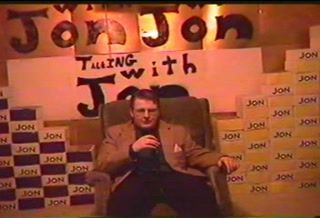
A word about the physical world these scenes lived in, because the one-person method extended to the set. The base setup was an armchair or recliner, a small white cabinet with mugs on it, the handheld mic, and a wall decorated with a checkerboard of gray and blue construction-paper squares. Later came the rebuilds, each one narrated on air like a home-improvement show: a black backdrop bought with "funds donated from our new sponsors," a blue backdrop, a hand-painted night-sky backdrop with stars and a crescent moon and a big JON, a whole grid of hand-lettered JON signs taped to the wall, a small TV he called "a plasma screen TV thing that we show our clips on," lowered into frame mid-episode.
The desk and monologue setup, then and now. Left: the armchair, the cabinet with mugs, the paper-square wall from the early episodes. Right: the JON-sign grid set from the middle years. Caption: "The set grew up with the show. Paper, tape, and confidence, rebuilt on camera and paid for by sponsors who did not exist.
Props came from the kitchen and the closet. A Tabasco bottle stood in for something it was not. Paper signs did the work of graphics departments. The famous line about the show's look could be: paper, tape, and confidence. Nothing was hidden and everything was shown. When the budget is zero, honesty becomes an aesthetic, and the audience can feel the difference between cheapness that apologizes and cheapness that performs. His never apologized.
That is the one-person crew, the complete method. Write it, shoot it, perform all of it, cut it together, hand it to people. Need a guest? Be the guest. Need a second guest? Change the coat. Need a sound guy? Hold the mic yourself, and if anyone asks, you fired him. The constraint did not just shape the comedy. In the end, the constraint was the comedy, and the kid holding the microphone was the whole studio.