
The First 100,000 Digits of Pi
Jon reads the digits of pi out loud, all 100,000 of them, in one marathon sitting. Runtime 10:00:01
JUST RELEASED
Everyday Repairs · Episode 7
Everyday Repairs #7: Welcome to ER
Welcome to ER, as I say this week. I hire a young kid off Craigslist, hand him a spare hammer, and put him to work, because that is what safety looks like around here. Another beautiful week of me proving that you, me, and a kid with a hammer can fix anything.
Episode pageJon reads the digits of pi out loud, all 100,000 of them, in one marathon sitting. Runtime 10:00:01
Jon counts out loud from 1 to 10,000, the opening stretch of the count to 100,000. Runtime 8:22:18
Jon counts out loud from 90,000 to 100,000, the final stretch of the count to 100,000.
A short one-off from a cruise trip Jon and Rachel took in May 2026. Runtime 1:29
The 2011 Moldytoaster lineup, joined by Tech Thursday and brought together in one quick, readable catalog.
Tech news, plain-English explainers, and videos from the Tech Thursday channel, updated daily.
The video posts below come from Tech Thursday on YouTube, a channel with about 199 videos of experiments, tests, and how-to projects.
Shows /
Shows / / Episode
This archived episode is currently unavailable.
Shows / Jon Drinks Water / Water Reviews
Winner:
Comedy lists, movie ideas, and the story of the official app. New pieces can join the same collection as they are written.
Articles / Archive
For collaboration, rights, or show-pitch questions, use the current public contact details on the Let's Tape It YouTube channel.
Moldytoaster began as Jonathan Harchick's home for original internet shows. By 2011, the site described itself as “TV for an internet generation” and gathered a wide mix of comedy, repair, art, gaming, movie, and talk series under one roof.
This edition restores that 17-show catalog and the original Articles section in a format made for current screens.
From Talking With Jon and Everyday Repairs to The Trampled Rose, Blindfolded Art, and Let's Tape It, the catalog records years of independent online video made before creator websites became unusual.
Want your show on Moldytoaster? Pitch it here.
A ranked collection of press coverage, television appearances, public records, and archives connected to Jonathan Harchick and Moldytoaster.
Daniel Tosh interviewed Jonathan by webchat about wrapping everyday objects in tape.
TIME covered Jonathan's 571-hour video and the extraordinary commitment required to watch it.
Nicholas Jackson highlighted Jonathan's 571-hour upload as The Atlantic's video of the day.
IMDb credits Jonathan Harchick as “Self” in the “Jeff Corwin/Mario Lopez/Jamie Lidell” episode for a homemade commercial he submitted; no footage has been found online.
Mack Lamoureux interviewed Jonathan about the water-drinking community, calling him the “godfather of the Drinkers.”
David Moye reported on Jonathan's record-length upload and the unusual scale of the project.
Kelly Hodgkins explained how a comparatively small video file could run for more than three weeks.
Adweek covered the 571-hour video as a striking record from YouTube's early years.
KSL brought the story of Jonathan's 571-hour upload to its news audience.
RecordSetter lists JONATHAN H of Pittsburgh, Pennsylvania at 596 hours, 31 minutes, and 21 seconds.
Know Your Meme preserved an entry for the original 571-hour upload.
Jonathan's campaign raised $11,379.92 from 309 donations, funding a well in Vaama, Sierra Leone that serves 301 people.
Jonathan is the self-published author of 21 books collected on his Goodreads author page.
Preserved copies include “THE LONGEST VIDEO ON YOUTUBE - 571 HOURS” and the JonDrinksWater collection; search for “MoldytoasterMedia” or “JonDrinksWater.”
Home / Random video
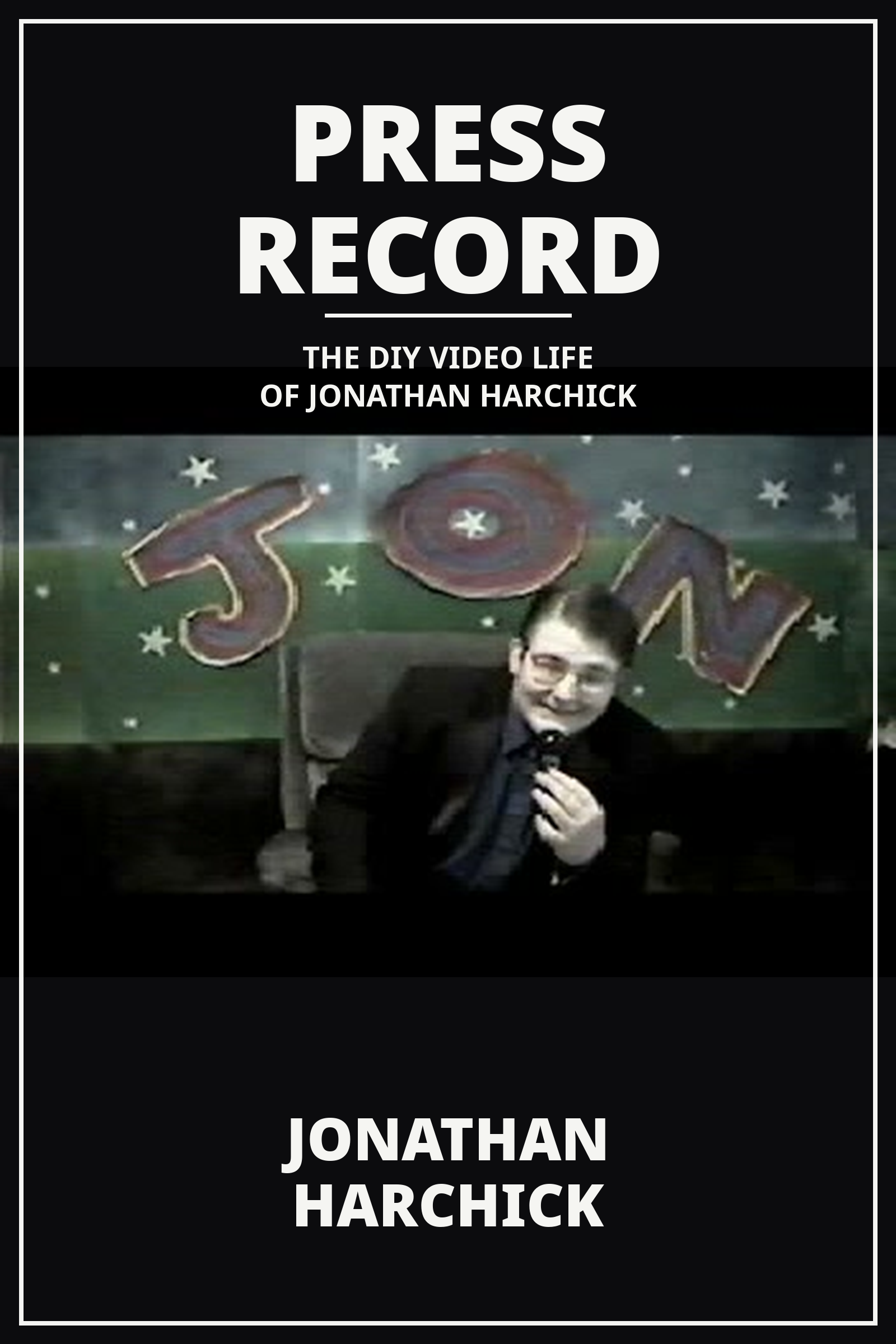
A co-authored coffee-table book
Working title, provisional. The co-authors may change it.
Foreword
Part I: Before the Platform
Part II: Talking With Jon
Part III: The Other Early Experiments and the Brand
Part IV: The 2011 Stunt Era
Part V: The Long Game
Part VI: How It Was Made
Part VII: On Screen and In the News
Part VIII: What the Bedroom Taught
Working title, provisional. The co-authors may change it.
Some people wait to be given a stage. Jonathan Harchick built one out of paper signs, a camcorder, and a bedroom in Pittsburgh, and then he did it again, and again, for more than twenty years.
This book exists because a shelf of his videos tells a story that does not fit inside any single one of them. A kid who taught himself to make television years before YouTube existed. A teenager who built his own audience-participation system, vote by vote and contest by contest, because no platform would do it for him. A young man who burned discs, hand-built websites, and walked into paintball forums asking strangers to watch episode 27. A grown creator who kept going, past every reasonable stopping point, until the work itself became the biography.
Most coffee-table books celebrate what everybody already saw. This one celebrates what almost nobody saw, and why it mattered anyway. The screenshots in these pages were pulled straight from the videos, frame by frame, many of them in the blocky, low-resolution quality of the era they came from. We have not polished them. Their roughness is the point. Every one of them is a small record of someone learning, in public, with whatever he had.
A word about honesty, since it is the foundation this whole book stands on. Talking With Jon was not famous. It was a teenager's show, made in his bedroom and distributed by hand, by website, and by forum posts, to a small audience, over five years. We are not going to pretend it was anything else. Its value is not that the internet noticed it. Its value is that it shows, in complete detail, what an ordinary ambitious kid had to do to publish video before publishing video was easy, and that he kept doing it for half a decade anyway. If a number is approximate, we say so. If we do not know something, we say that too, right on the page.
Jonathan co-wrote this book, and he asked for the same thing he has always asked of his work: tell it warm, tell it true, and assume the best of everyone in it. He also wrote books of his own, once, a long time ago, before the videos took over. This one is about the videos.
Turn the page. It is 1989, and there is a camcorder on a shelf, waiting.
Jonathan Harchick was born on January 16, 1989, in Pittsburgh, Pennsylvania. He grew up the way millions of American kids grew up in the 1990s: with a television on in the living room, and with that particular hunger that some kids develop not just to watch what is on the screen, but to get behind it.
It helps to remember what making a video meant back then, because it was nothing like it is now. There was no phone in your pocket that could record. There was no website where you could upload. There was, in many households, a camcorder: a boxy, shoulder-sized machine that recorded onto physical tape. If your family had one, it came out for birthdays and holidays. The rest of the year it sat on a shelf, full of possibility.
Tape made filming expensive and precious, and that is worth saying plainly for anyone who never touched a camcorder. A tape held a fixed number of minutes. Thirty, sixty, maybe one hundred and twenty if you flipped a switch and accepted worse quality. Every take you recorded wrote over whatever was on the tape before, or it ate into minutes you could not get back. There was no screen to check your work the way there is now; you pointed the camera, you pressed record, and you hoped. You could not delete a bad take with a tap. You could not see what you had until you hooked the camera to a television and played the tape back, end to end. So you planned. You rehearsed. You did not shoot forty versions of something. You did your best with the minutes you had.
Editing was its own adventure. If you were lucky, you had a computer and editing software, and you could drag clips onto a timeline, trim them, and add titles, though rendering the finished video could take hours while the computer chugged. If you were not so lucky, you edited the old way: two VCRs hooked together, playing the good parts off one tape and recording them onto another, in order, with no undo button. Either way, every cut was a decision you had to live with.
It helps to remember the television culture that surrounded all of this. The 1990s were the great age of the home camcorder. Families filmed birthday parties and graduations and first steps. A whole television show, America's Funniest Home Videos, was built on the premise that somebody's camcorder had caught something wonderful. Kids filmed each other skateboarding, pulling pranks, putting on plays in the backyard. And in many cities, public-access cable channels proved something important: ordinary people, not professionals, could put themselves on television. You did not need a network. You needed a camera and the nerve to use it.
For a kid who loved TV the way Jonathan did, the gap between watching and making must have felt enormous and tiny at the same time. Enormous, because the people on television lived somewhere else, in studios with lights and crews. Tiny, because the camcorder on the shelf did the same basic thing the studio cameras did: it pointed, and it recorded. The difference was everything around it. And he decided, early, that he would build everything around it himself.
This was the world Jonathan came of age in, and it shaped everything about how he works. Long before he could put a video on the internet, he was filming for its own sake: for the fun of it, for the people in the room, for friends who watched the tape the same night it was shot. Distribution, in those years, meant handing somebody a disc or sitting them down in front of the TV. The audience was whoever was there. The feedback was immediate and human. Somebody laughed, or somebody did not, and you knew it right away. Nobody was counting views, because there was nothing to count them with. You made the thing because making it was the fun part, and showing it to a friend was the prize.
He has said the work started around age 13, in the summer of 2002, in the months after the September 11 attacks, when he was a middle schooler in Pittsburgh. What began as a test became a habit, and the habit became a show called Talking With Jon, which ran for 34 episodes from 2002 to the summer of 2007, carrying him from 13 to 18. But even before it had a name or a shape, the pattern was already set: one kid doing all of it. The writing was his. The shooting was his. The performing was his. The editing was his. Friends showed up on camera sometimes, and by the later years a small crew got credited by name, Aaron Kaczynski, Rick Yao, William Dudas. But the engine of it, from the first test to the finale, was one person.
That one-person production pattern is worth pausing on, because it never left him. His first camera, he has said, was a "Clever Cam," a simple starter camera, and later the family's FireWire DV camera, a digital model that connected to a computer. He edited in Ulead VideoStudio, with 3D graphics made in Ulead 3D Production Studio. None of that was professional equipment. It was consumer software and whatever camera was in the house, pushed as far as one teenager's patience could take it. He taught himself television the way you teach yourself anything at 13: by trying, by watching the result, by trying again. The credits on the early website said the quiet part out loud: hosting, writing, editing, and all the other stuff, all Jonathan. Friends appear on camera. A small crew gets named in the later years. But the engine of it, from the first test to the finale, was one kid with a starter camera, then the family's digital camera, and consumer editing software he taught himself to use. Nobody showed him how. There was no class for this, no tutorial a click away. There was the loop: try, watch, try again, the same loop that had started with a camcorder and a tape with a fixed number of minutes.
Look at the early episodes of Talking With Jon and you can see the learning happen in public. Episode 1 is a static bedroom talk show with a self-interview and one short film screened for the camera. It is a test, plainly, and it worked well enough that he made another. Episode 2 opens the container up: a clip show with wraparounds. Episode 3 is sketch-variety, a retirement home, a cooking show, a cops parody, a dating show, with fake sponsors whose money "funds" a new background. By episode 4 he is declaring a season 2, with bumper stickers and face morphs and street interviews and a music-video closer. The sets evolve from paper signs to a checkerboard wall to a painted starry backdrop with a big JON sign, and the show keeps widening as it goes. Episode 5 introduces viewer contests, with an escalating ad campaign that trashes each fake product for the next, and closes with outtakes, letting the audience in on the mess behind the curtain. Episode 6 is a Christmas special with a mockumentary segment that shows real narrative ambition for a kid with a camcorder, and he narrates his own production upgrades on air, proud of the new backdrop, telling you about it the way a carpenter shows you the addition he built on his own house. A plasma television gets lowered on camera. Recurring characters arrive and refuse to leave: an old man with a cane who fights with the sound guy, until the show announces, straight-faced, that they really fired the sound guy. There are found-footage gags, green-screen experiments, and a helicopter shot over the city with a homemade visual-effects watermark. By year three there is a first-ever monologue, with jokes about the 2004 election, Halloween face paint, a show band the viewers voted on, and an original song done in the style of an educational cartoon. It is all done with paper, tape, costumes from around the house, and effects built in editing software, and it is charming precisely because you can see the seams. You are watching someone learn television in public, one episode at a time, and he is not hiding the learning.
He kept at it for five years. That is the fact to hold onto. Not the polish, because there was not much of it, but the persistence. Most bedroom video projects made by 13-year-olds die after three episodes. This one ran 34, through the end of high school, without a platform, without revenue, without any guarantee that anyone beyond a circle of friends was watching.
A brief word about the person behind the persistence, kept short on purpose. Jonathan lives with significant vision loss from an inherited retinal condition, he had spine problems that were fixed by surgery a few years ago, and he once weighed over 400 pounds before losing more than 200. None of that stopped him from running cameras, building sets, and editing for hours. The throughline of his life is resilience, and it starts here: a kid who loved TV, working around whatever stood between him and making it.
By 2005, when he was 16, the show had a website, contests, viewer votes, and episodes released in multiple formats for different kinds of viewers. All of that belongs to the next chapters, because it belongs to a bigger story: the internet itself was changing under his feet, and he was changing with it, one hand-built page at a time.
For now, the image to keep is the earliest one. A bedroom in Pittsburgh. A camcorder. A kid who did not wait for permission to make television, because in 2002, for someone like him, there was nobody to ask.
To understand what Jonathan did, you have to understand what the internet was like when he did it. For the first three years of Talking With Jon, there was no YouTube. It did not exist. The site launched in 2005, and it did not become a household name until 2006. So before we meet his show's website, we need to tour the world it lived in: an internet where video was slow, awkward, and scattered, and where getting anyone to watch your work took real effort and a little bit of nerve.
When Jonathan started filming in 2002, most American homes still connected to the internet the slow way. It was called dial-up: your computer literally called your internet provider over the phone line, with that familiar screeching sound, at speeds topping out around 56 kilobits per second. On dial-up, a single 40 megabyte video file could take two hours or more to download, and it tied up the phone line the whole time. Nobody was calling you while you downloaded a video. Broadband, the always-on, much faster kind of connection, was spreading through cable modems and upgraded phone lines, but it was not yet the norm.
Surveys from the Pew Internet Project trace the handoff. Among Americans who went online from home, about 35 percent had broadband in December 2003, 42 percent by May 2004, half by December 2004, and 53 percent by May 2005. Broadband passed dial-up right in the middle of Jonathan's show. By 2007, roughly 47 percent of all Americans had home broadband. So Talking With Jon lived through the exact transition: it started in a dial-up world and ended in a broadband one. Every year, video got a little more watchable for a little more of the audience. You can see it in the archive itself. The early episodes survive as tiny, low-resolution files built for slow connections. The later ones survive as full-quality masters.
If you lived through dial-up, you remember the texture of it. The connection tied up the phone line, so if someone picked up the phone in the kitchen, your download died. A big file downloaded overnight, and you went to bed hoping nobody would call. If it failed at 96 percent, you started over. Watching a video that streamed, in the rare cases streaming worked at all, meant watching a little spinning icon while the picture froze, stuttered, and froze again, a ritual everyone old enough remembers by a single word: buffering.
Today you tap a video and it plays. Then, there was almost no such thing as streaming, video that starts playing as it loads. You clicked a link, waited while the whole file downloaded, and then played it in a separate program: Windows Media Player, RealPlayer, or QuickTime. And sometimes the file would not play at all, because your computer was missing the right "codec," the software that decodes a compressed video file. Asking your audience to download a codec before they could watch your show was like asking them to install a special lens before they could read your book. Some did. Many did not bother. Every creator learned to dread the same message from a would-be viewer: "it won't play." Sometimes the fix was a different format. Sometimes it was a twenty-minute troubleshooting session over instant messenger with a stranger. Sometimes the viewer just gave up, and you never knew.
Video files in this period came in several competing formats, and careful creators released the same video in more than one, hedging their bets. Jonathan's archive preserves exactly this mix, which is one of the ways we know how he worked.
MPEG-1, or .mpg, at VCD quality. A Video CD, or VCD, was a way to put video on a standard compact disc, popular before DVD burners were common. The resolution was 352 by 240 pixels, tiny by today's standards. A modern phone screen is roughly ten times wider. But the files were small, they downloaded in reasonable time, and they played on almost anything. This was the everyday workhorse format.
.avi with DivX. AVI is a container format. Think of it as the box the video comes in; DivX was the compression method inside the box, popular in the early 2000s because it gave much better quality at similar file sizes. Creators who cared about quality often released a DivX version alongside a smaller one. It was especially popular on file-sharing networks.
.wmv, Windows Media Video. Microsoft's format, playable in Windows Media Player, which came with every copy of Windows. No extra download needed. Easy for the viewer, which is why so many creators, Jonathan included, offered it.
The variety is itself a historical fingerprint. Before one standard, YouTube's web player, unified everything, creators offered several versions of the same video and let the viewer pick the one their computer could handle. Every format was a small act of hospitality toward a stranger's computer.
Here is the part that surprises people. Putting video on your own website cost you money, and not just a little. Web hosting, renting the server space your site lived on, was priced partly by bandwidth: how much data your visitors downloaded. A popular video could cost the site owner real money. Around 2005, moving a single gigabyte of video cost roughly a dollar and forty cents. That sounds small until you picture hundreds of strangers downloading your files. A creator who got lucky could get a bill for it.
This is why creators kept files small and low-resolution, why episodes were compressed hard, and why free video-sharing sites were such a revolution when they arrived. It is also why a kid's personal site was both the cheapest and the most expensive option at once: free to set up, costly if anyone actually watched.
Put numbers on it and the squeeze becomes vivid. Say your episode is a modest 40 megabytes, small enough to download in reasonable time on a decent connection. If 500 people download it, that is 20 gigabytes of data leaving your server. At roughly a dollar forty per gigabyte, your little show just cost you around 28 dollars for one episode, and that is before the other 33 episodes anyone might click. For a teenager, that was real money. So you compressed harder. You split episodes into parts. You begged friends with faster connections to host mirrors. Or you simply accepted that only a small audience could be served, and you made the show for them.
There was one more distribution channel, and it deserves its own moment, because it is the one Jonathan used first. You could burn the video onto a CD or DVD and hand it to someone, or mail it. A Video CD, VCD, played in many DVD players and computers, which made it the era's great equalizer: no download, no codec hunt, no bandwidth bill, just a disc. The catch was the labor. Every copy took a blank disc, burn time, and a trip to someone's house or a stamp. It did not scale. But for a show whose audience was your friends, it was perfect, and it is how the first years of Talking With Jon traveled.
There was no single video site. Instead the internet had a scattered mix, each with its own character. A quick tour, in order:
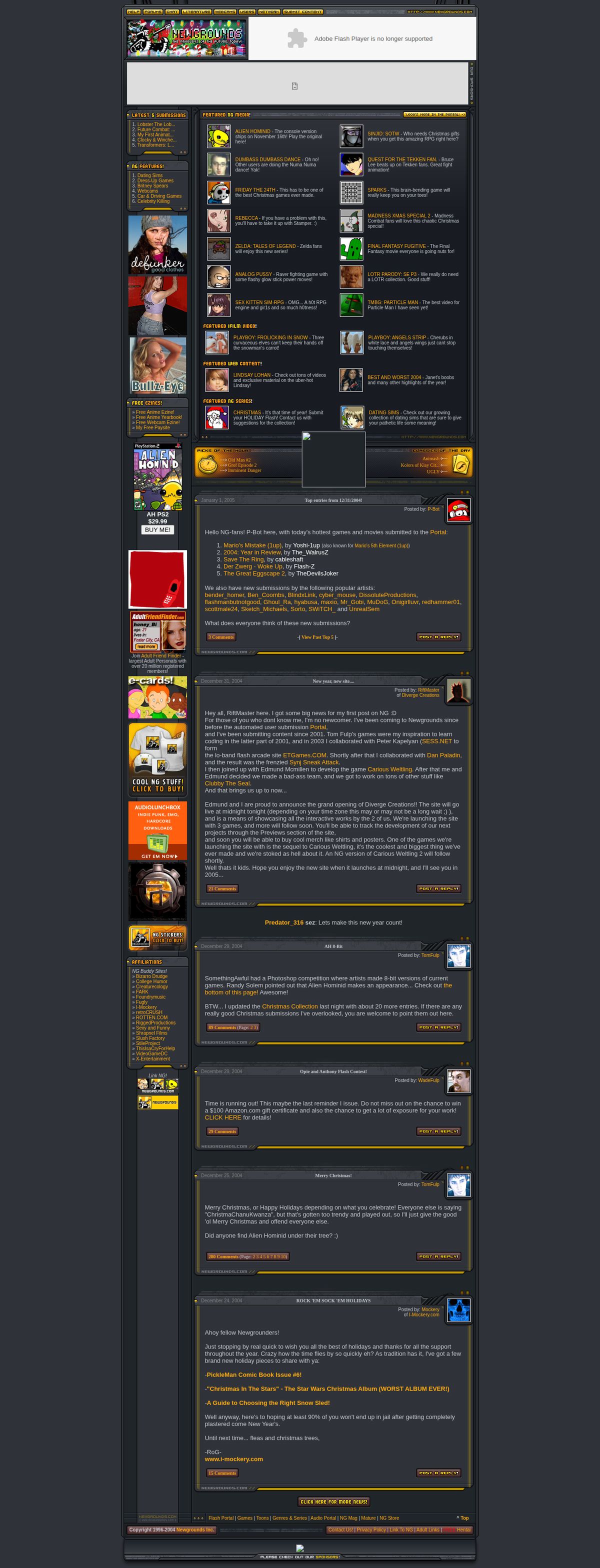
Newgrounds (1995). Founded by Tom Fulp, it was the big home of Flash animation, short cartoons made with Macromedia Flash, the software that powered most internet animation and games of the era. Its community judged every submission, and low-rated ones were deleted, a process called getting "blammed." If you drew cartoons, Newgrounds was your world. If you shot video with a camcorder, it was not really for you. Jonathan's live-action show sat outside its walls.
ShareYourWorld (circa 1997-2001). Often described as the first true video-sharing website. It proved the idea could work, then folded under the same bandwidth-cost problem described above, years before YouTube proved it again with better timing and deeper pockets.
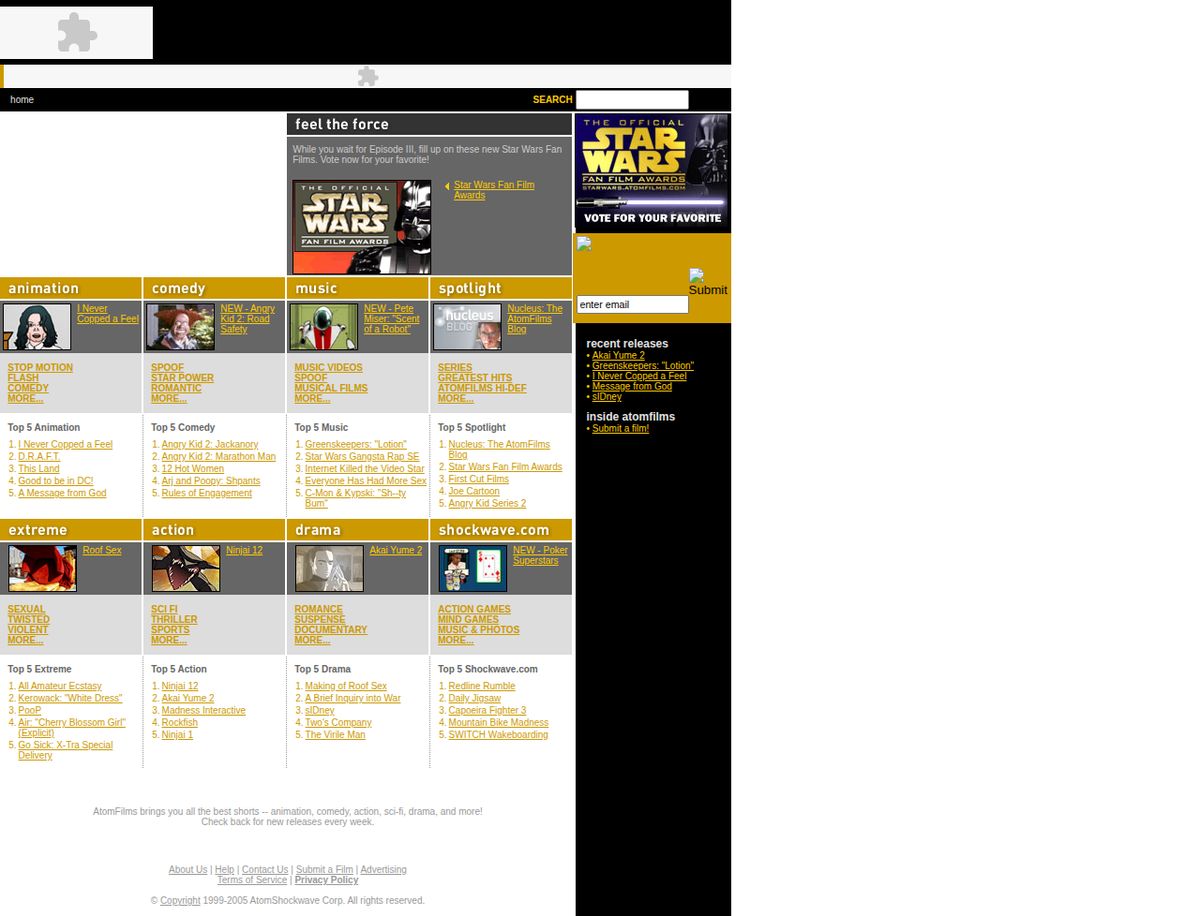
Atom Films (1998). Founded in Seattle, a curated short-film site run more like a film festival than an open platform. You submitted work and hoped to be accepted. It hosted early online work by future Oscar winners. A 13-year-old in Pittsburgh was not its audience, but it was the model of what "serious" internet video looked like, the model YouTube would later replace.
iFilm (1997). A popular site for short films and funny clips, eventually bought by MTV in 2005. More open than Atom Films, but still a destination you had to seek out, not a place where a kid built a following.
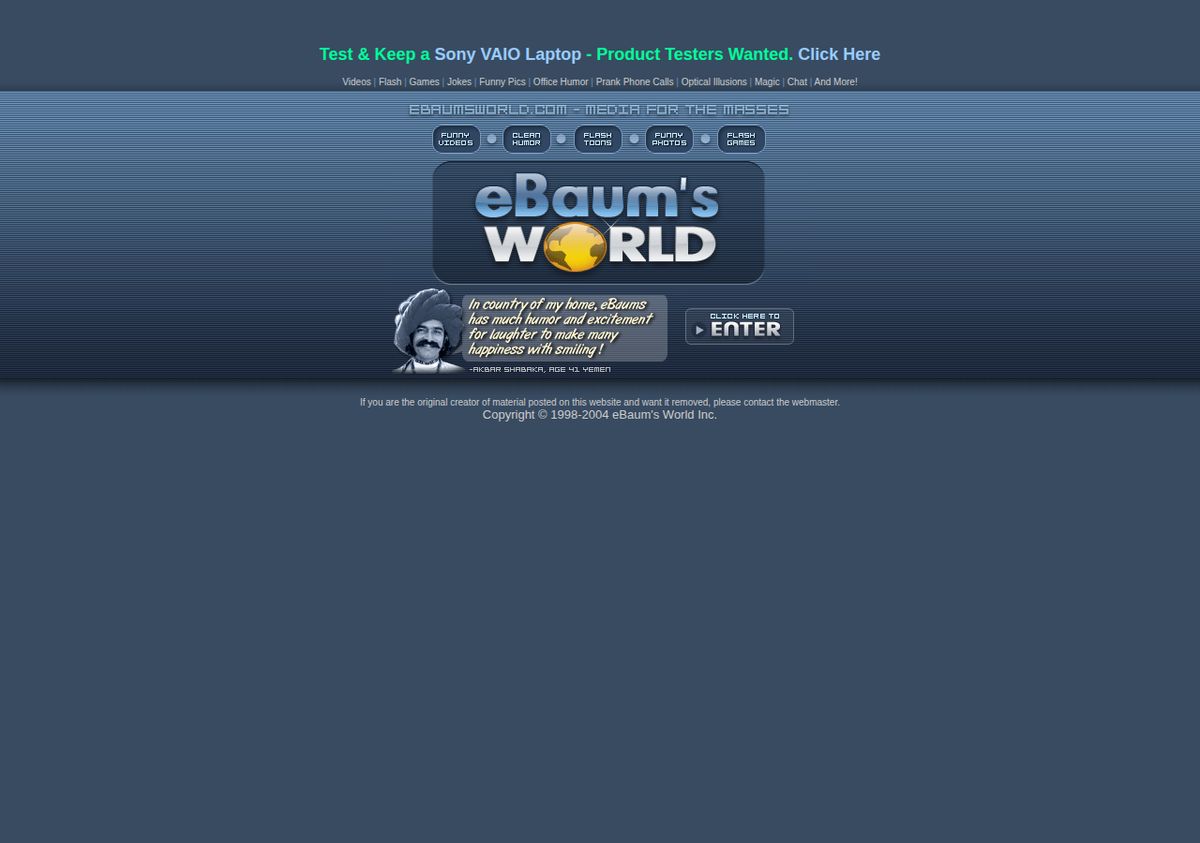
eBaum's World (2001). Created by Eric Bauman in Rochester, New York, one of the original homes of internet video, notorious for taking videos from other people's sites and posting them without credit, stamped with the eBaum's logo. It proved that "viral video" existed before YouTube. But it was an aggregator, not a place where a creator would choose to publish an original series. It collected other people's work rather than publishing its own.
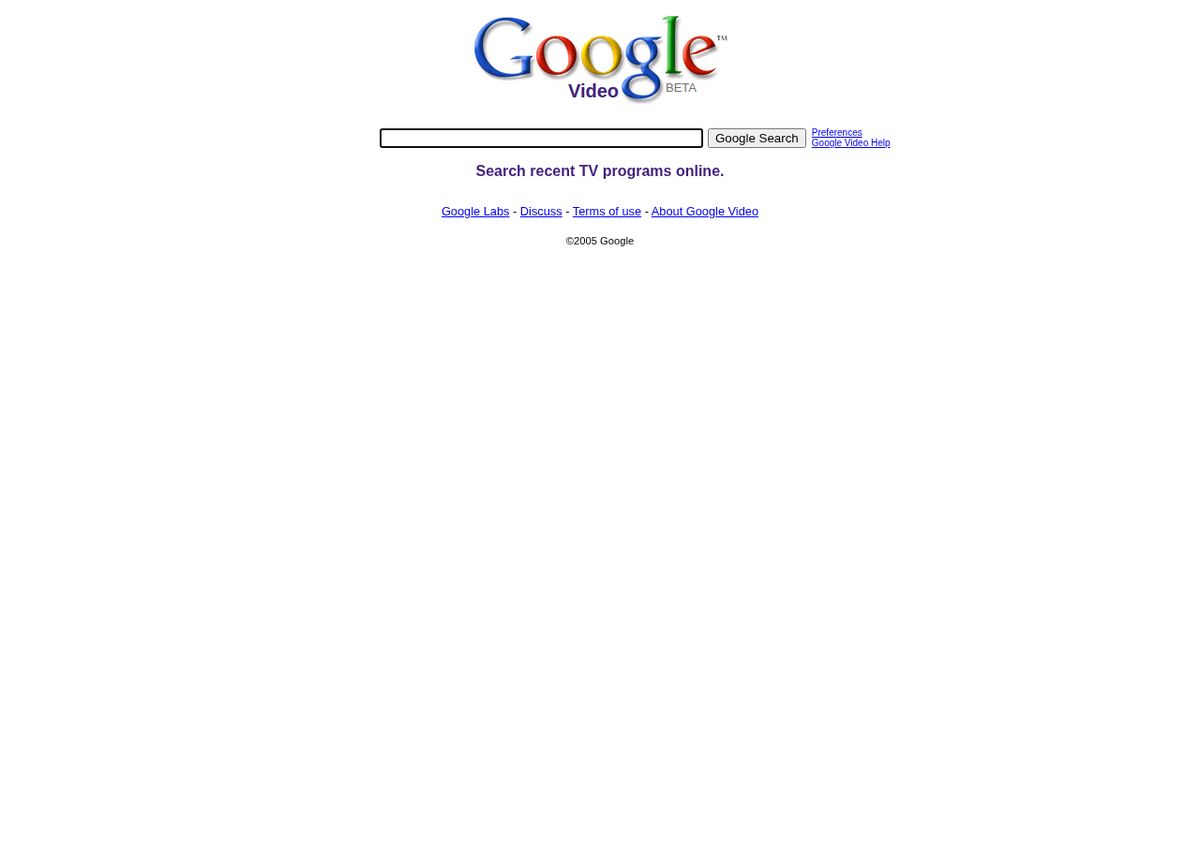
The 2003-2005 wave. Metacafe (2003), Vimeo (2004), Dailymotion (2005), and Google Video (January 2005). These were true upload-it-yourself video hosts. Google Video let people upload to Google's servers but had few community features. None of them combined free uploads with an audience already gathered in one place.
YouTube (2005). The domain was registered on February 14, 2005, by three former PayPal employees. The first upload, a 19-second clip of one founder at the zoo, went up April 23. The site opened to the public that December, and a bootlegged "Lazy Sunday" sketch from Saturday Night Live was the moment most Americans first heard of it. Google bought it in October 2006 for 1.65 billion dollars. The revolution was not hosting video; others did that. It was hosting plus a gathered audience plus a player that just worked, all free.
There was no recommendation algorithm and no search engine that searched inside videos. Discovery ran on word of mouth. People emailed links to friends, dropped them into forum posts and instant-messenger chats, and linked their sites together in chains called webrings, so browsing one led you to the next. Aggregators and "best of" sites surfaced clips. Getting featured on one could mean real traffic, but those sites were gatekeepers, not open platforms.
And viral video? It existed, but it traveled differently, and nobody could measure it. The two famous examples both date from Jonathan's era. In 2003, a Canadian teenager's homemade lightsaber video, filmed with a golf-ball retriever, was posted by classmates without his knowledge and spread around the world; it became known as Star Wars Kid. In 2004, Gary Brolsma's webcam lip-sync, Numa Numa, was passed from inbox to inbox until it was one of the most-watched clips on the early internet. These spread by email forwards, instant-messenger links, forum posts, and direct downloads. There was no share button and no view counter. Creators usually had no idea how many people had watched.
Notice something about those hits: they were almost always one-off clips, and mostly accidents. A deliberately sustained episodic series was the rare thing. Which is exactly what our kid in Pittsburgh was making.
In this period, a personal website meant something more load-bearing than it does now. You built it yourself, usually by hand in HTML, the code web pages are written in, and it was your only broadcast tower. There were no profiles, no feeds, no followers. Just pages.
Free web hosts like GeoCities and Angelfire would host your pages for nothing. Creators worked around the bandwidth problem with the tools the era offered: guestbooks where visitors left comments, simple poll scripts, an email address for direct contact, and webrings. Without comments or likes, creators invented their own interactivity. Contests, votes, email entries. This was the pre-YouTube version of audience engagement: you had to build the participation system yourself, by hand, because no platform provided one.
Before social media, strangers gathered on forums, also called message boards: topic-based discussion sites, each with its own culture and rules. Some were general, like Something Awful and Fark. Most were about a hobby, like PbNation, the paintball forum.
Forum culture had a specific attitude toward outsiders. A brand-new account dropping a link to its own video looked like advertising, and the regulars treated it that way. The standard reaction was suspicion or open hostility. Getting called a spammer was practically a rite of passage for a young creator. Everybody who tried to promote their work on a forum in 2004 or 2005 has a story like the one you are about to read in the next chapter. Jonathan's version happens to be the best-documented one we have.
So here is the landscape, all in one frame. Slow pipes getting faster. No single video site. Watching meant downloading. Sending video cost money. Discovery ran on word of mouth. Forums were the town squares, and they did not like strangers selling things. Into this world walked a 16-year-old with a camcorder, a show on its 27th episode, and a plan he had built entirely by himself.
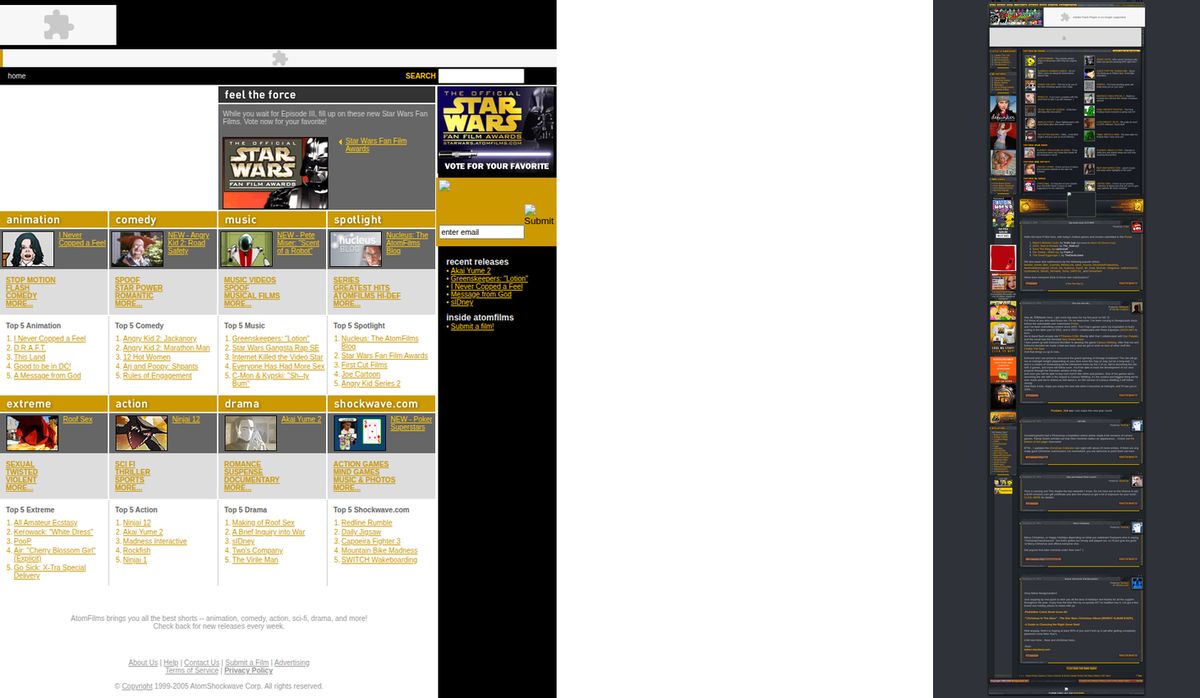
Against the backdrop of the last chapter, here is what one teenager actually did. Not a famous creator. Not a movement. Just Jonathan Harchick, of Pittsburgh, running a show called Talking With Jon from his bedroom, ages 13 to 18, and solving every distribution problem the era put in front of him, by hand, in the order the era presented them.
For the first couple of years, 2002 to 2004, the show traveled the way video traveled when there was no other way: on burned discs, handed directly to people. He has said he used to burn DVDs and hand them to friends. Episode 1 opens like a show made for a living room audience, because that is what it was. You made the thing, you burned it, you gave it to somebody, and maybe you sat there while they watched.
This sounds quaint now, but think about what it meant. Every copy cost a blank disc and a trip to somebody's house. There was no link to share, no view count, no analytics. The audience was whoever he handed a disc to: friends from school, family, whoever was around. And still he kept making them. The archive proves it: all 34 episodes survive in original quality, 41 files totaling about 27 gigabytes, including full-quality DV masters of the later episodes. That survival is remarkable on its own. In an era when most amateur video lived on fragile personal sites and vanished when the hosting lapsed, he kept everything for two decades.
By year three, around 2004-2005, with broadband spreading and the show established, he put Talking With Jon on the internet on his own terms. The site was talkingwithjon.com, and thanks to the Wayback Machine, we can walk through its whole life, era by era, like flipping through a photo album.
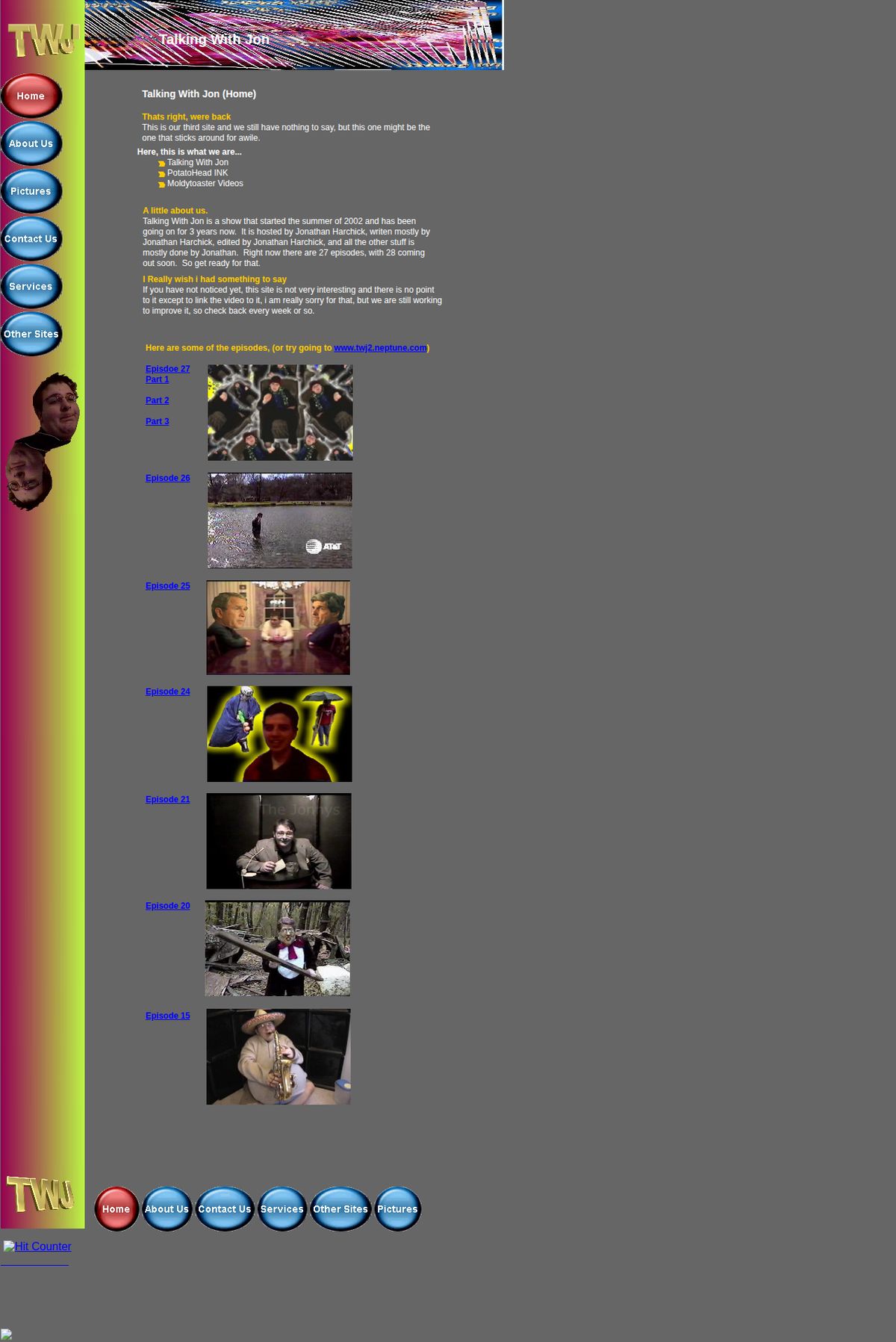
The earliest surviving capture is March 17, 2005. It is a plain, hand-built page, and it reads like a teenager talking directly to you. The top line is worth preserving exactly as he wrote it, spelling and all: "Thats right, were back. This is our third site and we still have nothing to say, but this one might be the one that sticks around for a while." This was already the third attempt at a website, and he expected it might not last either. The about text says the show "started the summer of 2002 and has been going on for 3 years now," and the credits are a small masterpiece of one-person production: the show is "hosted by Jonathan Harchick, writen mostly by Jonathan Harchick, edited by Jonathan Harchick, and all the other stuff is mostly done by Jonathan." Twenty-seven episodes were up. Number 28 was "coming out soon."
The practical details on that page are a perfect specimen of 2005 DIY video distribution. The site lived on free web hosting from a company called Neptune. The episode files were Windows Media downloads, offered in three parts for the big ones, with a mirror address for good measure. The navigation was simple hand-made pages: Home, About Us, Contact Us, Other Sites, Pictures, Services. A free hit counter tracked visitors under the site name "moldytoaster," a sign the two brands were already linked in his head. Note the timing, because it matters for what comes next: this capture is one month before the story this chapter is really about.
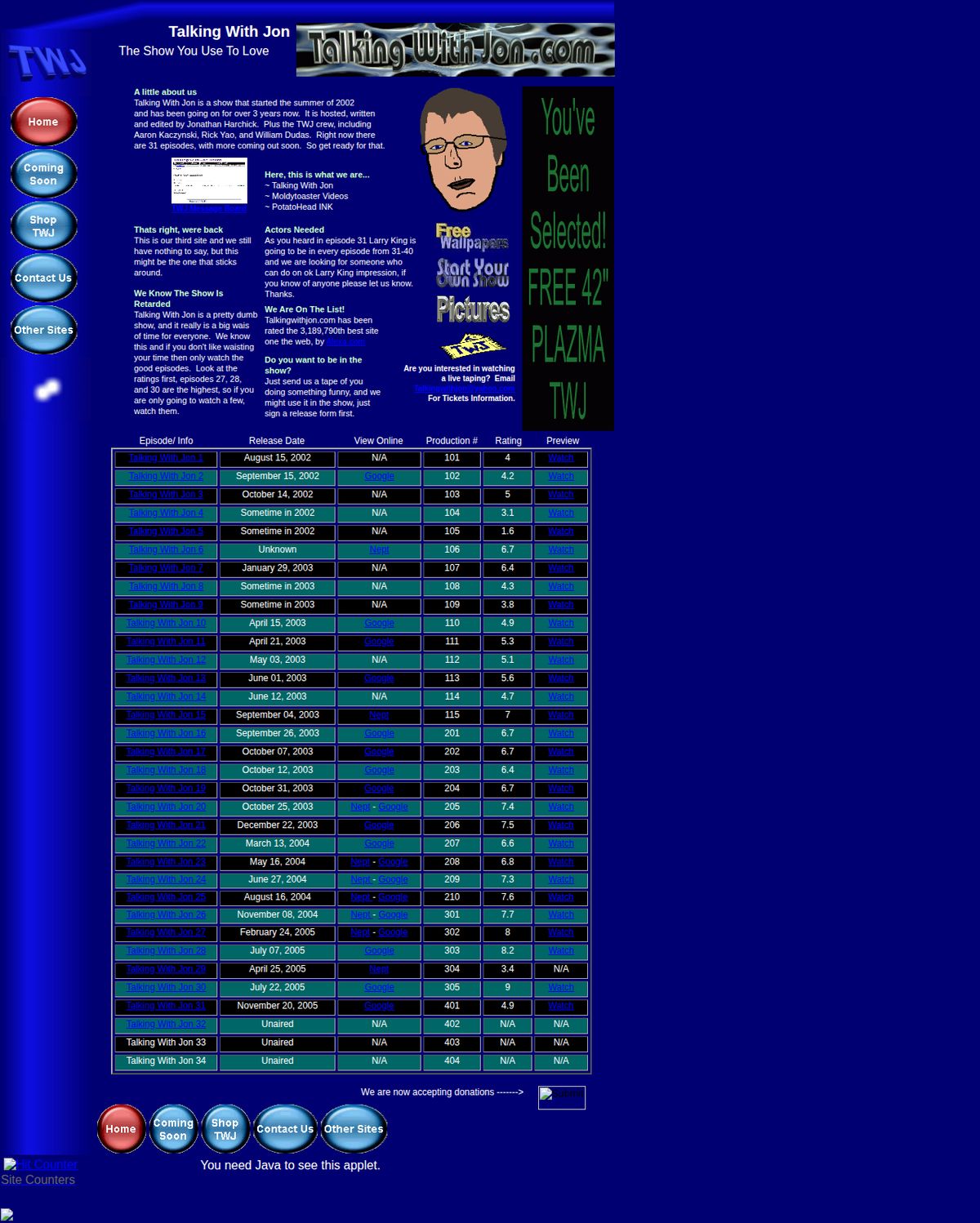
By December 2005, the site had been redesigned into something much more ambitious. The episode count was up to 31, and for the first time there was a real episode table: every episode with its release date, a production number, a viewer rating out of 10, a "View Online" column, and a preview link. The view options tell the distribution story in miniature: "N/A" for not online, "Google" for episodes uploaded to Google Video, and "Nept" for downloads from the Neptune mirror. He was hedging across the new platforms and his own hosting at the same time, exactly the multi-format instinct the last chapter described.
A crew was credited for the first time: Aaron Kaczynski, Rick Yao, and William Dudas, alongside Jonathan. A message board was open. The site even bragged about its web ranking, worn like a badge of honor: the 3,189,790th best site on the web, according to Alexa, the era's rough popularity score. And the audience-participation system was in full swing. Viewers could send in a tape of themselves doing something funny for a chance to appear on the show, with a release form to sign first. Tickets to a live taping were offered by email. A casting call ran on air and on the site, looking for someone who could do an okay Larry King impression, because the storyline had Larry King appearing in every episode from 31 to 40. Contests had started back in episode 5, with viewers guessing which clip would open episode 6, and entries came in by contacting Jonathan directly. The Halloween special in year three ran the show's first monologue, with jokes about the 2004 election, and let the viewers vote on the show's band.
Stop and think about what that is. Polls. Contests. A message board. A casting call. A viewer-picked band. Every one of these is a feature YouTube would later build into its platform. He built them by hand, with poll scripts and an email address, because no platform provided them. He was doing audience participation before the platforms built it in.
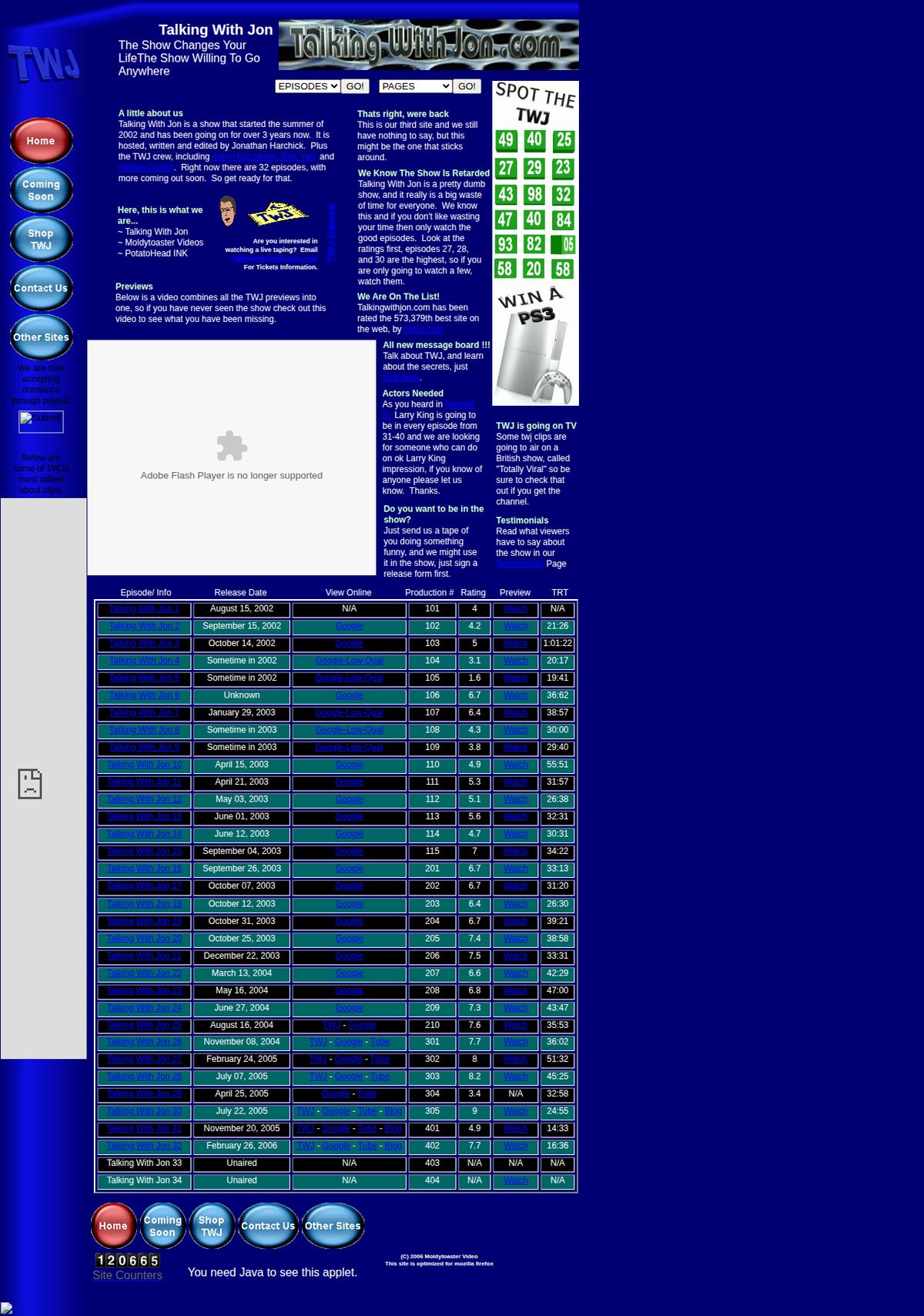
The peak came in 2006. By June the site called itself "Talking With Jon - Official Site," with the tagline "The Show Willing To Go Anywhere" and a navigation listing all 35 episodes, even though only 32 existed. Episode 35 was aspirational; the finale would land on 34. The page list shows how far his ambitions had grown: episode guides, insider info, a shop, wallpapers, a pictures page, a board games section, and "Your Show!," the viewer's corner. The site accepted PayPal donations, ran a brand-new message board, published a testimonials page of viewer comments, and offered one combined video of all the episode previews for newcomers. And then this: the site announced that clips from the show would air on a British program called "Totally Viral." Some of his material had crossed the Atlantic onto actual television. The Alexa rank had climbed to 573,379th.
By December 2006, the episode table's "View Online" column showed the platform migration in progress: episodes linked out to Google Video, to YouTube, which the site called "Tube," just months after Google bought it, and to a free video blog host. Episode 33 carried the highest viewer rating yet, 8.9 out of 10. An ad banner slot read "Your Ad Here." A small note said, "We are testing new layouts for the site right now." The Alexa rank had slid back down past two million. Read honestly, that is the shape of a burst of attention followed by the long tail, and the book will not dress it up as more than it was.
Then the pivot. By June 2007, a month before the finale, the talkingwithjon.com address no longer served the show's site at all. It served Moldytoaster Video, a multi-show video portal. Talking With Jon sat alongside The S.D.C., The Planetarium, Everyday Repairs, Jon Harchick's Blindfolded Art, Jon Harchick Movie Reviews, The JPO Show, and The CC Show, with pages prepared for more. Each show had its own episode folders. The page carried advertising from the AdBrite ad network, a Sponsors page, and a message board. And the TWJ episode entry read, simply: "After 5 years this is the final episode of the show."
The show had become one channel on his own little network. He built the multi-channel video portal himself, on his own domain, with ads, in 2007. If the last chapter's landscape was the problem, this was his answer to it, assembled by hand over five years: hosting, a participation system, promotion, and an archive, a miniature version of what YouTube would later sell as a service.
The two domains' afterlives are worth an honest paragraph. In 2008 the show's address folded into moldytoaster.com, which carried the portal forward: new episodes of the other shows, a 2011 redesign under the slogan "Moldytoaster - TV for an internet generation," and then, from 2016 on, a long stretch as a mere signpost redirecting to his YouTube channel. The last captures, from 2025, show it forwarding to his current home page, still pointing at him nearly twenty years on. The old talkingwithjon.com address had a stranger fate: by 2020 it had lapsed into other hands and served parked-domain gambling text, and its final capture, in 2023, is an unrelated fitness blog by a different Jon. That is the domain's afterlife, not his work, and we say so plainly.
moldytoaster.com, April 21, 2008, Wayback timestamp 20080421183413, beside moldytoaster.com, July 2011, timestamp 20110706002330. The brand absorbing the show, then the redesign as "TV for an internet generation." A paired caption can note the honest ending: the old show domain later lapsed and was repurposed by strangers.
Now the story this chapter has been walking toward. April 2005. Jonathan is 16. His show is on its 27th episode. The website is up, the downloads are live, and he needs viewers the way every creator in 2005 needed viewers: one stranger at a time.
So he goes to PbNation, a paintball forum, and posts episode 27 in the miscellaneous buy/sell/trade section, under the name "Moldytoaster." That name, he would later explain, started as his AOL Instant Messenger handle, a random combination of two words with no deeper story behind it. It became his brand for the next twenty years.
What happened next is the single best-documented promotion attempt of the show's original run, because the thread is still live and was re-verified in 2026. His account shows a join date of April 2005. He was brand new. The replies came fast, and they were exactly what forum culture dealt to outsiders: confusion, a report, and an insult aimed at his newcomer status, calling him a "2k5.er," meaning someone who registered in 2005, which in the pecking order of the time marked him as part of a flood of low-quality new users.
He stayed and argued his case. Politely, in complete sentences, with a little bit of roast in it. He did not want any trouble, he wrote; he just wanted to post the video and see what people thought. The exchange ran April 18 to 20, 2005, and he even followed up two days later. He did not slink off. He did not flame back. He stood there, 16 years old, and made his pitch to a room full of strangers who had already decided he was spam.
That is the whole era in one story. The personal website as the destination. The forum as the only town square. The new account, the off-topic section, the hostile regulars. The standard failure mode of pre-YouTube promotion, and the notable part is not that he was flamed. It is that he stayed.
the PbNation "Talking With Jon 27" thread, live page https://www.pbnation.com/showthread.php?s=&postid=12540423, posts dated April 18-20, 2005. Forum-as-distribution captured in one screenshot. Grab a Wayback capture of this URL for the art pass so the book does not depend on a live forum page.
One more move, and it might be the most telling of all. In January 2007, while the show was still running, Jonathan uploaded it to the Internet Archive, the nonprofit digital library that preserves websites, books, and video. The item is called "Talking With Jon," dated January 16, 2007, his eighteenth birthday. Uploading there in 2007 was one of the few free, permanent hosting options in existence.
Think about what that means. The show was not over yet. Episode 34, the deliberate finale, would not arrive until that July. And he was already making sure it would survive him, or at least survive the fragile personal-site hosting it lived on. He had watched enough of the early internet to know how things vanished. He was not going to let his show be one of them.
the Internet Archive item page for "TalkingWithJon," dated 2007-01-16. His own permanence play, the archive instinct made visible. A Wayback capture of the item page from 2007-2008 would be ideal if one exists.
Now the part this book promised in the foreword. Talking With Jon was not famous. The audience was almost certainly small, dozens to low hundreds of people, not thousands. Nothing in the record suggests wide circulation: no aggregator features, no surviving forum threads beyond PbNation, no press. We do not know how many people watched any given episode. No view counts existed; download counts, if any, are lost.
But small is not the same as nothing, and the book will not pretend it is. The contests drew entries. The band vote happened. The multi-format releases, episode 29 came out as both VCD and DivX five months apart, suggest he was responding to real viewers with real playback problems. The participation system worked well enough that he kept building it across multiple episodes. Somebody was out there, voting and entering and downloading, even if we will never know exactly how many.
And here is the sentence this chapter has to earn: if his audience was a dozen friends and a forum thread, that is not a footnote to the story. That is the story. A kid made 34 episodes of television for whoever would watch, built the whole apparatus to reach them by hand, and kept going for five years with no platform, no revenue, and no guarantee anyone was watching. The longevity is the single most unusual fact about the show. Most bedroom projects died after three episodes. His ran from 13 to 18, through the dial-up years, the YouTube launch, and the YouTube boom, without changing course.
There is one more unusual fact, and it is a question, not an answer. When the platform arrived that solved every distribution problem he had spent five years solving by hand, he finished his show his own way instead of moving it. Episode 34 is a deliberate finale: a toga in the woods, a mock history of the world, a closing song, "where are they now" gags. He knew how to end things. Why he did not bring the show to YouTube, we do not know, and the book will not guess. It is his question to answer.
What came next would be bigger, louder, and stranger: the stunts, the records, the thousands of episodes. But the pattern was already set here, in the bedroom, on the discs, on the hand-built site, in the forum thread where a 16-year-old would not back down. Make the thing. Put it out. Keep going. That is the whole biography, and it starts in his corner of the early internet.
End of Foreword and Part I (Chapters 1-3). Part II continues with Talking With Jon.
It started with a camera called the Clever Cam and a question that thirteen-year-olds have been asking since television was invented: what if I had my own show?
The year was 2002. Jonathan Harchick was thirteen, in eighth grade in Pittsburgh, Pennsylvania, and he watched late-night television the way other kids watched sports. He knew the shape of the thing he wanted. There was a host behind a desk. There was a monologue. There were guests, and the host interviewed them, and the whole room ran on the easy rhythm of one person steering the conversation while another person supplied the surprises. He named his heroes right at the top of his first episode: Conan O'Brien, Jay Leno. He was not coy about what he was doing. He was copying the format he loved, because that is what you do when you love something at thirteen, and he was doing it in his bedroom with a consumer camcorder and a recliner.
Episode one of Talking With Jon was not supposed to start anything. Jonathan himself says so, plainly: it was just a video test. He pointed the Clever Cam at his setup, pressed record, and tried out the idea of being a talk-show host. The test worked. So he made another one. Then another. Over the next five years, that test would grow into thirty-four episodes, but the important thing about the beginning is how small it was. Nobody commissioned it. Nobody assigned it. A kid tested whether he could be Conan O'Brien in his bedroom, and the answer came back yes enough times to keep going.
There is a philosophy buried in that little story, and it is worth pausing on, because it explains everything Jonathan made afterward. A video test is a question asked without permission. You do not wait for someone to hand you a show. You point the camera at the idea and see if it holds up. Most people never ask the question. Jonathan asked it, and when the answer came back yes, he did not celebrate and move on. He raised the stakes. Each episode became a test of something new: could he do characters, could he do commercials, could he hold an audience for an hour, could he end the thing on purpose when he was done. The ambition never arrived from outside. It grew inside the work, episode by episode, the way a plant grows toward whatever light is available. The test that snowballed is the entire arc of Talking With Jon, and it started with a thirteen-year-old pressing record just to see what would happen.
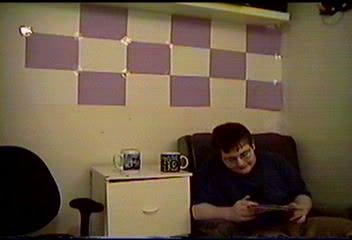
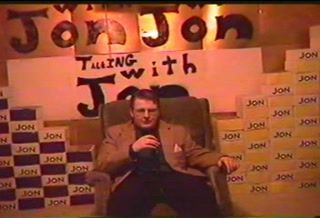
The episode 1 bedroom talk-show setup as art pass imagines it, recliner, small cabinet with mugs, handheld mic, construction-paper checkerboard on the wall, a kid with a camcorder.
The set of that first episode tells you everything about how this show got made. An armchair. A small white cabinet with mugs on it. A handheld microphone. A wall decorated with gray and blue construction-paper squares taped into a checkerboard. Everything was paper, tape, furniture that was already there, and confidence. Later in the series he would rebuild this set again and again, and he would narrate every rebuild on the air, but the original is the one that matters: a bedroom that decided, for fifteen minutes at a time, to be a television studio.
The camera he used was an old one called the Clever Cam, and the footage had the soft, noisy look of early consumer video, with room echo and auto-gain pumping baked into every shot. He edited on the family computer in Ulead VideoStudio and made his animations and title graphics in Ulead 3D Production Studio, a program meant for simple 3D titles that he pushed far past what it was designed to do. The finished episodes came out as VCD-era video, tiny MPEG files at a resolution that looks like a postage stamp on a modern screen. The typos piled up, some of them on purpose and some of them not, and he has said as much himself. That detail is worth sitting with for a moment. A kid who cared enough to build a whole show did not always bother to fix the spelling, and sometimes the misspelling was the joke. It is easy to read that as sloppiness, but it reads better as priorities. The energy went into making the thing, not polishing the thing, and the occasional deliberate typo was a wink at the audience: yes, I saw that, and I left it in, because the show is funnier with the seams showing. Nothing about the tools was professional. Everything about the effort was.
The show opened with his production banner: Potato Head INK. If that sounds like the studio credit of a major motion picture, that was the joke, and the pride. He was thirteen and he already had a production company, even if the company was just him. Under the banner he ran clips of Statler and Waldorf, the two old hecklers from The Muppet Show, watching from their theater box, and he scatted a wordless version of "Mahna Mahna," the Muppets' famous nonsense song, as his theme music. He loved the Muppets, and the logic of the opening was simple: borrow the framing of the thing you love, then put your name on it. Homage as branding. He was thirteen and already thinking like a producer.
Then came the monologue and the cold open, where he welcomed viewers to his new talk show and explained, in the straightforward way of a kid who assumes you have seen these shows too, that it was like Conan and like Leno, that he would bring in guests and interview them. And then the show hit its first real problem, which was also its first real invention: there were no guests. There was no audience. There was no budget, no crew, and no green room. A kid with a stricter sense of the rules would have done a monologue-only show, or quit. Jonathan did something else. He became the guest.
The first guest in the history of Talking With Jon was Jonathan himself, introduced under his full name, Jonathan Hartchick. Host-Jon sat in the host chair and asked the questions. Guest-Jonathan sat in the guest chair and answered them. He told the audience he liked making videos, that he had made one about New York, that he lived in Pittsburgh, that he went to middle school, that he had been born in Pittsburgh, that he liked Mr. Potato Head. It is the kind of interview that only works if both people are the same person, and the comedy lives in the gap: a host running the format with a straight face while the guest supplies nothing but raw, unfiltered kid.
The two Jons on camera together, host-Jon and guest-Jonathan, the show's central visual device.
Years later, when asked about it, Jonathan gave this decision a name that turns it from a workaround into a philosophy. The two Jons on camera together, he said, represent the two sides of the brain. The host-Jon is the left brain: format, questions, transitions, the part that runs the show. The guest-Jonathan is the right brain: the maker, the fan, the kid who likes Mr. Potato Head and makes films about things he cares about. Logic interviewing impulse, both of them deadpan, both of them the same thirteen-year-old. Once you see it that way, the whole series opens up. Every character he would later play against himself, the old man with the cane, the chef, the pitchman, the cop, is a variation on this first device. There was only ever one brain in the room, so he split it in two and let the halves talk. A kid thinking out loud, in costume, with a straight face.
It is also the show's contract with the viewer, signed in the very first episode. Everything here is handmade, including the people. There are no real guests coming, no celebrities booked, no audience members waiting off camera. There is just Jonathan, the furniture, and whatever he can dream up, and he will not pretend otherwise. He will not do an empty-chair interview and hope you do not notice. He will fill the chair himself and make the filling of it the funniest part. That honesty, that refusal to fake resources he did not have, is what makes the show feel warm instead of cheap. He was not hiding the trick. The trick was the show.
The show's pretend economy started in episode one, too. The Hartchick Society, an imaginary organization with a name suspiciously close to the host's own, had supposedly donated the furniture and set decorations. Jonathan did ad reads for it and other imaginary organizations the way a real talk show would thank its sponsors, which was funny on two levels: there were no sponsors, and the room really did need furnishing. Later, when the sets got bigger, the fiction would grow with them, and the imaginary sponsors would take credit for every upgrade. But it started here, as a throwaway credit gag that was also true, because his family really had provided the room. If you cannot afford sponsors, invent them, and make the invention part of the comedy.
And then, in the middle of this silly little talk show, episode one did something that set the tone for all thirty-four episodes to follow. Jonathan stopped the comedy and screened a film he had made about September 11th, a serious documentary assembled from news-style audio and footage about the attacks, running roughly ten minutes. The host introduced it, the film played, and the show went quiet for the seriousness of it. He was thirteen years old, a year out from the attacks, and he had made a sincere film about a national tragedy, and his talk show was his only screen, so the film went on the talk show.
That collision, a goofy self-interview and a heartfelt documentary sharing the same fifteen minutes, is the tonal thesis of Talking With Jon. He never sorted his work into serious and silly piles. He never signaled which parts the audience was supposed to take seriously. He just made things, and the show played what he made, and the sincerity sat right next to the absurdity without apology. That refusal to rank his own work by tone, that willingness to let the sad thing and the funny thing share a stage, would stay with him through everything he made afterward. It started here, in episode one, because the show was a container, not a genre.
The film itself shows how seriously he took the making of it. It runs on narrated news-style audio, the measured voice of a broadcast recounting the morning of the attacks, laid over footage that includes his local Pittsburgh station's coverage, images of lightning striking the Twin Towers, and multi-panel composites he built himself in the editing software, layering several moving pictures into one frame. At one point a small picture-in-picture figure of a firefighter appears in the corner of the screen, the kind of effect that takes real patience to build in consumer editing software. He was thirteen, working with the same tools he used to make a pizza beg for its life, and he gave the serious film the same care he gave the jokes. The craft did not know the difference between the tones. Neither did he.
The 9/11 short film inside the comedy show, news-style montage giving way to the talk-show set, the show's founding tonal collision.
Episode two, recorded about a month later in September 2002, showed what happened when the test became a habit. Jonathan welcomed viewers back, introduced a new guest, a mushroom-creature character called Go Shroomo who declared himself a good fighter in broken English, and followed him with another costumed guest, a grim-reaper figure in a black hooded robe and skull mask, interviewed while standing as Jonathan sat with the microphone. The guests were getting stranger, which meant the show was getting more confident. Long stretches of episode two are clips with host wraparounds: wrestling promos, parody songs, comedy bits stitched together by Jonathan in the living room with the microphone. The container was opening. The talk show was becoming a variety show, because the kid running it kept making things that did not fit neatly between a monologue and an interview.
Episode two also gave the show its first real tradition. It closed with an original song, a crude and catchy sign-off refrain that Jonathan sang to end the episode, and it became the recurring closer, the thing the audience would come to expect the way late-night audiences expect the band to play them out. A kid who had just learned he could make a show was already learning that shows have rituals.
There is a footnote to the Conan O'Brien name-check that deserves a moment, because it says something about how far a bedroom test can travel. Years later, the kid who had introduced his little show by comparing it to Conan's would have his own videos played on Late Night with Conan O'Brien. His IMDb page carries the credit. A thirteen-year-old points a camcorder at a recliner and says he wants to be like Conan, and the line between the imitation and the real thing turns out to be thinner than anyone would have guessed. He was not just copying the format. He was aiming at it, and eventually the format noticed.
That is the whole story of the talk-show dream, really. A thirteen-year-old wanted to be Conan O'Brien and Jay Leno. He had a recliner, a cabinet, a handheld mic, a wall of construction paper, and an old camera called the Clever Cam. He had no guests, so he played the guest. He had no sponsors, so he invented the Hartchick Society. He had a production banner called Potato Head INK and a theme song borrowed from the Muppets. He had a serious film about September 11th and nowhere else to show it, so he showed it on his comedy show. It was a video test. It worked. So he made another one.
The snowball was rolling.
Sometime after the first two episodes, the camera changed, and with it, everything else.
The family's FireWire DV camera arrived, and Talking With Jon entered its second phase. FireWire was simply the cable that moved video from the camera to the computer, a fast connection by the standards of the early 2000s, the bridge between shooting something and editing it. In Jonathan's house, that bridge kept collapsing. The transfers failed constantly. Footage corrupted. Clips that had been fine on the camera came through the cable broken, glitched, or gone entirely. Every artifact in the episodes from this era, every frozen frame and digital hiccup, is evidence of a kid fighting his tools and refusing to stop. He did not have better equipment. He had the family camera, a flaky cable, and the same determination that had turned a video test into a show.
The show he was making with that camera was no longer really a talk show. By 2003, Talking With Jon had become a variety hour, a container for everything he made: fake commercials, recurring characters, songs, clip compilations, parodies, stunts, contests. The monologue-and-guests format was still in there somewhere, but the show had outgrown it, the way a bookshelf outgrows the first row of books. Whatever he made went on Talking With Jon. The show had no genre because Jonathan had no single genre.
The Hartchick Society grew up, too. In episode three, Jonathan opened by announcing that the show had a new background, and he explained the upgrade the way the show explained everything: the sponsors had paid for it. His imaginary patrons were now funding his production design. It was a joke about money he did not have, and it was also the show documenting its own making, which became one of its most modern qualities. He would keep narrating his own upgrades on the air for the rest of the series, turning real production growth into fiction. The black backdrop of the third episode gave way to a blue one by episode six, and each time he told the audience about it, as if a network executive were briefing the press. The sponsors were pretend. The progress was real.
The show even started declaring its own eras. Episode four opened with an announcement: this was the second season. Nobody at a network had approved a second season. There was no network. But Jonathan understood something that took most creators years to learn, that a show with seasons is a show with a future, and saying the words out loud made them true. Later episodes would get title cards marking the year, golden film-reel graphics announcing that the series had entered its second year, as if Talking With Jon were a long-running broadcast institution rather than a teenager's bedroom project. It was both. The fiction of the institution and the reality of the teenager were the same thing, and the season declarations were the show telling itself, on the air, that it was going to last.
[IMAGE: book-screenshots/ep18/ep18_001.jpg, "Talking With Jon 18 / Year 2" title card with golden film-reel graphic, the show declaring its own eras.] Nowhere was the variety identity clearer than in the fake commercials, which went from one-off gags to a full serialized campaign. The centerpiece was Dave Braslowski, a self-described representative of Sony, played by Jonathan in full pitchman mode. The first ad had Dave introducing himself and selling the PlayStation 3, which he claimed ran many thousands of times faster than the PlayStation 2, an absurd number delivered with total corporate sincerity. He always closed by asking viewers to mention his name to Sony, as if the company had any idea who he was. One fake ad is a sketch. But Jonathan did not stop at one. A few minutes later Dave was back, this time selling the PlayStation 4, and the pitch had curdled: the PlayStation 3, the very console he had just praised, was now a terrible machine that nobody should ever buy. Then came the PlayStation 5 ad, which trashed both of its predecessors. The same shameless pitchman, believing every new thing completely, disowning every old thing completely. The real target was never Sony. It was the upgrade treadmill itself, the way every new product arrives with a man in a suit telling you the last one was garbage. Dave had no shame, and that was the whole joke, and it kept getting funnier because Jonathan understood that a pitchman who believes his own pitch is a character you can bring back forever.
The commercials around Dave were just as handmade. In episode four, a pizza with a face begged for its life on camera, pleading with a hungry customer named Aaron not to eat it, introducing itself as Bob and insisting, with a straight face, that it was a talking pizza. Another spot featured a guest pitcher named Martin Hart-Jeeck hawking a fake product called Captain John with full infomercial energy, combining, as he put it, the power of the product's own name. These were not polished parodies. They were a kid in his house doing the grammar of television advertising from memory, and the grammar was perfect: the breathless claims, the satisfied customer, the product name repeated until it stuck. He was teaching himself commercials by making them.
The genre parodies worked the same way, one television format at a time. Episode three toured the Hartchick retirement home, a facility Jonathan claimed to run, introducing an elderly resident named Mr. Joe McDuffie and wandering the halls with the brisk confidence of a man giving a promotional tour of an institution that did not exist. The same episode staged a dating-show parody, complete with three handsome young bachelors who lifted weights and did karate, and one of them, a contestant named Rick Hill, proved his credentials by lifting an eighty-pound weight on camera. Another guest appeared with a paper bag over his head and oversized paw gloves on his hands, interviewed as if this were a perfectly normal booking. The joke in every case was the format played straight around people and premises no real show would book, and the straight face never cracked.
The characters multiplied just as fast. Captain Hunt arrived in a parody of the police show Cops, complete with the show's famous disclaimer rewritten into something looser, stalking a suspect through the woods with deadpan law-enforcement seriousness. An old man with a cane shuffled through episodes, one of the easiest costumes to assemble (a coat, a hunch, a cane) and one of the most reusable, and he would keep coming back, growing into the show's lore. In the Christmas episode, the show's narrative ambition took a leap with a full mockumentary, the supposed true story of a man named Carl Schmicks, a poor criminal from Idaho who claimed to have made about thirty thousand dollars before being abducted by aliens who forced him to make a talk show full of subliminal messages. It ended with a deadpan warning to the audience: keep watching, and the rabbits would take over the world. It was the most ambitious story the show had attempted, a little movie with a beginning, a middle, and an apocalypse, and it premiered inside Talking With Jon because that was where everything premiered.
In the kitchen, a chef named Rick hosted a cooking segment built on a single principle: the food had to be disgusting. He mixed every spice in the house with coconut cream, trail mix, and soda, admired his moldy ingredients on camera, declared the results beautiful, and forced a guest to take three bites. The comedy was in the cooking-show format played completely straight around ingredients no cooking show would touch, and in Rick's pride, which never wavered. The wrongness was the point. A bottle of Tabasco stood in for the drugs in a Grand Theft Auto mission parody, because the wrong prop is funnier than the right one and it was what happened to be in the kitchen. Resourcefulness was a comedy engine: whatever was in the house became whatever the sketch needed.
Dave Braslowski in pitchman mode, mid-escalation, selling a console with total corporate sincerity.
The segments stacked up alongside the characters. There was the stunt-clip roundup that started under a rough title and settled, by episode six, into "Stupid things done by stupid people," a franchise in the making. There was the bumper-sticker segment, where Jonathan read real funny bumper stickers off a board he held up to the camera, curating found comedy from the actual world. There was the face-morph machine, a tech gimmick with a personal twist: he fed in photographs of his real teachers, his seventh-grade math teacher, the family consumer science teacher, the librarian, the Latin teacher, the gym teacher, and showed what their children would look like if they had kids together. It was the show at its most mischievous, using the people from his actual school day as raw material, and it worked because the morphs were just plausible enough to be funny. There were man-on-the-street bits, where the crew went out and let random people say whatever they wanted, taking the show out of the bedroom for the first time. Episodes closed on music videos. And the outtakes, the bloopers and flubbed lines, became a standard way to end an episode, which tells you something important: he was showing the seams on purpose. The making of the show was part of the show.
By episode six, the show had earned its first holiday special. The Christmas episode opened with a crooned holiday standard, and Jonathan took a moment, in his hosting voice, to walk the audience through the production situation: same background as the third episode, new camera, the upgrades narrated like a tour. Song parodies and character bits filled the middle, the stunt-clip roundup returned under its settled title, and the whole thing had the loose, celebratory feeling of a show that knew it had survived long enough to have traditions. Seasonal episodes are event television, the thing a real network does when it wants the audience to feel like part of a family, and Jonathan was doing it in his house, at fifteen, with a blue backdrop and a camera that corrupted his footage. The family feeling was real anyway. That was the trick the whole series kept pulling off.
By episode five, the audience stopped being hypothetical. Jonathan announced the show's first-ever viewer contest: guess which clip would open the next episode. The prize structure was pure Talking With Jon. If you picked correctly, he explained, you would win nothing, because it was the first contest and there was nothing to win yet. A second contest followed: watch the music videos, rank them from best to worst, and the winner would get a terrific prize. The show now assumed an audience that wrote back. A website went up, and viewers could vote and enter there. A few years later he would hold votes on that site for the show's own band, letting the audience pick the musicians. He was fifteen and sixteen years old, running audience participation mechanics that real television networks used, with a fraction of a fraction of their resources.
And he went looking for that audience himself. In April 2005, at sixteen, posting under the name Moldytoaster, he put an episode of Talking With Jon up on PbNation, a paintball forum, in the buy/sell/trade section. The forum regulars flamed him as a spammer and told him to get lost. He argued back, politely but with good humor, roasting them right back while insisting he just wanted to post his video and see what people thought. It is a small story, but it is the whole hustle in miniature: a teenager manufacturing his own public, taking the hit, staying funny, and not backing down. He was not making these episodes for a drawer. He burned discs and handed them to people, because YouTube did not exist yet and discs were the distribution network. He wanted to be seen, and he went and found the seeing.
[IMAGE: book-screenshots/ep25/ep25_004.jpg, Fake-ad gag card, the show's commercial-parody instinct in typographic form.]
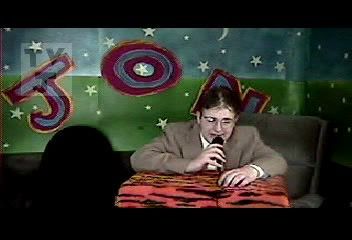
The craft kept climbing, and he kept telling the audience about it. In the fall of 2003, the set reached its most famous form: a wall covered in dozens of hand-lettered JON signs, taped up in a grid, with a Talking With Jon banner and a small television that he called his plasma screen TV thing, the monitor where he showed his clips. He lowered it into frame on camera, mid-episode, so the audience could watch the upgrade happen. He started wearing a blazer to host, the closest thing the show had to a uniform, the visual signal that this was a professional broadcast even though it was a teenager in his house. The handmade universe was getting more elaborate, but it never stopped being handmade. Paper signs, tape, a coat from the closet: the cheapness was the aesthetic, and the confidence was what made it work.
The meta-production comedy matured with the craft. The sponsors kept funding the backdrops, a fiction everyone was in on. The old man with the cane got into a staged backstage fight with the technical people, and the show's verdict was delivered flatly: they had fired the sound guy. It was a joke about a crew that did not exist, which made it a joke about the show's own ambition, which made it the most honest kind of joke. And when a segment ran its course, Jonathan canceled it himself, on the air, in front of everyone. "That was the last ever stupid things done by stupid people." Only someone fully in charge can retire their own hit live, and he did it without sentimentality. The show edited itself. Nothing was sacred, including the bits the audience liked best.
[IMAGE: book-screenshots/ep16/ep16_001.jpg, Host in blazer at the desk before the painted starry "JON" backdrop, the definitive talk-show framing.]
Look at what he was learning, discipline by discipline, and the variety explosion starts to look like a curriculum. Hosting. Interviewing. Characters. Commercials. Music. Editing. Set design. Audience participation. Distribution. He was running a one-man network and teaching himself every job in the building, one episode at a time. A few years later he would go to Robert Morris University to study TV production, and he would arrive having already run a show for five years. Talking With Jon was the self-directed prerequisite, the film school he built in his bedroom and basement and backyard before he ever set foot in a classroom.
The tools stayed humble the whole way. The FireWire transfers kept failing. The footage kept corrupting. The audio stayed rough, room echo and inconsistent levels baked into every episode, music beds swallowing dialogue. He was pushing consumer software past its limits and losing fights with a cable. None of it stopped him. Each episode taught him something, and the next episode spent it. The test had become a habit, the habit had become a show, and the show had become a variety hour with fake sponsors, a pitchman named Dave, a talking pizza, a chef who cooked with mold, a mockumentary about alien abduction, viewer contests, a website, a band, and a blazer.
The snowball was not rolling anymore. It was an avalanche, and it was heading straight for the craft years, when the kid who had taught himself television in his bedroom would start acting like he owned the place. Because by then, in every way that mattered, he did.
What was coming next was the part of the education no camera could teach. The contests would get bigger. The website would become a real hub, with votes and entries and a band chosen by the audience. He would write his first proper monologue, stand up in front of the camera with election jokes, and admit on the air when the jokes bombed, because honesty was always funnier than pretending. The sets would keep evolving, the characters would keep compounding, and the show would keep documenting its own making, season after season, until the kid who had started it all decided, deliberately and on purpose, that it was time to end it. But that is the next chapter's story. This one ends the way the era felt: loud, crowded, handmade, and just getting started.
By late 2004, something had changed about Talking With Jon. The show was no longer a kid testing a camera in his bedroom. It was a production, with a season structure, a set that got rebuilt on camera, a band chosen by viewers, a website, contests, and a host who had started to study the form he was imitating. Jonathan was fifteen, a sophomore in high school, and the talk-show dream that had started it all was finally being built the way the real shows built it: a monologue, a band, sketches, commercials, a closer. He was still doing everything himself. That part never changed. What changed was the polish, and the ambition behind it.
The proof arrived in November 2004 with episode 26, the Halloween special, a thirty-six-minute episode that stands as the fullest expression of what the show had become. Jonathan opened in blue face paint, wished everyone a happy Halloween, and then did something he had never done before: a monologue, Jay Leno style, the way the actual late-night hosts did it. He joked about gas prices, about George W. Bush winning a second term, about John Kerry's concession speech, about the new Pixar movie, and he reached for a dark joke about the World Trade Center site that only a teenager in 2004 would attempt. Then, with the instincts of a host twice his age, he told the audience the jokes were terrible and moved on. He had taught himself the hardest discipline in talk television, the nightly monologue, and he opened his first attempt by grading it himself. That honesty was the whole show in miniature: he knew exactly what he was doing, he knew it wasn't perfect, and he kept going.
The rest of episode 26 reads like a variety-show checklist. Viewers voted online for a new band member, with three candidates introduced on air. A Schoolhouse Rock-style original song taught adverbs, complete with a jingle for a fictional adverb shop. A new recurring bit compared photographs of people "twenty years" apart. And then, in the middle of the episode, Jonathan did something that revealed how completely he was in charge: he retired a segment on the air. The "stupid things done by stupid people" clip compilations had been running since the early episodes, and they had quietly become filler, the kind of segment a show keeps because it is easy. Jonathan played one last installment, this time involving vinegar, and then looked into the camera and said, "That was the last ever stupid things done by stupid people." No other show on his imaginary network could have canceled him. Only the host could cancel the host, and he did it live, as a bit, with a straight face. The episode also premiered the pilot for an animated cartoon called Saving Private Edwards, built in his 3D animation software, and it closed the way the show usually closed, with outtakes and a promise of more specials to come. It was the work of a fifteen-year-old operating at the absolute ceiling of what his tools allowed.
The band deserves its own mention, because it shows how the audience grew into the show. The band started as a joke and became an institution run by viewer vote. In episode 13 Jonathan introduced Roberto G, a guitarist character, as the new band member. By episode 16 Roberto had "gone on tour" and viewers were voting at the show's website to pick his replacement. Episode 17 gave the win to the old man with the cane, who celebrated by playing a song on a small keyboard and then getting into a staged backstage fight with the technical crew, after which Jonathan cheerfully announced they had fired the sound guy. Later votes added the Mummy, a "space guy that destroys stuff," and a "big guy," until episode 25 opened with all four of them playing together. Episode 27's winner was the Canadian garbage man. None of these musicians existed outside Jonathan's living room, but the voting was real, the campaigns played out on air over months, and the bit kept escalating because the audience, whoever and wherever it was, kept playing along. The set grew up alongside the band: the hand-lettered paper signs of the early years gave way to a mottled brown-and-orange backdrop introduced as new for year three, and Jonathan narrated every rebuild the way a contractor narrates a renovation, because the making of the show had always been part of the show.
[IMAGE: book-screenshots/ep26/ep26_001.jpg: "Talking With Jon 26 / Halloween" title card, marking the Halloween special.]
Those tools deserve a word, because the later episodes of Talking With Jon survive in a tangle of file formats that tells its own story. The archive holds versions labeled VCD, DVD, DIVX, and WMV, and the episode numbers themselves drift out of order: one version of episode 29 is dated April 2005, three months before episode 28's July date, and a second version of episode 29 follows in October, after episode 30. For a general reader, here is the plain-language version of why a teenager's show kept changing formats. A VCD file was tiny, a grainy little video that fit on a cheap blank CD he could burn and hand to a friend. A DVD file looked much better but was enormous, the kind of file that filled a hard drive and choked the already unreliable FireWire connection between his camera and his computer. DIVX was a clever compression trick of the era: it squeezed near-DVD quality into a small file, which mattered enormously when you were trying to move video across the slow internet connections of 2005. WMV was Microsoft's own compressed format, which played natively in Windows Media Player on practically every PC his friends owned. No single format solved every problem. The big files looked good but were hard to share; the small files were easy to share but looked rough. So he kept switching, trying each new container as his needs changed, as his computer filled up, as the internet got a little faster, as he learned what his audience could actually play. The exact reason for any single switch isn't written down anywhere, but the pattern is unmistakable: a kid iterating on distribution the same way he iterated on everything else, by trying it and seeing what worked.
What he was distributing, by 2005, was no longer just a talk show. It was a network. Episode 27, the Christmas special, ran fifty-one minutes and opened with a Star Wars-style text crawl. Episode 28 abandoned the talk-show format entirely and became a full game show, with contestants pulled from his circle of friends, trivia rounds, physical challenges, a flag hunt in the woods, and a Sony PSP as the grand prize. Episode 29 was a stand-up comedy special, Jonathan on a stage with a microphone doing twenty-plus minutes of jokes about Pittsburgh potholes, the Pope, and putting furniture together from the Spanish side of the manual. Episode 30 was a best-of clip show marking the end of the third year, with the host marveling on air at the tally, thirty episodes and three years, and admitting it surprised him to hear it out loud. Episode 31, the premiere of year four, was a "48-hour special," written, shot, and edited in two days, with the host warning the audience up front that it would not be as good as usual. He was sixteen, making a game show, a stand-up special, and a speed-run episode in the same year, and narrating every experiment as it happened.
[IMAGE: book-screenshots/ep28/ep28_004.jpg: a quiz-show parody frame from the full game-show episode of 2005.]
He also wanted an audience, and he went looking for one the way teenagers did in 2005. The show had a website where viewers voted for band members and entered contests. And in April 2005, at sixteen, Jonathan did something that says everything about his hustle: posting as "Moldytoaster," he shared episode 27 in the buy/sell/trade section of PbNation, a paintball forum, of all places. The regulars flamed him as a spammer. He stayed, argued back politely, and roasted them right back. There was no video platform strategy, no algorithm to game, just a kid walking into a room full of strangers and saying, in effect, I made this, what do you think. It took nerve, and it is the same nerve that would carry every project he ever promoted.
[IMAGE: book-screenshots/ep25/ep25_010.jpg: George W. Bush and John Kerry heads composited onto diners at a table, the show's topical 2004-election humor.]
By 2006, the pace was slowing, and the show knew it. Episode 32, from February, is the strangest experiment of the later years: Jonathan handed the hosting chair to his friend Bill, retitled the show "Talking With Bill" for the night, and let the whole thing run as a gentle parody of itself, complete with the "Billy Awards," an awards show where the nominees for best letter were M, R, B, and A, and the winner was E. Episode 33, the fourth Christmas special, ran about twenty minutes and was mostly a single unbroken block of clips, introduced with the explanation that introducing each one would be a waste of time. The episodes were getting shorter. One surviving screenshot shows the host in a recliner before a wall of pizza boxes spelling out giant "TWJ" letters, which is either the ultimate DIY credential or a young man running out of construction paper. Probably both.
[IMAGE: book-screenshots/ep32/ep32_001.jpg: the host in a recliner before a wall of pizza boxes spelling out giant "TWJ" letters.]
[IMAGE: book-screenshots/ep33/ep33_001.jpg: the red-lit Christmas wonderland set of episode 33, holiday maximalism on a teenager's budget.]
And then, in the summer of 2007, at eighteen years old, Jonathan ended it. Not with a fade, not with a long silence, but with a finale as deliberate as anything he had ever made.
Episode 34 opens with a history of the world. A narrator's voice walks through the milestones: Abraham Lincoln and the Emancipation Proclamation, the moon landing, the atomic bomb, the end of World War I, and then, jumping forward to the recent past, the 2006 incident in which Vice President Dick Cheney accidentally shot a hunting companion in the face. Each event gets its date and its weight. Then the punchline, delivered with total seriousness: "July 2007, the final episode of Talking with John." All of human history, it turns out, was just the opening act.
What follows is sixteen minutes of a young man closing every door on purpose. There is Jonathan in a toga, out in the woods, playing the philosopher-king of his own small empire. There is a Pulp Fiction homage built around Jules' famous speech, billed on screen as "Samuel L Jackson & Dakota Fanning," a piece of miscasting so wrong it becomes the joke. There are valley-girl news anchors reporting on the Iraq war. There is one more rendition of the closing song the show had been singing for years. And there are "where are they now" captions over the familiar faces, affectionate punchlines that give every recurring character a fake future, the comedy equivalent of a yearbook signing.
a clear frame of Jonathan in the toga in the woods from episode 34, the philosopher-king shot of the finale.
He did not cry, and he did not apologize, and he did not promise to be back. He simply gave the audience the final tally, thirty-four episodes across five years, and allowed that it wasn't bad. Then the credits, the outtakes, and black.
It is worth pausing on what that means, because it is rarer than it sounds. Most creators do not know how to stop. Shows made by teenagers especially do not get finales; they get abandoned, the camera put in a closet one day and never taken out, the audience left to guess. Jonathan, at eighteen, understood something that eludes professionals with agents and time slots: that an ending is a creative choice, and that choosing it is a form of respect, for the work and for the people who watched it. He had started Talking With Jon as a video test at thirteen. He had spent five years raising his own bar, episode by episode, until the show contained a monologue, a band, a game show, a stand-up special, a cartoon pilot, and a mockumentary. And when he felt the idea was complete, he gave it the biggest frame he could think of, the entire history of the world, and closed it on purpose. He knew how to end things.
The timing was not an accident either. He was eighteen, finishing high school, and he already knew where he was going next: Robert Morris University, to study television production. He would graduate in 2011 with a degree in the thing he had been teaching himself since he was thirteen. Think about what that means. Most students arrive at film school having watched television. Jonathan arrived having run one. He had written, shot, performed, edited, distributed, and promoted thirty-four episodes of a show with his own two hands, inventing the sponsors when there was no money, playing the guests when there was no cast, holding viewer votes when there was no audience yet. Every discipline the university would teach him, hosting, interviewing, character work, commercials, music, editing, set design, audience participation, he had already practiced, in public, for five years, starting from a camcorder and a recliner.
That is the quiet thesis of this whole era, and the line this chapter has been walking toward: Talking With Jon was his film school. Not a metaphor for one, not a cute way of saying he learned a lot, but the actual self-directed prerequisite, completed before he ever set foot in a classroom. The one-person production pipeline he built between 2002 and 2007, write it, shoot it, perform it, edit it, get it in front of people, is the same pipeline he still uses today, on every project, in every medium. The tools got better. The method never changed.
So the finale is not really an ending. It is a handoff. A kid in a toga in the woods, joking that history itself was leading up to his little show, was telling the truth in the way that mattered: the show was the prologue. Everything after it, the degree, the longer videos, the series that followed, the whole career of making things and putting them in front of people, starts here, in these thirty-four episodes, with a teenager who learned how to begin something from nothing and, just as importantly, how to end it well. He was eighteen, and he was just getting started.
Most people who know Jonathan's work know the big projects: the counting video, the longest-video records, the thousands of water episodes. But before any of that, and alongside all of it, there was a shelf. Not a literal shelf, though if you visit his old websites you can still see the shape of it. It was a roster of shows, each with its own title card, its own intro, its own little world. He made a repair show, a stoner sketch comedy, a gaming rant series, a space documentary, a DVD review show, a blindfolded art show, and a handful of others whose names survive mostly as fond mysteries. Talking With Jon was the flagship, the one that ran for five years and taught him everything. But he was never a one-show person. He was constantly experimenting with formats, the way a musician tries different instruments. This chapter is a walk along that shelf, one or two spreads per show, with a simple plain-language caption for each: what this was, when it was, and what it tells us. Two of the shows get only a brief hello here, because each gets a full case study in the next chapter. The rest get their moment now.
A collage-style spread of show title cards from the Moldytoaster Video portal era, arranged like DVD box art on a wooden shelf. Everyday Repairs hand-drawn intro lettering, the S.D.C. green banner, the Planetarium starfield title, the Blindfolded Art chrome letters, the Video Games rant title, each in its own frame, slightly uneven, homemade.
Before we tour the shelf, a note on the two shows that anchor it. Everyday Repairs was Jonathan's repair show: eight episodes made between 2011 and 2013, in which a deeply delusional handyman demonstrates absurd and dangerous home repairs in the flat, earnest voice of a real how-to program. It was a repair show years before repair content had a name on YouTube. Jason & Pals was something else entirely: a live-action stoner sketch comedy from about 2012, three episodes, a gang of friends playing themselves-as-characters through fake local-TV ads, dream endings, and escalating gags about milk. Both shows lived on the MoldytoasterMedia channel, both went down with it in December 2021, and both survived because Jonathan re-uploaded them elsewhere: Everyday Repairs to the Tech Thursday channel on November 13, 2023, and Jason & Pals to the Let's Tape It channel in November 2023. They are the two directions his work kept pulling, practical how-to formats in one hand and ensemble comedy in the other, so each gets a full case study in Chapter 8. Here, they get a wave as we pass.
Two side-by-side frames. Left: Jonathan as the Everyday Repairs host in his backyard, claw hammer in hand, speaking into the camera with total sincerity. Right: a cast frame from Jason & Pals, Jason Gulbin and friends in the faux-brick living room set, mid-sketch. A small caption ribbon under each naming the show.
The "Video Games" folder in Jonathan's archive is really a series with a simpler name: "The X Sucks." Across roughly a decade, he and at least one friend sat down in front of the camera and declared, with deliberate overstatement and total commitment, that a piece of gaming hardware was garbage. The titles tell the story of a decade of consoles: "The DS Sucks," "The PSP Sucks," "The Playstation 3 Sucks," "The Nintendo Wii Sucks," "The XBox 360 Sucks," "The Wii U Sucks," "The Xbox One Sucks," "The Nintendo Switch Sucks," plus side entries like "PC Gaming Sucks" and "iPods Suck." Each video follows the same fixed bit: introduce the product, declare "it's a fact," cite absurd evidence ("look it up in the dictionary, look under suck"), and close having proved nothing. The catchphrases repeat across episodes like a ritual: "it's a fact, folks," "check the facts," "look it up on the internet."
What makes the series worth more than a joke is its span. A throwaway line in "The DS Sucks" dates it: the Game Boy has been around since 1987, the ranter says, "it's a 19-year-old system," which pins that entry to 2006. The Switch entry lands in 2017. So this is an eleven-year run of the same joke, told about every console generation that passed through Jonathan's life. Underneath the comedy, it is his first catchphrase system and his first truly serial format: one product, one rant, one verdict, repeated until it becomes a tradition. The opinion-rant shows he would make later grew directly out of this soil.
A split frame showing two eras of the rant series. Left: the 2006-era bedroom setup from "The DS Sucks," two young men to camera, low-resolution. Right: a later HD rant from the Switch era. Between them, big text reading "IT'S A FACT, FOLKS."
"The Planetarium" is the most produced-feeling of the early shows, and it is also the one Jonathan seems least likely to have made, which is exactly why it belongs on the shelf. It is an eleven-episode space documentary series hosted by two young women who go by the space-named pseudonyms Luna and Venus. Each episode is a countdown of space phenomena, presented like a school science-magazine show: the hosts at a desk in front of a greenscreen starfield, a big caption naming each item, a narrator reading entries over simple graphics. The sign-off became a ritual: "Signing off for the universe, I'm Luna. And I'm Venus."
The archive keeps the full season with unusual care: every episode survives as a DV-tape master (over a gigabyte each) alongside a smaller web encode, plus a dedicated intro and a three-minute reel of episode 4 outtakes showing the hosts cracking up through flubbed takes in front of a blue backdrop. The scripts read like adapted science articles: brown dwarfs, neutron stars ("the walking corpses of the cosmos"), cosmic rays, lunar dust, the sun's hot corona. Nobody in Jonathan's notes mentions Luna and Venus anywhere else, so they were probably classmates or early collaborators, now preserved in amber. The show is pure early evidence of his documentary instinct, the same one that later surfaced in his fact-driven series, and the catchphrase sign-off is an early example of his signature move: give the show a closer, a little branding ritual, right from the start.
The Planetarium desk setup, Luna and Venus at the desk in front of the greenscreen starfield, a big caption reading "BROWN DWARFS!" on screen. Warm, homemade, earnest.
If The Planetarium is the most produced of the early shows, The S.D.C. is the least, and it is just as revealing. Two teenage hosts sit in front of a hand-painted green banner reading "S.D.C." and ramble: smoking paraphernalia, video games, bike wheelies, a Sega Genesis of unknown origin, and whatever else wanders through. The show's one piece of paperwork is a winking disclaimer card: "No illegal substances were used during the taping of the show. We do not recommend you use marijuana, it is against the law in most areas." The acronym's exact meaning is never clearly spelled out on camera. It plays like an inside joke between friends, because that is what it was.
The show sits squarely in the Talking With Jon umbrella years: both the intro and ending cards read "See more at www.talkingwithjon.com," and the archive keeps the same versioning habit seen across his work, a DV master plus web encodes plus an "under 100mb" cut of episode 1. Episode 2 is five minutes of the host mugging with the Sega Genesis "for no reason," riffing on PVC piping and ending by chanting "Let's make a jump" into the camera. The S.D.C. is the comedy lineage that leads to Jason & Pals: teen friends, a camera, no adults, jokes about smoking gear. The long endurance videos he makes now are solitary, but he learned the camera as a group toy first, in a basement, in front of a hand-painted banner.
The two S.D.C. hosts at the green banner desk, one holding the Sega Genesis up for the camera, both mugging. The disclaimer card shown as an inset.
Twelve episodes. One rule: Jonathan makes art while blindfolded, and the camera watches the results. The title card is a small masterpiece of the era: "JON HARCHICK'S" in chrome 3D letters over a green backdrop, then a blindfolded classical head statue with "Blindfolded Art" in big yellow rounded letters. The archive keeps a 22-gigabyte master of all twelve episodes, a blank intro template, and an ending card reading "See more at www.talkingwithjon.com," the same packaging discipline that runs through the whole shelf.
The premise writes itself, and it fits his whole catalog: take one simple constraint and repeat it until repetition does the entertaining. Blindfolded art is Jon Drinks Water with paint instead of water. There is also a deeper layer that only lands once you know Jonathan's story: he is legally blind from a retinal condition, and as a kid he made a show about voluntarily giving up his sight to make art. He was playing with blindness as a concept years before it defined his daily life. That is worth knowing, not as a punchline, but as a window into how long he has been turning his own circumstances into material.
The Blindfolded Art title card, chrome "JON HARCHICK'S" letters, the blindfolded classical head statue, big yellow "Blindfolded Art." Beside it, a frame of Jonathan painting blindfolded.
Jonathan's DVD review show is exactly what the name says: he sits in front of his DVD shelves, holds up each disc's case to the camera, and reviews both the movie and the DVD release itself, the transfer, the packaging, the booklets, the bonus features, even whether the NTSC disc will play on a European PAL television. Every review closes with a star rating. It is as much a collector's show as a critic's show: he docks a Spielberg Collector's Edition for reusing cover art in the booklet, and he has reviewed editions of movies he cheerfully admits he has not watched.
The episodes are long, forty to fifty minutes of unhurried opinions, and they are full of small cameos of the habits that would define his later work. "Mini water as our drink" gets a shout-out in one episode, a tiny early appearance of the water habit that became Jon Drinks Water. He notes he is going "a little faster than normal because we eat a lot tonight," and there it is, the eating-on-camera habit already forming. His on-camera name here is spelled "John Harchik," no S, a small sign of a young creator still deciding what to call himself, years before he settled into the identity the directional channels would give him.
Jonathan in front of the DVD shelves, holding a disc case up to the camera, mid-review, with a hand-drawn star rating graphic (three and a half stars) overlaid.
Some shows on the shelf survive only as a line in an old webpage. "Money Solves Everything" appears in the 2009 capture of the Moldytoaster portal with this description: "In the premiere episode we show you how to save money and get ready for your retirement." The archive holds a folder of about three gigabytes for it. That is all we know, and the book will not pretend otherwise. But the title alone tells you something about the era: a young man in his early twenties, making a show with the most optimistic title on the shelf, about the least funny subject in the world. It belongs here as a reminder that the shelf has corners we have not fully explored yet.
A recreation-style frame: the 2009 portal page listing "Money Solves Everything" with its one-line description, rendered like an old webpage on an old monitor. Caption notes this is an illustration, not the original page.
Tech Thursday needs an honest caption. It is one of Jonathan's four directional channels, the "Up" to Jon Drinks Water's "Left," Let's Tape It "Down," and Jon Eats Carrots "Right." As a show in its own right, the archive study has not yet cataloged its contents, so this book will not invent a description of episodes that have not been verified. What is documented is its second life: on November 13, 2023, all eight episodes of Everyday Repairs were re-uploaded to the Tech Thursday channel (@techthursday9277), giving the repair show a home after the MoldytoasterMedia channel was terminated. A channel became a lifeboat. That is worth saying plainly, because it is the pattern of this whole era: the work outlived the platform it was made for, and Jonathan found it new rooms.
The Tech Thursday channel page showing the Everyday Repairs re-uploads with their November 2023 dates, rendered as a screenshot-style illustration.
Every archive has a drawer labeled "later." In Jonathan's Shows folder, two names sit in that drawer: watchmofo and Copy Cat. They exist as folder names and not much else yet; the study pass has not reached them, and this book will not guess what they were. They are here because an honest shelf includes the unopened boxes, and because their names alone tell you something about the era they come from, the anything-goes naming of early-2000s internet video, when a show's title was a dare.
They are not alone. The 2007 portal roster included The JPO Show and The CC Show as full shows, with pages prepared for The Bestest Show, Cooking With Swan, Counting, Video Games, and Saving Private Edwards. Some of those pages may have become shows; some may have stayed aspirations. "Counting" is a suggestive one, given what came later. The point of listing them is not to catalog what we cannot verify. It is to show the scale of the experimenting. At any given moment in those years, Jonathan had several shows running, several more planned, and no particular worry about whether any of them would find an audience. He was not building a brand yet. He was filling a shelf, because the shelf was there and he had a camera.
A dim archive drawer or folder view labeled with the pending names, watchmofo, Copy Cat, The JPO Show, The CC Show, half in shadow. A caption that reads, in effect: these are real, and they are still being studied.
Step back from the individual shows and a pattern appears. Jonathan was never really a YouTuber in the modern sense, a person who finds one format and optimizes it. He was a showrunner without a network, inventing formats the way other people doodle: a repair show, a rant show, a space show, an art show, a review show, a stoner talk show, a sketch comedy. Some ran for years. Some ran for weeks. Some may never have gotten past a title card and a folder name.
Two things carried across all of them. First, the packaging discipline: every show gets an intro, an ending card, a title, a closer, a ritual. He was doing branding before he had anything to brand. Second, the serial instinct: pick a premise, repeat it, let repetition do the work. The one-off was never his unit of thought. The series was.
The shelf also explains something about the later, bigger projects. When people encounter the thousands of Jon Drinks Water episodes, they sometimes wonder how anyone sustains a single idea that long. The shelf is the answer. He had been sustaining ideas for years before the water videos, just smaller ones, on a hand-built website, for an audience he mostly had to find himself. The water series was not a new discipline. It was the old discipline, finally pointed at one thing.
A wide pullback of the whole shelf, all the title cards together, with the Moldytoaster Video portal banner across the top, like the end of a tour.
Every creator has a moment when you can see the whole career in miniature, two works that contain everything else in seed form. For Jonathan, those two works are Everyday Repairs and Jason & Pals. They could hardly be more different. One is a solo performance: a single man, a hammer, a backyard, a deadpan voice explaining how to do home repairs that no sane person should ever attempt. The other is a group effort: a gang of friends, a fake living room, sketch comedy about getting high, getting evicted, and getting a credit card, with fake local-TV commercials in between.
They belong together in this chapter for two reasons. First, they show the two directions his work kept pulling: toward practical how-to formats on one side, and toward ensemble comedy on the other. He never chose between them. He just kept doing both. Second, they share a survival story. Both shows lived on the MoldytoasterMedia channel. Both went down with it in December 2021. And both are watchable today only because Jonathan re-uploaded them somewhere else. This chapter is about what they were, how they worked, and how they lived through the end of the channel that made them.
A two-panel title spread. Left panel: the Everyday Repairs animated intro, hand-drawn floral wallpaper, painted "EVERYDAY REPAIRS" lettering. Right panel: the Jason & Pals photo title card. A ribbon between them reading "two directions, one shelf."
The premise fits in a sentence. A man who believes he can do every home repair cheaper and safer than any professional demonstrates his methods on camera, and his methods are deranged. That is the whole show, and it is enough for eight episodes.
The series ran from 2011 to 2013, eight episodes of five and a half to nine minutes each, hosted by Jonathan alone in the flat, unblinking cadence of a real home-improvement program. Every episode opens the same way: a hand-drawn animated title sequence, floral wallpaper with drifting flowers and shapes, painted "EVERYDAY REPAIRS" lettering, a music sting, and then the host to camera with the greeting the show never varies. In one episode he shortens it to "welcome to ER," and the joke lands precisely because he never varies it otherwise.
The comedy engine is the gap between the earnest how-to format and the content. The host's solutions to ordinary household problems include painting over toxic black mold, stirring dried paint with his bare feet, making paper by sawing a tree down to a hundredth of an inch, mixing pesticide out of lighter fluid and WD-40 and vanilla, charging batteries by hammering them, fixing computers with bug spray, and installing bathroom security cameras with a hammer. He holds that contractors and corporations are, in his words, "the scum of the universe," trying to steal your money, and that he is here to save you some. He repeatedly injures himself on camera and treats it as content: he sprays his homemade pesticide on his own hand and ends up in the hospital, and he shoots himself with a nail gun. The deadpan never breaks.
A four-frame strip from a single Everyday Repairs episode. Frame 1: the host greeting the camera, hammer in hand, backyard stud-wall set behind him. Frame 2: the moldy basement with exposed joists. Frame 3: a close-up of the hammer doing something it should not be doing. Frame 4: the host, bandaged or unbothered, continuing the demonstration.
The show runs on rules, and the rules are stated on camera. Rule number one of safety: keep a hammer in your hand at all times. He carries a hammer instead of a hard hat, though he occasionally wears a yellow hard hat as a visual gag. "Let gravity do its work," he says, painting a floor. The hammer is the universal tool: he welds with scissors, drills with a hammer, and insists the hammer is key. The episodes close with teasers for next week's even more dangerous project: drilling for oil, playing with a bulldozer, fishing with hammer-hooks. The escalation is the joke, and the joke is that he means it.
A small cast of real people drifts through the segments. Frank, his brother, is mentioned constantly and becomes the subject of episode 6, which is largely about killing him and disposing of the body, set to a song called "Woodsmoke" played over a mock eulogy. Paul is a Home Depot employee Jonathan films on location and calls a name the book will soften here. Seth is a contractor Jonathan confronts while digging up a pipe, asks "where's your hammer," and then implies he has taken care of. There is a young day-laborer found on Craigslist, handed a spare hammer and a plaid flannel shirt, who co-stars in episode 7's basement scene. Linda and Eric Weston, Aunt Patty, a wife doing better after physical therapy, a son with a game system: mentioned, never seen, part of the show's invented domestic world.
The visual look is early-2010s standard-definition digital video, natural light, mostly locked-off tripod shots mixed with handheld close-ups. The locations are his own: the backyard with its wooden stud-wall set and brick fire pit, a grungy unfinished basement that doubles as every client's home, a cluttered garage, the woods behind the house, and real location footage from a Home Depot. The food gags are their own subplot: he tastes tree sap and finds it delicious, fishes a hammer out of a toilet and declares it tastes good, keeps mushrooms growing in the garden so he never runs out of food. The tone stays dry throughout. Almost nobody laughs, which is why it is funny.
The eight episodes, with their runtimes:
What matters about Everyday Repairs, beyond the jokes, is the timing. This was a repair-show format in 2011 to 2013, years before repair and DIY content became one of the defining genres of online video. Jonathan did not invent the genre, and the book will not claim he did. But he was there early, working in the format with total commitment, building the parody version of a genre before the sincere version had fully arrived. It is also the clearest expression of one of his two great directions: the practical format, the show that teaches you something, even if what it teaches you is how not to do it. The how-to impulse never left him. It just found better-behaved subjects later.
The episode list rendered as a handsome series guide, eight entries with runtimes, styled like a TV season menu, with the note that all eight were re-uploaded to the Tech Thursday channel on November 13, 2023.
The first thing to get right about Jason & Pals is what it is not. It is not a cartoon. The show is live-action stoner sketch comedy, shot on consumer camcorders with cheap digital effects: greenscreen, 3D text cards, double-exposure transitions, fighting-game health-bar overlays. Three episodes, made around 2012, running seven and a half, ten and a half, and fourteen and a half minutes. The cast plays themselves-as-characters, friends with a camera and no adults in sight, the direct descendant of the S.D.C. days, now with better jokes and a meaner streak.
The structure is ritual. Every episode opens with a photo title card, runs through sitcom-style opening credits over holiday jazz, carries a TV-PG bug and a MoldytoasterMedia watermark for faux-broadcast authenticity, then moves through the same stations: sketches, a fake local-TV commercial, more sketches, a music montage, and a dream or meta ending, closing with joke credits full of pun names. The fake ads are a series unto themselves: Big Jeffrey's used socks ("only $4.44 plus $503 shipping"), a light-bulb Emporium, a Neil Anderson action figure. The running gags escalate across episodes, most famously milk, which starts as a gag and ends, in episode 3, as a plot point in a murder.
A cast photo-style frame from Jason & Pals, the gang in the faux-brick living room set, with name captions in the style of the show's joke credits. Below it, three small frames showing the fake ads: the used socks, the light bulbs, the action figure.
Episode 1, "Jason Gets High" (7:34). The setup episode. Jason Gulbin plays Jason, heavyset, short dark bowl-cut, plaid shirt over a dark tee. Around him: Josh Elsass as Josh, slim, long black hair, bandana and headphones; Ernie Bernard as Ernie, bearded, orange t-shirt, usually in a garage; and a deep bench of friends filling out sketches with names like Shaniqua, Teshane, Michael, Adam, Mollie, Kim, Melisa, and Sean Stacho, credited as "The Stacho" with a mock mugshot gag. The episode's spine is a rambling monologue proposing the solution to all the world's problems, surrounded by the milk and vomit gag, a dealer visit, an anti-pharma rant, a trip montage, and the show's signature landing: it was all a dream.
Episode 2, "Jason Gets Evicted" (10:25). The plot episode. It opens on a pile of mail, bill after bill, and then the eviction notice. What follows is a mock-serious homeless narration played dead straight, all shoplifting and dumpsters and petty crime, undercut by the show's bathos engine: inner voices chanting "Jason you suck," a twin brother named Mass revealed as a supervillain in Blofeld silhouette, a bathos-laden "okay I'll talk to you later bro see you around." The fourth wall does not survive the episode. It ends with the cast essentially agreeing to just end it.
Episode 3, "Jason Gets A Credit Card" (14:28). The epic. Jason gets a credit card and the episode becomes a spending montage played at maximum volume: a thousand hamburgers, a hamburger fighting game with health bars and a KO screen, two hundred cell phones a day, five thousand copies of James and the Giant Peach, a gold-plated, diamond-crusted 1996 Ford Contour. There is an escort date with a woman whose full name is a running joke in itself, a Scrabble game with delicious pieces, a golf caddy named Matt, a musical number about a tongue glued to a wall, a Publishers Clearing House parody with a million-dollar check made of taped paper, and a "celebratory milk cocktail." Then the tone turns: Josh dies. The episode stages a full mock eulogy, a coffee-can urn labeled JOSH, an ash-scattering at a Pittsburgh river bridge, a balloon release, and then Jason flushes the remaining ashes down the toilet. The punchline lands on the show's favorite note of bathos: wait, you have to pay for credit cards?
The engine of the comedy, across all three episodes, is bathos: the heartfelt undercut by the petty, the serious played until it becomes ridiculous. The cast-as-themselves format gives it a warmth that the jokes keep trying to destroy and never quite manage. These are real friends, and you can tell. The music, mostly production-library tracks, later caused a small real-world ripple: a 2013 commenter named Doug Wood wrote in to ask how his music had ended up in the videos, a reminder that even the cheapest production has paperwork, and a detail that matters for the revival, because music clearance will matter there too.
Three episode title cards in a row, "Jason Gets High," "Jason Gets Evicted," "Jason Gets A Credit Card," with their runtimes, in the show's photo-card style.
Both shows were MoldytoasterMedia shows. When the channel was terminated in December 2021, they went down with it, along with years of other work. What happened next is the reason this chapter can show you frames at all: Jonathan re-uploaded them. All eight episodes of Everyday Repairs went up on the Tech Thursday channel on November 13, 2023. All three Jason & Pals episodes went up on the Let's Tape It channel in November 2023. The re-uploads are not restorations in the fancy sense. They are the episodes, in watchable quality, in new homes, with their original title cards and joke credits intact.
This is worth pausing on, because it is the quiet thesis of the whole book. The termination chapter comes next, and it will tell that story in full. But the survival part belongs here: several of Jonathan's early works exist today only because he moved them. He did not wait for an archive or a fan project. He re-uploaded his own shows to his own channels and kept going. The shelf survived because the person who built it refused to let it go.
A simple, moving spread. On the left, a dark frame labeled December 2021, the MoldytoasterMedia channel page gone. On the right, two bright frames: the Tech Thursday channel page with the Everyday Repairs episodes dated November 13, 2023, and the Let's Tape It channel page with the Jason & Pals episodes dated November 2023. A caption: the same shows, new rooms.
The story does not end with the re-uploads. Jason & Pals is being revived, as animation. The plan follows the model of shows that made the jump from live action to cartoon: a fourth episode, drawn in a deliberately crude cartoon style, with temporary voices standing in until the original cast returns to re-voice their own roles. Jason, Josh, Ernie, and the rest, played by the same people who played them in 2012, now as animated versions of themselves-as-characters.
It is a fitting next step for a show whose whole identity was friends playing themselves. The cast is real, the friendships are real, and more than a decade later the joke credits still read like a reunion waiting to happen. Animation solves the practical problems: no one needs to be in the same room, no one needs to find the old camcorder, and the cheap digital effects that defined the originals become a style choice instead of a limitation. What it keeps is the important part: the ensemble, the fake ads, the dream endings, the bathos.
There is also a smaller revival stirring on the other side of the chapter: an animation test for Everyday Repairs, built around the basement scene from episode 7, with a voice script written and waiting on Jonathan's own recording. The delusional handyman may yet get a second life in drawn form, hammer and all. But the Jason & Pals revival is the one with momentum, and it is the right place to end this chapter: not with an archive, but with a production. The shelf is not a museum. It is a workshop, and there is still work happening on it.
A production-style frame for the revival: a rough animated version of Jason in the show's crude cartoon style, holding a title card that reads "Episode 4," with a caption noting the original cast will return to voice their roles.
Every shelf needs a name on the spine. For nearly two decades, the name on Jonathan's shelf was Moldy Toaster Media. It was his screen name, his forum handle, his website, his production banner, and eventually his YouTube channel. Then, in December 2021, the channel was terminated, and the name that had tied the early work together became a story about loss and salvage. This chapter is about the brand: where the name came from, what it held together, what happened to it, and what survived. The termination is part of the preservation story, which is part of why this book exists. It is told here the way Jonathan tells it, because it is his story to tell.
The Moldy Toaster Media banner as it appeared on the videos, a simple production card, full-bleed, with a caption giving its years of use.
"Moldytoaster" started as Jonathan's AOL Instant Messenger name. That is the whole origin, and he has said so himself, plainly, in his own words on a livestream in December 2021: it was a random combination of words, and there is no deeper story behind it. Every brand wants a myth. This one has an anti-myth, and it suits him. He did not workshop it. He did not hire anyone. He was a kid picking a screen name, and he picked two words that sounded funny together.
The name stuck because he stuck it everywhere. By March 2005, the hit counter on the third version of the Talking With Jon website was already tracking visitors under the site name "moldytoaster," a sign the two brands were linked in his head from the start. In April 2005, at sixteen, he posted episode 27 of Talking With Jon to the miscellaneous section of PbNation, a paintball forum, under the name "Moldytoaster." He was flamed as a spammer within minutes ("reported," "gtfo 2k5.er"), and he stayed and argued his case politely. The name was on the door from the beginning: the kid getting flamed on the forum and the kid making the show were the same person, and the screen name said so.
A recreation-style illustration of the April 2005 PbNation thread, the "Moldytoaster" username with its April 2005 join date, the episode 27 post, rendered like an old forum page. Caption notes the exchange is verified and still live.
The brand's first real home was not a channel but a website, or rather two websites in sequence, whose life stories the Wayback Machine preserved in unusual detail.
talkingwithjon.com (2005-2008) was the show's own home. The first surviving capture, from March 17, 2005, is a plain hand-built page that reads like a teenager talking directly to you. The top line is worth keeping: "Thats right, were back. This is our third site and we still have nothing to say, but this one might be the one that sticks around for a while." Spelling as on the page. This was already the third attempt at a website. The about text credits the show as hosted, written, edited, and otherwise mostly done by Jonathan, and counts 27 episodes. The episodes were Windows Media downloads on free Neptune hosting, with a mirror for good measure. By late 2005 the site had an episode table with viewer ratings, a message board, a casting call for a Larry King impressionist, and an Alexa ranking it wore like a badge of honor. By 2006 it had PayPal donations, testimonials, wallpapers, a board-game section, and a note that clips from the show would air on a British program called "Totally Viral." And by June 2007, a month before the finale, the address no longer served the show's site at all. It served Moldytoaster Video, a multi-show portal: Talking With Jon alongside The S.D.C., The Planetarium, Everyday Repairs, Blindfolded Art, Movie Reviews, The JPO Show, The CC Show, with pages prepared for more. The show had become one channel on his own little network, with ads, in 2007. He built the multi-channel video portal himself, years before the platforms made it normal.
Three eras of talkingwithjon.com side by side. 2005: the plain hand-built homepage. 2006: the episode table with ratings. 2007: the Moldytoaster Video portal with the show roster. Rendered as browser-window illustrations, with a caption noting these are illustrations based on archived captures.
moldytoaster.com (2008-2025) is the brand outliving the show. The first capture, April 2008, shows the same Moldytoaster Video portal, newest-episode and top-rated widgets, the full roster of shows, and by 2009 new entries like Everyday Repairs episode 5. A 2011 redesign gave it a slogan worth quoting: "Moldytoaster - TV for an internet generation." By 2013 it was down to a minimal splash page. From 2016 on, the domain stopped being a website and became a signpost, redirecting visitors to the MoldytoasterMedia YouTube channel. The brand's home had moved to the platform he never needed as a kid. The final captures, from 2025, show the domain redirecting to his current Google Sites page. Nearly twenty years after it first appeared in the archive, the address still points at him.
The portal had the full apparatus of a tiny network: advertising from the AdBrite ad network, a Sponsors page, a message board, and tidy episode folders for each show (Episodes/TWJ, Episodes/SDC, and so on). The Talking With Jon entry for the finale read simply: "After 5 years this is the final episode of the show." The flagship had signed off, and the brand carried on without it. That handoff, from show to brand, is the quiet hinge this whole book turns on.
The honest afterlife gets one paragraph, because the book does not hide the boring parts. The talkingwithjon.com domain lapsed: a 2020 capture shows it parked and serving unrelated text, and a 2023 capture shows a fitness blog by a different Jon. That is not his work, and the book will not present it as his. Domains lapse. The work is what survived.
It is worth pausing on what "Moldy Toaster Media" actually was, as a brand, because it was never a company in any formal sense. There were no employees, no office, no logo designed by an agency. It was a screen name that grew into a production banner by sheer repetition. Jonathan put it on the forum posts, on the hit counter, on the website, on the watermarks, and finally on the channel, and each placement made it more real. By the time the MoldytoasterMedia channel existed, the name carried a decade of accumulated meaning: if you saw it in the corner of a video, you knew whose hands had made the thing, and roughly what kind of thing it would be. Homemade, serialized, a little obsessive, funny in a way that assumed you were in on it.
That is why the name mattered when the channel died. Losing MoldytoasterMedia was not like losing a username. It was like losing the sign over the shop. The shop itself, the videos, mostly survived, because he had the masters and the habit of keeping everything. But the sign, the thing that told a stranger stumbling onto episode 29 that there were 28 more where that came from, was gone. The re-uploads gave the shows new rooms. They could not give them the old sign back. This book is, among other things, an attempt to put the sign back up.
For the YouTube years, Moldy Toaster Media was the production banner in the corner of the frame. The Jason & Pals episodes carry the MoldytoasterMedia watermark next to a TV-PG bug, part of the show's faux-broadcast joke, but the watermark was real: it said whose work this was. The channel lived at youtube.com/user/MoldytoasterMedia, and for years it was the archive of record for the early shows, the stunts, the experiments, the livestreams. If you wanted to see the whole shelf in one place, that was the place.
This is the part of the brand story that is hardest to show in a book, because the channel is gone. There are no screenshots of a living page to reproduce, only the watermarks burned into the surviving videos and the re-uploads that carried the work to safety. That absence is the point of this chapter. A production banner is a promise that the work will be there when you come back. For MoldytoasterMedia, the promise was broken by someone else, and kept by Jonathan himself.
A frame from Jason & Pals showing the MoldytoasterMedia watermark and TV-PG bug in the corner, circled or highlighted, with a caption explaining what the watermark meant.
Here is the story the way Jonathan tells it. During a livestream on the MoldytoasterMedia channel, someone cut to a video of a naked person. YouTube removed the whole channel afterward. He appealed, and YouTube did not restore it. In a later retelling, he added a detail: it was not a viewer getting naked on camera, but someone cutting to a video clip. That is his account, from his livestreams in 2022, and this book presents it as his account. No villain narrative, no conspiracy, just the facts as he gives them: a livestream, an interloper, a termination, a denied appeal.
The loss was real, and the chat logs from those 2022 streams show people mourning it in real time. A fan in the chat mourned the Talking With Jons that went down with the channel, quoting a line from the show's tsunami sketch in episode 29. Years of work, the archive of record for the shelf this book has been walking, gone in the way things go on the internet: not with a fire, but with a form letter.
Two things need saying plainly here, because the internet is full of wrong versions. First, the terminated channel was MoldytoasterMedia. It was not Let's Tape It. Let's Tape It is live and public, and this book will never suggest otherwise. Second, the termination is not the end of the story. It is the middle.
A restrained, non-sensational spread. A darkened channel page with the termination notice, dated December 2021, beside a simple timeline: the livestream, the removal, the appeal, the denial. No imagery of the incident itself, which was never Jonathan's content.
What Jonathan did next is the reason several of the shows in this book can be watched at all. He re-uploaded them. All eight episodes of Everyday Repairs went up on the Tech Thursday channel on November 13, 2023. All three Jason & Pals episodes went up on the Let's Tape It channel in November 2023. The episodes survived with their title cards, their joke credits, their watermarks, and their flaws intact. He did not wait for a fan restoration project or a platform amnesty. He moved his own work to his own channels and kept going.
This is the honest framing the book promised at the start of the chapter: the termination is part of the preservation story. It is tempting to tell it as a tragedy, the platform killing the archive. It is more accurate, and more like Jonathan, to tell it as a salvage operation. The work mattered enough to him to move, piece by piece, to new rooms. Some of it made the trip. The shows on the shelf in Chapters 7 and 8 are the ones that did.
There is a coda worth adding, because it is still happening. The re-uploads were not a one-time rescue. The Everyday Repairs animation test, the Jason & Pals animated fourth episode, the ongoing study of the Shows archive folder by folder: the salvage operation turned into a practice. He is not just preserving the old work. He is still building on the same shelf, under new banners, with the same discipline that put an intro and an ending card on a show nobody was watching in 2005. The name on the spine changed. The hands making the shows did not.
And that is part of why this book exists. A coffee-table book is a strange, old-fashioned object to make about internet video: heavy, permanent, printed on paper, the opposite of a channel that can vanish with a form letter. But that is the point. The videos lived on borrowed ground, first on free hosting with bandwidth bills, then on a platform that could remove them. The book is a different kind of ground. It cannot be terminated. The shelf, in these pages, is finally on a shelf that will hold.
The closing spread. A bookshelf, photographed warmly, with handmade DVD-style cases for each show spine-labeled in the Moldytoaster style: Everyday Repairs, Jason & Pals, The Planetarium, The S.D.C., Video Games, Blindfolded Art, Movie Reviews. A small banner across the top reading "Moldy Toaster Media." The caption: the shelf, finally on a shelf that will hold.
It was December 2011, and a twenty-two-year-old in Pittsburgh pressed upload on a video unlike anything YouTube had ever seen. The title was in all capital letters, the way people typed when they wanted the whole internet to hear them shouting: "THE LONGEST VIDEO ON YOUTUBE." The length of the video was 596 and a half hours. That is nearly twenty-five days of continuous video. If you had started watching it on the day it went up and never slept, never paused, never looked away, you would still have been watching it on Christmas.
The video itself was almost comically plain. Two flat colors, alternating, hour after hour after hour. No plot. No jokes. No Jonathan on camera. Just a two-tone pattern stretching across twenty-five days. And that plainness was the entire point, though almost nobody would have guessed it at first glance.
In the description, or in the video itself, came the open dare. He told the whole internet, in words that would travel further than the video ever did: "I challenge anyone to try and make a longer video."
the video's title frame, "THE LONGEST VIDEO ON YOUTUBE" in full
That sentence deserves its own page in this book, because it tells you everything about the spirit of the stunt. It was not a boast about being the best at something. It was a question aimed at a system. YouTube let people upload videos. Nobody seemed to know exactly how long a video could be before the system said no. So Jonathan decided to find out.
Years later, in a livestream in December 2021, he was asked why he had done it, and his answer was the kind of answer that explains a whole era of the internet in two sentences. He said he made the video "for the same reason we go to the moon, because I can. I wanted to see the limits of YouTube... I found the exact amount of time the YouTube servers allow."
pull-quote spread with the challenge quote, "I challenge anyone to try and make a longer video."
Read that again slowly. He did not make the longest video on YouTube to get famous, or to make money, or to break anything. He did it because there was a limit somewhere inside the machine, and he wanted to know exactly where it was. The same reason we go to the moon, because I can. That is the whole project in nine words. The video was the instrument, not the destination. The destination was the answer to a question nobody had thought to ask: what is the exact amount of time the YouTube servers allow?
To understand the video, it helps to understand a particular kind of internet dare that was flourishing in 2011. People call these endurance stunts, and the idea is simple enough to explain to anyone. An endurance stunt is a challenge built around outlasting something: outlasting your own boredom, outlasting the system's patience, outlasting every previous attempt. People run marathons. People climb the tallest mountains. And in the early 2010s, a corner of the internet decided that the mountain worth climbing was duration itself.
Long-video stunts were perfect for the moment. YouTube had recently raised its upload limits, broadband was fast enough that ordinary people could put real files online, and the whole culture was full of people testing the edges of the new platform. What is the longest video anyone can upload? What is the longest song? The longest chain of comments? The internet had a new frontier, and it was measured in hours.
Jonathan was a natural for this kind of thing, because he already had a decade of filling tape. Since he was thirteen, he had been the kid who made hours and hours of variety-show episodes in his bedroom, filling every minute of every VCD and DVD he could get his hands on. Duration was his home turf. The longest-video stunt just pointed that old instinct at a brand-new target.
To feel how strange the stunt was, it helps to remember what YouTube looked like in December 2011. The site was six years old. Most videos were a few minutes long: music clips, comedy sketches, cats doing things, a teenager talking to a webcam in a bedroom. For most of its life the site had capped uploads at ten minutes, and even though longer uploads were now allowed, the culture of the place was still built around the short clip. You watched something, you laughed, you moved on.
Then this arrived. A video that was not minutes long but weeks long. It did not fit the shape of anything on the site. Scrolling past it must have felt like finding a freight train parked in a bicycle lane. The title did all the talking: THE LONGEST VIDEO ON YOUTUBE. You did not need to watch it. The title was the whole experience, a signpost that said someone had gone out past the edge of the map and planted a flag.
That is the thing about records. Nobody reads every page of the world's longest book. Nobody needs to. The existence of the record is the story. The 596-hour video worked the same way. Its audience was everyone who heard the title and did the quick math in their head: twenty-five days. Of two colors. And then asked the only question that mattered: why would someone do that? Which brings us back to his answer. For the same reason we go to the moon, because I can.
a simple infographic of the numbers, 596.5 hours against a timeline of days
Here is the part most people miss when they first hear about the stunt, and it is the cleverest part. Why two flat colors? Why not film himself doing something for 596 hours, or record a landscape, or show anything at all? Because of the math of video files.
Think of a video file the way you might think of a suitcase. A suitcase holds a certain amount of stuff, and if you want to pack for a very long trip, you need to pack light. Every minute of video is more stuff to pack, and in 2011, home internet was slow and YouTube capped how big a file you could upload. A 596-hour video filmed normally, with real moving pictures in every frame, would have been an impossibly large file. It could never have made it through the door.
But video files have a trick built into them. They do not store every frame from scratch. They store what changes from one frame to the next. A flat color screen where nothing changes compresses down to almost nothing, because there is nothing new to record. Two flat tones alternating are nearly as simple as video gets. So Jonathan packed for the longest possible trip with the lightest possible luggage: maximum length, minimum file size. The boring visual was not a lack of imagination. It was the engineering solution. Like a marathon runner choosing the lightest possible shoes, he built the lightest possible video so it could run the longest possible distance.
This is worth pausing on, because it is the thing that separates a stunt from a joke. The two-tone pattern was the point. Every choice in that video served the question he was asking the machine: how long will you let me keep going? And the machine answered. The upload went through. The video sat on YouTube at 596 and a half hours, and for a while, the answer was on the record: this is the exact amount of time the YouTube servers allow. He had found the limit, and the limit had his name on it.
the two-tone pattern itself, full-bleed, with a caption explaining the compression logic
There is a straight line from the bedroom to that 596-hour upload, and once you see it, you cannot unsee it. The thirteen-year-old who made Talking With Jon filled hours of tape because tape was the canvas he had. He wrote sketches, played every character, edited on a home computer, and burned the results onto discs. He was a one-person television station, and the signature move of that station was filling time. Every episode was another chunk of time claimed and filled.
By 2011, the canvas had changed. YouTube was the new tape. And the same instinct that once produced thirty-four episodes of a bedroom talk show now produced a video whose content was duration itself. The medium had flipped. Instead of filling hours with variety sketches, he filled hundreds of hours with pure length. It was the same creative reflex, pointed at a bigger wall.
This is a pattern you will see across his whole body of work, and it is worth naming plainly. Jonathan does not change; he scales. The boy who counted laughs in a bedroom became the young man who counted hours on a server. The kid who squeezed sketches onto a VCD became the adult who squeezed a 571-hour slideshow under a 20-gigabyte upload cap. The tools get bigger, the platforms get bigger, but the underlying move stays the same: take the whole canvas, and fill it. When the canvas was a living-room television, he filled it with a talk show. When the canvas was YouTube's duration limit, he filled it with two tones for twenty-five days.
There is something warm about that consistency. A lot of creators reinvent themselves every few years. Jonathan kept doing the same thing he had always done, and let the world catch up to what that meant.
"I challenge anyone to try and make a longer video." Look at the shape of that sentence. It is not "I am the best." It is not "nobody can beat me." It is an invitation with a dare inside it, or a dare with an invitation inside it. It assumes someone will try. It practically asks them to.
That matters, because it shows what kind of competitor Jonathan is. Some record-holders guard their records. They hope nobody tops them. His challenge does the opposite. It hands the reader a measuring stick and says, go ahead. The record is not a wall to hide behind. It is a starting line he drew for everyone.
And in a way, the challenge is the most social thing about a deeply solitary stunt. Making a 596-hour video is lonely work. Nobody watches you render it. But the sentence at the end reaches out. It turns a private experiment into a public game. Try it, the sentence says. See what the machine says to you. It is the same generous instinct that ran through everything he made in the bedroom years: make something, put it out, and invite people in.
A 596-hour video is exactly the kind of story that news outlets love. It is short, it is visual, it is a record, and it needs no expertise to understand. The stunt got picked up as a novelty story, the way odd records always do: the internet's longest video, uploaded by a young man in Pittsburgh, with an open challenge attached.
What can be said honestly at this stage is that the coverage treated the stunt the way novelty coverage always treats such things: with a mix of amusement and genuine curiosity about whether it would work. The fun of the story was the question at its center, and the coverage leaned into it. Would YouTube really host a 596-hour video? Apparently, yes.
news article screenshots or coverage screenshots, pending verification
A note about scale, since this book is committed to honesty about it. The longest-video stunt was a genuine internet novelty, and it traveled. But this book will not inflate the moment into something it was not. It was not a cultural phenomenon that changed YouTube. It was a young man asking a machine a question, and the question was so good that the press wanted to watch the answer arrive. That is enough. It does not need to be more than it was.
There is a reason creators love limits, and it is worth spelling out for anyone who has never tried to make something under a hard constraint. A blank page with no rules is paralyzing. A rule, a box, a number you cannot cross, is a gift. It tells you exactly what to push against. Painters have the edge of the canvas. Poets have the sonnet. Jonathan had the YouTube servers, and he wanted to know where their edge was.
His answer to the why question, the moon-shot line, belongs in a long tradition of people who test things just to see. Engineers stress bridges to find the breaking point. Climbers stand on summits because they are there. The tradition is not about the practical value of the result. Nobody needed to know the exact duration limit of YouTube's servers the way nobody needs to know the exact height of a mountain. The value is in the asking. It proves the question can be asked, and answered, by anyone curious enough to run the experiment.
That is what makes the stunt quietly democratic. He did not have special access to YouTube. He did not work there. He was a twenty-two-year-old recent graduate with a home computer and a question. The servers answered him the same way they would have answered anyone. The experiment was open to the whole internet. He was just the one who ran it.
There is a quiet satisfaction to the way this story ends. He set out to find the exact amount of time the YouTube servers allow, and he found it. The video went up. The number was on the record. Somewhere inside a server farm, a limit had been located by a twenty-two-year-old who just wanted to know.
"I challenge anyone to try and make a longer video." The challenge was never really about him staying on top. It was an invitation to keep asking the question. Try it, he was saying. Find the next limit. See how far the canvas goes. It was the same invitation he had been extending since he was thirteen, handing out burned discs of his talk show to anyone who would watch: come look at what happens when someone just keeps going.
And here is the last thing worth saying about the longest video on YouTube. It cost him almost nothing to make, just time, patience, and curiosity. But it paid for itself many times over, because it proved something he would spend the next decade proving again and again: that an ordinary person with a question can get an answer out of the biggest machines on earth, as long as he is willing to keep going until the answer arrives.
Some stunts are about endurance of the machine. Others are about endurance of the person. In 2011, Jonathan tried both.
Here is a question to ask a friend sometime: how long would it take you to count out loud from one to one hundred thousand? Most people guess wrong. They picture themselves rattling off numbers for an afternoon, maybe a long evening. The real answer is humbling, and it is the whole reason the next stunt needed two parts.
Try it small first. Count from one to one hundred out loud at a natural pace. You will notice something immediately. The small numbers are quick. One, two, three, four, they fly by. But the numbers get longer as they get bigger, and longer numbers take longer to say. "Seven" is fast. "Seventy-seven" takes noticeably longer. "Ninety-nine thousand, nine hundred and ninety-nine" is practically a sentence. So counting to 100,000 is not like counting to 100 repeated a thousand times. It is slower than that, because the words keep getting longer.
Here is the math, kept simple. Counting from 1 to 100,000 means saying out loud a total of 488,895 digits. Every one of those digits takes roughly half a second to speak, about 0.54 seconds apiece. Multiply it out and you get around 264,000 seconds of talking. That is roughly 73 hours. Three full days and nights of speaking numbers, without stopping, without sleeping, without a break.
Nobody can do that in one sitting. That is the first lesson of the stunt, and it is why "Jon Counts to 100,000" came in two parts. Part 1 alone ran for more than 74 hours, and even that was not enough. The numbers were not done. So he made a part 2 and kept going until the counting was complete.
counting-video frames, Jonathan at the camera mid-count
Think about what that means as a human experience. Seventy-four hours is more than three days. You cannot stay awake for it. You cannot keep your voice steady for it. You have to sleep, eat, rest your throat, live your life, and come back to the camera again and again, picking up the numbers where you left off. The video is not a performance. It is a record of a person refusing to quit a ridiculous task.
What makes the counting videos work as a story is that anyone can feel them in their body. You do not need to understand video compression or server limits. You just need to have tried to count something long, and gotten tired, and kept going. The stunt turns a private childhood game, the kind of dare kids issue on long car rides, into a public marathon. It is the same dare, scaled up until the scale itself becomes the joke.
Try to picture one minute of it. Not the whole 74 hours. Just sixty seconds, somewhere in the middle, when the numbers are long and the novelty has worn off.
He is sitting in front of the camera. The number on his lips has five digits now, which means every number takes a full breath or more to say. Forty-one thousand, two hundred and eighteen. Forty-one thousand, two hundred and nineteen. Forty-one thousand, two hundred and twenty. Each one has to be right. If he loses his place, the whole project wobbles. So there is a rhythm to it, a pace he has to hold the way a runner holds a pace, except the marathon is in his mouth and his memory at once.
Now stretch that minute across a day. Across three days. The voice gets tired before the mind does, or the mind gets tired before the voice does, and either way the numbers keep coming. Somewhere in there he has to sleep. Somewhere in there he eats, drinks water, rests his throat, lives a normal hour or two, and then sits back down and finds the number again. The video does not show you a man counting. It shows you a man returning. Again and again and again, to the next number.
That is the human core of the stunt, and it is why the math matters. 488,895 digits at about half a second each is not a statistic. It is a description of what three days of a person's life sounded like. Every digit is a small decision to continue. Say it again: 488,895 decisions.
Earlier that same year, in July 2011, Jonathan tried a different kind of impossible. He took a trip's worth of photographs from Chile, photos of graffiti, dogs, stairs, airports, the ordinary scenery of travel, and turned them into a video 571 hours, 1 minute, and 41 seconds long. A photo slideshow running at one frame per second. If you had watched it straight through, you would have been watching for nearly twenty-four days.
slideshow frames, the Chile photos, graffiti, dogs, stairs, airports
This one was not about duration for its own sake. It was about a fight with the size of the file. A video is a file, and files have to be uploaded, and in 2011 YouTube had a rule: no file bigger than 20 gigabytes. Twenty gigabytes sounds like a lot until you try to squeeze 571 hours of video into it. A normal video runs about half an hour per gigabyte at modest quality. At that rate, 571 hours would have needed something like a thousand gigabytes. The cap was twenty. The math did not work. Not even close.
So Jonathan did what he had done with the two-tone video: he packed light. He shrunk every photo down until each image was a tiny preview roughly eight pixels by eight pixels, closer to a mosaic tile than a photograph. One frame per second, tiny frames, and the simplest possible video. The whole 571-hour slideshow squeezed down to 549 megabytes. Half a gigabyte. That is less than three percent of the 20-gigabyte limit.
a simple infographic of the numbers, 571 hours, 1 frame per second, roughly 8 by 8 pixels, 549 megabytes under a 20 gigabyte cap
To picture what that squeeze meant, imagine the upload cap as a suitcase. YouTube says the suitcase can hold 20 gigabytes and no more. Jonathan had 571 hours of travel photos to fit inside it. If he packed them at normal size, he would have needed fifty suitcases. Instead he folded everything down until it was nearly flat, pressed out all the air, and fit the entire trip into a corner of one suitcase. The 549-megabyte file is the feather in the suitcase. It is almost all air.
And here is the lovely contradiction at the heart of it. The slideshow is a record of a trip to Chile, a place full of color and detail, and the version that went up on YouTube was reduced to images eight pixels wide. The graffiti, the dogs, the stairs, the airports: all of them present, and all of them blurred down to near-abstraction by the demands of the file size. The trip survived, but only as a ghost of itself. That is the price of the stunt, and also its poetry. He kept everything, and kept almost nothing.
It is hard to picture how small eight pixels by eight pixels really is, so let us build it up from zero. A pixel is the smallest dot your screen can show. Everything on this page, every photo you have ever seen on a screen, is made of pixels lined up in a grid. A modern phone screen holds millions of them. A single letter of the text you are reading right now is probably drawn with hundreds.
Eight by eight means sixty-four pixels total. Sixty-four dots to draw an entire photograph. A dog becomes a brownish blur in a greenish field. Graffiti becomes a smear of bright color. An airport becomes a gray rectangle with a lighter streak. You could cover the whole image with your fingertip and still have room to spare.
Why shrink them that far? Because every pixel costs file space, and he had over two million frames to store. At one frame per second, 571 hours is roughly 2,055,000 individual images. Two million photos, each one sixty-four dots. Even so, the video that came out of it was 549 megabytes, which tells you how tight the math was. If he had kept the photos even a little bigger, sixteen by sixteen, say, the file would have ballooned past what the plan allowed. Eight by eight was not a style choice. It was the size the puzzle demanded.
one Chile photo shown at full size next to its 8 by 8 version, the squeeze made visible
There is an honesty to this that is easy to miss. He could have cheated the stunt. He could have used fewer photos, or looped them, or faked the length. Instead he did the real thing: every photo from the trip, one per second, for 571 hours, each one honestly shrunk to fit. The file is small, but nothing was skipped. That is a very Jonathan kind of integrity. The stunt is absurd, but the execution is dead serious.
Put the three stunts side by side and a pattern emerges. The two-tone video asks: how long will the machine allow? The counting videos ask: how long can a person keep going? The slideshow asks: how small can 571 hours be made? Three different puzzles, one set of hands. And all three were solved in the same year, 2011, the year he graduated from college with a degree in television production and turned, immediately and fully, to testing what the internet's new canvas could hold.
It is also worth saying what these stunts are not. They are not pranks. Nobody is being tricked. They are not stunts in the daredevil sense, where the danger is the point. They are closer to experiments, run in public, with the results posted for anyone to check. The lab notebook is the video itself. That public-experiment spirit is the thread that connects the 596-hour video to everything he made before and after. The kid who filmed a talk show in his bedroom was always running experiments on an audience. The stunts just swapped the audience for the platform.
It is easy to read about these videos and picture only the clever idea. But every one of them had a second, invisible phase that took real patience: making the actual file, and getting it onto the internet.
Rendering means the computer builds the final video, frame by frame, from the raw material. A normal home video might take a few minutes to render. A 571-hour video means the computer has to assemble over two million frames, one after another, without crashing, without a power outage, without the program giving up. On a home computer in 2011, that was not a quick errand. It was an operation you started and then left alone, hoping the machine would still be standing when you came back.
Then came the upload. Even squeezed to 549 megabytes, the slideshow was a large file for 2011 home internet, where uploads crawled compared to downloads. And the 596-hour video, light as it was, still had to travel across that same slow connection. Uploading meant the computer stayed on and connected for hours, sometimes days, with the progress bar creeping forward. If the connection dropped, you started over.
This is the part of the stunt era that deserves its own quiet respect. The ideas were bold, but the follow-through was pure grind. Anyone can imagine a 596-hour video. Finishing the render, nursing the upload, watching the progress bar for a day and a half: that is where the stunt actually lived. The dare was issued to YouTube, but the labor was all his.
the 20 gigabyte cap explained visually, the suitcase comparison
This book is built on records, and it is honest about the gaps. As of this writing, the 596-and-a-half-hour video and the Chile slideshow are not on YouTube anymore. They came down with the rest of the early channel history, and what remains are the records: the titles, the lengths, the upload dates, his own accounts of why he made them, and the documentation gathered since.
That matters, and it should be said plainly. A coffee-table book about videos is, in part, an archive of things you can no longer click on. Where the videos survive, this book points you to them. Where they do not, the book says so, and tells you what is known from the record. The counting reference numbers are solid: 488,895 spoken digits at about 0.54 seconds each, part 1 running past 74 hours, a part 2 finishing the job. The slideshow numbers are solid: 571 hours, 1 minute, 41 seconds, one frame per second, squeezed to 549 megabytes under a 20-gigabyte cap. The moon-shot quote is his own, from his own mouth, in 2021. The challenge is his, in his own words.
The stunts were always about the attempt more than the artifact. You do not need to watch 596 hours of two tones to get the joke, and you were never meant to. The attempt was the art. The record was the point. And the record stands, even where the files no longer do. Somewhere in the history of YouTube, there is a line that reads: this is how long a video could be, and this is the young man who found out.
Step back and look at the year as a whole. In 2011, Jonathan graduated from college with a degree in television production. He had spent his whole young life learning to make TV the old way: cameras, tapes, editing software, burned discs. And the moment he finished school, he turned to the newest canvas available and started testing it the way he had tested everything since he was thirteen: by filling it completely and seeing what happened.
Three stunts, three questions, one year. How long will the machine allow? How long can a person keep going? How small can 571 hours be made? Each one is a complete thought, and together they are a kind of thesis statement. This is what he does. He takes the whole canvas.
The stunt era did not last. It was never meant to. It was a burst, a young maker firing off everything he had learned at the exact moment the platform was new enough to be surprised. What came next was slower and stranger: ten thousand silent videos of drinking water, one after another, for over a decade. But the stunts were the overture. They announced the themes. Duration. Discipline. The whole canvas, filled. If you understand 2011, the decade that followed starts to make sense.
On December 4, 2011, Jonathan Harchick posted a video of himself drinking water. It was titled "Jon Drinks Water #1." He drank an entire bottle of water, on camera, and then the camera turned off. That was the whole video.
Then he did it again. And again. And again.
Ten years later he was still doing it. By September of 2021 he had posted his ten-thousandth numbered video of drinking water, and as of this writing the count stands past 10,030, with new videos still going up. Each one follows the same spare format: a short silent clip of Jonathan drinking water, then the camera turns off. No talking. No intro, no music, no editing flourishes. Just the act itself.
If that sounds like a joke, it is worth knowing that Jonathan never treated it as one. When asked about the series in an interview, he called it "an exercise in pop-art minimalism." He had studied media arts at university from 2007 to 2011, and he cited Andy Warhol's long experimental films as his inspiration: the sleeping man, the single unbroken eight-hour shot of the Empire State Building. Warhol took the most ordinary things in the world and pointed a camera at them until they became art. Jonathan took a bottle of water and did the same thing, one numbered episode at a time, for a decade. This is the part of the story that tends to surprise people. The dumbest idea on YouTube was, in his mind, a deliberate art project from the first day.
Jon Drinks Water #1 beside a recent episode, showing the bottle-to-cup evolution over a decade
He did not plan to go ten thousand videos. He did not even plan to go two thousand. The original plan was one thousand, and then he was going to stop. That is the part he has told himself and anyone who asks: one thousand, done, moving on.
What changed the plan was a fan. In his own words: "a guy named Nick started a similar channel called Nick Drinks Water, and his channel sort of inspired me to keep going." Think about that for a moment. A stranger on the internet saw the thing Jonathan was doing, started doing it himself, and Jonathan looked at that and thought, no, this isn't finished yet. He kept going because somebody else showed up. That detail tells you almost everything about the kind of person Jonathan is. He responds to encouragement. Community pulls him forward.
The production of the series was, true to its subject, refreshingly plain. Jonathan has explained on his livestreams that he usually recorded an episode whenever he was thirsty. That was the whole scheduling philosophy. Sometimes he recorded one because the location or the background was interesting enough to be worth a frame. Around episode five thousand he made a quiet but historic change: he switched from bottles to cups. So roughly the first five thousand episodes are bottles, and everything after is cups, and somewhere out there is a fan who could tell you exactly which episode made the switch.
He did not just drink water on camera. He studied it. Around the later episodes he started reviewing and ranking brands, keeping a "chart of the top water drinkers" linked in every video description, and after tasting his way through hundreds of waters he named Hawaiian Springs as his favorite. Day to day, he drank filtered water, which is the most Jonathan Harchick sentence imaginable: connoisseur on camera, pragmatist in the kitchen. He was careful not to overstate things, describing one water as only one or two percent better than another and warning his viewers against overhyping. He joked that he was "the person who introduced the world to water," which is funny precisely because, in a way, he might actually be. He once said he wished he had owned a programmable LED hat during regular production so the episode number could scroll across his forehead. He never got one. The numbers just appeared in the video titles and the thumbnails, climbing and climbing.
One practical detail worth knowing: he eventually disabled comments on many of the videos, because answering them had become, in his words, "a net negative." It was taking more time than it gave back. This was not a man who disliked his audience. He personally replied to donors during his charity fundraiser, thanking them by name. It was a man doing the math on ten thousand videos' worth of comment threads and deciding his time was better spent making the next one.
Every video description carried the same block of links, and it doubled as a map of his whole YouTube universe. Four directions, four channels: Left for Jon Drinks Water, Up for Tech Thursday, Down for Let's Tape It, Right for Jon Eats Carrots. The series never existed alone. It was always one room in a house he was building.
Now, about the discipline. The numbers deserve a plain reading. Ten thousand videos in roughly ten years works out to nearly three videos a day, every day, for a decade. Nearly every one of those uploads got a modest audience at best. Most got very little attention at all. There was no viral payoff in the middle stretch, no algorithmic reward, no trending page. He posted anyway, because he had said he was making one thousand videos and then, because a fan named Nick had inspired him, he was making more, and then one day it was ten thousand.
It is worth pausing on what that takes in human terms, because "consistent" is too small a word. This is not going to the gym for a month. This is picking up a camera and filming yourself drinking water almost every day for ten years while hardly anyone watches, and then getting up the next day and doing it again. There is no glamour in it. There is no moment where it suddenly gets easier. The only thing carrying the project is the decision, remade ten thousand times, to keep a promise to yourself and to a handful of strangers who showed up. People who have never made anything on the internet underestimate how hard it is to keep going without an audience. Jonathan kept going for years on the strength of almost nothing. That is either stubbornness or faith, and the difference between the two has never been as important as people think.
The milestones became events. Number one thousand arrived around 2012, and by then a Steam fan club had already formed in June of that year, posting announcements like "Jon Hits Bottle #1000!" Number three thousand got a milestone montage. Number seven thousand pulled around 189,000 views. A mid-series video, number 2,919, broke out around 2015 with roughly 177,000 views. The numbers were never huge by internet standards, but they were climbing, and the people who found the channel tended to stay.
milestone video graphics, e.g., #1000, #3000, and #10000 thumbnail art
The two most-watched videos on the channel tell you a lot about how the internet works. The champion is #8772, "Inflating 500 Balloons," with roughly 442,000 views: a stunt episode from around 2020 in which the water took a back seat to the spectacle of five hundred balloons being inflated. The runner-up is the original "Jon Drinks Water #1," at roughly 421,000 views, which grew over the years into a kind of pilgrimage site for anyone who heard about the project and wanted to see where it started. Between them sit the other landmarks: #7000, a compilation of two thousand bottles drunk at speed, the #10000 finale, a nine-plus-hour compilation that some mad viewer actually assembled.
Around 2020 the channel entered what you might call its reviewing era. Jonathan started lining water brands up against each other: Fjord Natural Mineral Water versus Primo five-gallon jugs, Starkey Spring Water versus Table Rock Spring versus Hawaiian Springs. He published "The Top 10 Worst Waters" and "The 15 Best Designed Water Bottles" and handed out "Honorable Mention Water Awards." He kept a chart of the top water drinkers, a leaderboard for a competition only he was really tracking, and it made perfect sense to everyone who watched him. He has always loved ranking things. It is the same instinct that built his directional channel map and, later, the community leaderboard for the entire water-drinking scene.
Then there are the special episodes, and they matter more than their count suggests. The standard Jon Drinks Water format is silent: no talking, camera on, drink, camera off. But a handful of times Jonathan broke the format and spoke directly to the camera, and those episodes are the channel's occasional windows into his actual life. In #8454, "Story Time: Sort of Homeless in 2010/2011," he told a personal story about a hard stretch of his life. In #9085, "Bad Eyesight / Cone Dystrophy," he talked about his vision condition, a serious topic handled with his usual plainness and good humor. In #9931, "A Final Basement:Bedroom Tour," he filmed a move-out tour of his home. None of these are long confessional essays. They are a guy talking to a camera for a few minutes, the way he might talk to a friend. They are worth mentioning here not for their details but for what they represent: for a decade, the most famous thing about Jonathan on the internet was a silent ritual, and every so often he used that ritual's stage to say something real. The health material stays where he put it, high-level and framed by resilience, but the fact that he chose to say it at all, in the middle of a ten-thousand-video art project about hydration, tells you he never thought of the channel as only a joke.
frames from the special spoken episodes #8454, #9085, and #9931
The finale arc, in the late summer of 2021, was the closest thing the channel ever had to a coronation. Numbers 9,998 and 9,999 drew swelling attention, and then came #10000. Jonathan treated it as an ending, and he marked it the way he marks everything that matters to him: he turned it toward other people. He ran a charity:water fundraiser and seeded it with $2,500 of his own money.
the charity:water fundraiser page for the #10000 finale
The donors who showed up were the community he had been building, drink by drink, for ten years. One fan, Nolan, donated $500 and left this message: "Congratulations on reaching 10,000 bottles of water, buying your house, finding love, and being an absolute legend. I love you, dude. Seriously." Jonathan personally replied to donors, thanking them by name and signing off the way he always did. A Steam fan club that had been cheering him on since 2012 posted its congratulations. The series that had started with one silent man drinking one bottle of water ended, ten thousand episodes later, with that man giving away his own money so other people could drink clean water. If there is a better closing image for a project about water, nobody has found one.
The recognition came, too, from outside his own corner of the internet. Jonathan Mann, the musician behind the long-running "Song A Day" project, made "Jon Drinks Water #10,000 | Song A Day #4431," a tribute song for the milestone. Jonathan deeply admired Mann's own daily production discipline, two daily creators saluting each other across the internet. And he was featured by Vsauce, which meant more to him than a bigger feature by MoistCr1TiKaL, simply because he was already a major Vsauce fan before any of it happened. There is something touching about that: the man who drank ten thousand waters on camera was still a fan first.
After #10000, the uploads slowed sharply. Where the decade had run at nearly three videos a day, the post-finale years trickled: #10001 in 2022, and the count creeping up to #10030 by September of 2026. The later uploads included experiments outside the format entirely: music uploads, comedy experiments, louder and stranger videos. He did not abandon the project. He tapered it. That is its own kind of discipline, knowing when the monument is finished and letting it stand.
There is one more thing worth saying about the videos themselves, because it explains why people watch them at all. The signature shot, visible in the thumbnails across the whole decade, is a close wide-angle lens: Jonathan, a bottle or a cup, the room around him ordinary. The number overlaid in bold text, sometimes red, sometimes with a splash graphic. The milestones got extra production: #3000's thumbnail is a montage of dozens of tiny drinking frames arranged around a central shot. A viewer experience, half joking and half sincere, treats the series partly as ASMR. The video keywords say as much. And the MetaFilter commenter who wrote "Glug, glug, snort of camera" was documenting the real audio signature of the series: the drinking, and then the small snort of the camera being switched off. That is the whole soundtrack, ten thousand times.
The compilations became their own subgenre. Jonathan posted a video of himself drinking two thousand bottles of water at speed, and fans assembled monsters: a nine-plus-hour compilation of two thousand bottles, a "from #1 to #6000" supercut. On one of his livestreams, a viewer claimed to have watched every water video by scrolling the channel page, and reported reaching only #682 after eighty minutes of scrolling. That is the scale of the thing, rendered in human terms: an hour and twenty minutes of scrolling, and you are not even seven percent of the way through.
The tapering after #10000 deserves its own note, because it is so characteristic of him. He did not announce a retirement. He did not delete anything or declare the project over. He just slowed down: a video in 2022, a few more, the count creeping to #10030 by September of 2026, with music and comedy experiments mixed in among the waters. He does not abandon projects. He tapers them. The monument stands finished, and he visits it when he feels like it. There is dignity in that, the dignity of a man who decided he was done and did not feel the need to make a speech about it.
And through all of it, the same description block on every video: Up, Down, Left, Right, four channels, four directions, one man pointing his audience in every direction at once. "Stay hydrated" at the end of his replies. The wholesome man hydrating himself, ten thousand times, on purpose, as art.
Ten thousand thirty numbered videos of a man drinking water, begun on a December day in 2011 with a plan to stop at one thousand. A Warhol-inspired pop-art minimalism exercise that accidentally became one of the longest-running single-subject series on YouTube. A project with almost no audience for most of its life, kept alive by a decision remade daily, and by a fan named Nick whose copycat channel made Jonathan feel like the thing was not done yet. And at the end, $2,500 of his own money for clean water for strangers, and a fan writing "I love you, dude. Seriously." and meaning it.
That is the discipline story, told straight. Not a stunt, not a bit, not a content strategy. A man who said he would do a thing, and then did it ten thousand times, mostly alone, mostly unseen, and finished it by giving something away.
There is a second channel in Jonathan's directional universe that deserves its own chapter, because it shows the same mind working from a different angle. Jon Drinks Water is minimalism: one man, one glass, silence. Let's Tape It is maximalism: one man, an ordinary household object, and an unreasonable amount of tape.
The concept is exactly what the name says. Jonathan picks an everyday object and wraps it in tape. A remote control. A phone. A water bottle. He wraps it until it is a tape cocoon, smooth and absurd and weirdly satisfying. The videos are process videos, the whole pleasure being in the watching: the familiar shape disappearing layer by layer under his hands until only the taped form is left. It is the same instinct that drives a decade of water drinking, applied to adhesive: take the most ordinary action imaginable and commit to it completely.
The channel is still posting. Years after it started, Jonathan is still wrapping things in tape, still finding new objects and new tapes, still trusting that the joke never gets old if you never stop. That is the pattern with all of his series. He does not chase novelty. He picks an idea and outlasts everyone's attention span for it, including, sometimes, his own. The tape channel has the same quiet stubbornness as the water channel, just stickier.
Let's Tape It frames showing everyday objects fully wrapped in tape
But Let's Tape It did something Jon Drinks Water never did: it got Jonathan on television. Or at least, on the closest thing his generation had to television that still felt like television.
Tosh.0 was a Comedy Central clip show hosted by Daniel Tosh, and for readers who never saw it, the format is easy to picture. Tosh stood on a stage in front of a screen, showed the audience a funny video from the internet, and spent a few minutes being clever and mean about it, in roughly equal measure. At its height it was one of the defining shows of the early social internet, the bridge between viral videos as a curiosity and viral videos as a culture. Getting featured on it meant your weird little internet thing had been noticed by the mainstream, which is both a compliment and a roast, usually in that order.
Daniel Tosh interviewed Jonathan about wrapping everyday objects in tape. The clip went up on Tosh.0's official Facebook page under the title "TBT: Daniel interviews a guy who wraps tape around everyday objects on YouTube." There it is, the whole concept of Let's Tape It, summarized by a television host for an audience of millions: a guy who wraps tape around everyday objects on YouTube. Jonathan got to sit there and explain himself to Daniel Tosh, which is a sentence that would have been unthinkable on the December day he started the water channel.
Here is what matters about that moment for this book. Long before any of this, back when Jonathan was making Talking With Jon as a teenager, he was already making fake commercials. He understood, before YouTube even existed, that a commercial is a kind of performance: thirty seconds of enthusiasm about an object, a script you believe in while you are saying it. The fake-commercial instinct was always there. Twenty years later, it came back around with real sponsors attached. The kid who pretended to sell things on camera grew up into the man who actually sells things on camera, and the only thing that changed in between was that he kept making videos for two decades.
Which brings us to the present day, because the tape story is not finished. In 2026, Jonathan did what any sensible channel owner with a tape-wrapping series would eventually do: he pitched tape brands for sponsorship. Thirteen of them. He wrote to thirteen tape companies and made the case that a man who has spent years publicly wrapping objects in tape on the internet is, in fact, a tape influencer, and that they should send him tape. One of them, Gaffer Power, answered through a man named Eric Gage, who offered to send free rolls for Jonathan to test. The reply went out. The rolls were coming. The fake commercials of Talking With Jon, the ones he made for nobody, had become real product pitches to real companies, written by a man who could point to a decade of evidence that he takes tape extremely seriously.
a still from the Tosh.0 segment with Daniel Tosh and Jonathan
The channel sits in a cultural lane that the internet eventually named: the satisfying process video. Millions of people watch paint mix, soap cut, and objects restored, not for the result but for the doing. Let's Tape It belongs to that family, except it arrived with no trend to ride and no category to file under. Jonathan was wrapping objects in tape before "oddly satisfying" was a genre with a name. He was not following a format. He was the format, one object at a time, in a room in Pittsburgh, with a roll of tape and a camera and the patience to finish.
That patience is the product, really. Anybody can wrap one object in tape. The channel is the proof that he wrapped hundreds of them, that he never got bored of the bit before the bit was done, that he treated the silliest possible premise with the seriousness of a craftsman. Viewers can feel the difference between a joke and a practice. A joke gets old. A practice deepens. The tape channel deepened.
And the audience for it overlaps with all his other audiences in a way that only makes sense once you see the whole system. On one of his livestreams, in December of 2021, the chat filled with viewers from all four channels at once: water drinkers, carrot viewers, balloon collectors, dice rollers, and Let's Tape It viewers, all in the same room, all there for the same man. The directional map on every video description is not just branding. It is a real audience that moves in four directions and meets in the middle. The tape people know the water people. The water people know the carrot people. Jonathan built four rooms and one house, and the residents visit each other.
He is still posting to Let's Tape It. That fact deserves its own sentence, because in the attention economy it is the rarest sentence there is. No viral moment sustains a channel for this long. No algorithm carried it. He kept wrapping things in tape because wrapping things in tape is what the channel is, and the channel is what he does, and he does what he says he will do. Somewhere ahead of him there is another object, another roll of tape, another video. The premise has not changed since the first one. It does not need to.
There is a version of this story where the Tosh.0 interview is the punchline: the internet weirdo gets his fifteen minutes and goes home. That is not what happened. The interview became a credential. Jonathan cites the Tosh.0 segment in his sponsorship outreach, one humble line, and it works, because "a guy who wraps tape around everyday objects on YouTube" is exactly the person a tape company should want testing its product. The joke was always the pitch. He just needed twenty years and thirteen emails to close the loop.
Let's Tape It is still going, and that may be the most Jonathan sentence in this whole book. Not "it went viral," not "it changed his life," just: it is still going. The water channel tapered after ten thousand. The tape channel keeps wrapping. Somewhere in Pittsburgh, right now, there is an object Jonathan has been looking at for weeks, and he is deciding whether it deserves the tape. That is not a bit. That is a career.
The craft of the videos is worth describing, because the concept sounds like nothing and the execution is the whole show. There is no narration explaining what is happening. You watch a familiar object, a thing you have held a thousand times, disappear under Jonathan's hands. The tape goes on in strips and wraps, the edges tuck, the shape rounds out, and what is left is a smooth, gleaming, slightly absurd artifact that is technically still the object and also completely not the object. It is the same pleasure as the water series, translated into adhesive: the ordinary made strange through sheer commitment. And like the water series, it trusts the viewer to find the fun without being told where it is.
In the directional map that Jonathan prints on every video description, Let's Tape It is Down. Four channels, four directions: Left for the water, Up for Tech Thursday, Down for the tape, Right for the carrots. It is the kind of system a person builds when he plans to be doing this for a very long time. The tape channel has never been the biggest room in the house, but it has always been one of the load-bearing walls.
To understand what the Tosh.0 moment meant, it helps to remember what the show was. Tosh.0 ran on Comedy Central from 2009 to 2020, and in the early 2010s it was one of the main ways the mainstream encountered the internet. Tosh's whole act was the ironic distance between television and the web: he showed the clip, he mocked the clip, and then, often, he brought the person behind the clip on the show and mocked them to their face, affectionately or not, while the audience decided whether the video was brilliant or ridiculous. Being featured was a rite of passage for viral weirdness. It meant your strange little corner of YouTube had crossed the border into the culture at large, passport stamped by a comedian in a blazer.
For Jonathan, the crossing had a particular sweetness. His channels had always been defiantly small and defiantly earnest: no irony, no winking, just a man drinking water and a man wrapping tape, posted with total sincerity for years. Tosh's stage was the house of irony. And Jonathan walked into it and explained himself anyway, on camera, to Daniel Tosh, about tape. The clip lived on Tosh.0's official Facebook page with the gloriously plain title "TBT: Daniel interviews a guy who wraps tape around everyday objects on YouTube," and in that title you can hear the whole internet-era collision: a television show reduced to describing a YouTube channel in the most literal possible terms, because literal was all it needed.
He never treated the appearance as a joke at his expense. He treated it as a credential, which is what it was. Long after the show ended, the interview stayed useful, because "a guy who wraps tape around everyday objects on YouTube" is a description that does exactly what a description should do: it tells a stranger what the channel is in one breath. Jonathan cites the Tosh.0 segment in his sponsorship outreach, one humble line, the way you would list a credit. It is not bragging. It is evidence. Here is the thing I do, here is a television show that noticed the thing I do, here is why your tape company should send me tape.
And the 2026 outreach is worth a closer look, because it is the fake commercials coming full circle in real time. Thirteen tape brands. Not one hopeful email to a favorite company, but a full campaign: thirteen pitches, each making the same essential case. A man who has spent years wrapping everyday objects in tape, on camera, in public, with a documented audience, is asking for tape to wrap. It is the most honest sponsorship pitch ever written, because there is no gap between the content and the product. He was already doing the ad for free. He was just asking them to supply the props.
Gaffer Power said yes, or the first yes that mattered. Eric Gage, their contact, offered free rolls for Jonathan to test, and Jonathan approved a reply asking for a real variety: standard two-inch rolls in different colors, plus narrower rolls, the full palette. Think about what that request implies. He was not asking for one roll to make one video. He was stocking a studio. He had plans for those colors. The man who wraps everyday objects in tape had opinions about which tapes, in which widths, which is the least surprising sentence in this chapter and also the most telling. He takes the bit seriously. He always has.
Think about the distance traveled: a teenager making fake commercials for imaginary products in his parents' house, twenty years later, receiving real rolls of real tape from a real company because a real person at that company watched the videos and saw the fit. The commercials stopped being fake. Nothing else about the work had to change.
The through-line from Talking With Jon to Tosh.0 to the Gaffer Power email is the through-line of this whole book in miniature. He makes the thing. He keeps making the thing. The world notices the thing, eventually, on its own schedule. And when it does, he is still there, still making the thing, with a longer track record than anyone thought the idea deserved. The fake commercials became real ones. The kid became the pitch deck. Nothing about the work changed except the letterhead.
Here is the part of the story that is bigger than Jonathan.
He started a channel about drinking water. That was the whole idea. And then, slowly, without any plan and without any encouragement from him, other people started doing it too. Not parodying it. Doing it. Numbered videos of themselves drinking water, one after another, posted to YouTube, in the exact format he had invented.
By his own count, given in an interview, there are about 75 different water-drinking channels. Know Your Meme, the internet's unofficial archive of how memes are born, documents the phenomenon as the "Drinks Water Challenge" and names Jonathan's channel as the origin. Read that again: a man drinking water on camera in Pittsburgh started a genre. Not a trend, not a meme of the week. A genre, with dozens of practitioners, a leaderboard, and a documented history.
This is the one place in this book where we can say, with evidence, that Jonathan's work caused something clearly bigger than itself. We will state exactly that, and no more, because the evidence supports exactly that and no more. He did not set out to found a movement. He set out to drink water on camera a thousand times. The movement showed up anyway.
The heart of the community is the chart. Every Jon Drinks Water video description links to it: "A chart of the top water drinkers." It is a leaderboard that ranks the water-drinking channels by their video counts and their waters-per-day, and it has a section at the bottom for dead channels, the ones that stopped posting, remembered by their last known counts. Jonathan maintains it. He built the original with formulas that pulled each channel's count automatically; when the automatic feeds broke, he repaired it with static counts and direct links and kept it current. This is worth saying carefully: the chart is a tool he maintains, the way a carpenter maintains a level. It is not who he is. It is something he keeps for the community, because somebody had to keep it and he was the somebody.
the Water Drinkers leaderboard chart, showing ranked channels and the dead-channels section
The names on the chart are real people who really did this. At the top sits Jonathan himself, past 10,030. Right behind him is Nick Drinks Water, the fan whose copycat channel inspired Jonathan to keep going past one thousand, now at 10,000 of his own. That detail deserves a second look: the imitator did not fade away. He kept drinking. He is one video count away from matching the man he imitated, and the man he imitated credits him with keeping the whole project alive. There is no jealousy in that story. There is only Jonathan's own quote about it, which is warm.
Below them the chart runs on: Aaron Drinks Water near 9,800, Matt and Kalen in the eight thousands, Dylan near 6,900, and then the long tail of smaller channels, Connor, another Aaron, Ari Drinks Water at around 2,400, Nolan, Big Mike, Martin, Al, John, and the newest arrivals doing daily short series in the dozens. The dead-channels section is its own small memorial: Nicky, Cohen, Owowatsdis, Cooper, each with a last known count and a note about where the channel went. Some renamed themselves and deleted the water videos. Some just vanished. The chart remembers them anyway.
We will not pretend to know these people. The rule for this chapter is simple: name only the verified, keep it warm, invent nothing. Nick is verified, because Jonathan named him himself as the inspiration for continuing. Ari is verified, a real water-drinking creator whose channel Jonathan knows. The rest are names on a chart, and that is enough. They are people who watched a man drink water on camera and thought: I want to do that too. The internet is full of reasons to be cynical about that sentence. This chapter is not one of them.
What Jonathan does for the small channels is the part that tells you who he is. He plans to leave supportive comments on them, the little channels with a few dozen waters, the ones nobody is watching. He does not have to do this. He is the originator of the genre; he could ignore everyone below him on the chart. Instead he goes and encourages them. It is the same instinct that made him keep going when Nick's channel appeared: somebody showed up, so the thing mattered. He has been on both sides of that sentence now, the inspired and the inspirer, and he treats the people below him the way he would have wanted to be treated when he was at video number nine hundred with almost no audience.
a spread of thumbnails from several water-drinking channels in the community
Then there is the fan layer, the part of the community that does not drink water on camera but shows up anyway. It started early. On June 15, 2012, a Steam community fan club called the "Jonathan Harchick Fanclub moldytoaster" was founded, and its announcements read like a drumbeat of the channel's history: "Jon Hits Bottle #1000!" and, nine years later, "Congratulations to Jon for hitting 10,000 water bottles." A decade of strangers on a gaming platform, cheering on a man drinking water.
The internet's reference works noticed, too. Urban Dictionary carries an entry for the channel: "A wholesome channel of a wholesome man hydrating himself, entertaining thousands of viewers." Read that definition one more time and notice what it does not say. It does not call him weird. It does not call it a stunt. Wholesome channel, wholesome man. That is how the internet at large filed him, and it is accurate.
In May of 2015, MetaFilter, the internet's oldest community weblog and a place not known for being easily impressed, hosted a thread about the channel. The commenters called it "internet performance art." One of them captured the entire aesthetic of the series in four words: "Glug, glug, snort of camera." That is the sound of a Jon Drinks Water video, if you have never heard one: the drinking, and then the little snort of the camera being switched off. A decade of videos, and the whole thing fits in a comment.
The chart has its own backstory, and it is a small parable about maintenance. It was originally built on formulas that pulled each channel's video count automatically from YouTube's feeds. When those feeds changed and the formulas broke, the whole chart filled with errors. Jonathan did not let it die. In 2026 the chart was repaired by hand: static counts pulled fresh from each channel's page, dead short links replaced with direct URLs, broken image columns removed, a new "Dead channels" section added at the bottom, and the old broken formulas preserved on a second sheet as reference. Somebody had to do the unglamorous work of keeping the leaderboard alive, and the somebody was him. Again.
The dead-channels section is worth lingering on, because it is the chart's conscience. Nicky Drinks Water: last known count over three thousand, channel renamed, water videos removed. Cohen Drinks Water: over eight hundred, videos removed. Owowatsdis: gone entirely, handle returns a 404. Cooper: "this channel does not exist." These are not failures. They are people who did the thing for a while and stopped, and the chart remembers them anyway, with their last known counts, like a hall of fame with the lights left on. Jonathan keeps their names on the list. That is a choice, and it is a kind one.
The living tail of the chart keeps growing, too. In 2026 a channel called "Just drinking water" joined the list, a daily shorts series that was on day twenty-five when the chart was repaired. Twenty-five waters. Everybody on that chart was once at twenty-five waters, including the man at the top with ten thousand. The chart does not laugh at twenty-five. It counts it.
And the metric that matters most on the chart, after the raw count, is waters-per-day. It is the only honest measure of the thing, because the raw count rewards longevity and the per-day number rewards devotion. A channel with two thousand waters posted over two years is doing something different from a channel with two thousand waters posted over two months, and the chart knows the difference. It is a small, nerdy, perfect piece of design, the kind of thing you build when you genuinely love the activity you are measuring.
Ari Drinks Water sits in the middle of the pack, around 2,400 waters, the series running inside a channel with a different name, the water episodes numbered and steady. Jonathan knows the channel. He knows the small ones. The plan, stated plainly, is to leave supportive comments on them. This is not a growth strategy. Nobody grows a channel by commenting on a channel with two thousand water videos. It is just encouragement, offered by the one person on the internet whose encouragement on a water video actually means something.
The fan layer around all of this is older than most people realize. The Steam fan club was founded in June of 2012, when the water count was still in the low thousands. Its announcements trace the whole arc: "Jon Hits Bottle #1000!" in the early days, and then, nine years later, "Congratulations to Jon for hitting 10,000 water bottles." Nine years. The same club, the same people, or their successors, still cheering. There is something deeply internet about that, a fan club on a gaming platform for a man drinking water, and something deeply human about it too: they showed up, and they stayed.
Urban Dictionary's entry is short enough to quote in full: "A wholesome channel of a wholesome man hydrating himself, entertaining thousands of viewers." It is a dictionary definition written by the internet about a man the internet decided to be fond of. And the MetaFilter thread from May of 2015 is the critics' verdict: "internet performance art," from a community that does not hand out that label lightly. Between the dictionary and the critics and the fan club, you have the complete reception history of the genre: the fans loved him, the reference works filed him under wholesome, and the snobs called it art. Everybody was right.
It is worth being precise about what "about 75 channels" means, because the number is doing a lot of work. These are not reaction videos. They are not parodies. They are numbered series, in Jonathan's format, of people drinking water on camera: #1, #2, #3, onward, the same silent ritual, the same numbered titles. Know Your Meme calls it the "Drinks Water Challenge" and documents Jonathan's channel as the origin, which is the closest thing the internet has to an official record. A challenge implies a beginning. Somebody did it first, and then other people did it because he did. The record says the somebody was him.
This is what separates a trend from a genre, and it is worth spelling out for readers who did not live through the era. A trend is a wave: it rises, everybody rides it, it crashes, everybody moves on. A genre is a room: somebody builds it, and then other people move in and stay. The water-drinking videos are a room. Nick moved in around 2012 and never left; he is at ten thousand himself. Aaron moved in and is near ten thousand. Dozens of others moved in and posted hundreds or thousands of waters each. Nobody told them to. There was no prize. There was just a man in Pittsburgh drinking water on camera, and the evident pleasure he took in the doing, and the thought, apparently shared by seventy-five strangers, that this looked like a good way to spend a few minutes a day.
Jonathan never claimed ownership of the room, which is part of why people stayed in it. He kept the chart, which is the opposite of gatekeeping: it is a door with a list of everyone inside. Every video description links to it. Every new channel that starts numbering its waters can end up on it. The leaderboard does not rank quality or production value or personality. It counts waters. That is the whole admission test. Drink the water, number the video, and you are on the chart.
And his own sign-off became the community's greeting. "Stay hydrated" is how he ends his replies to donors and fans, and it is the kind of phrase that sounds like nothing until you hear it ten thousand times. Then it sounds like a benediction. The Urban Dictionary definition got this exactly right: "A wholesome channel of a wholesome man hydrating himself, entertaining thousands of viewers." Wholesome is doing a lot of work in that sentence. It means he never turned the thing mean. He never sold out the premise, never mocked the imitators, never treated the small channels as competition. He treated the whole phenomenon the way he treated the first video: sincerely.
So here is the honest accounting. Jonathan Harchick made a silent video of himself drinking water. He meant to make a thousand. A fan named Nick started doing it too, and Jonathan kept going. He reached ten thousand, raised money for clean water, tapered off, and kept the chart. And somewhere along the way, about seventy-five other people started their own numbered water-drinking series, and a fan club formed on Steam, and Urban Dictionary wrote him up as wholesome, and MetaFilter called it performance art, and Know Your Meme wrote down his name as the origin of the whole thing.
That is what this chapter is: the evidence that the work escaped the room. Everything else in this book is about what Jonathan made. This chapter is about what what he made, made. A man drank water on camera until the internet decided water-drinking was a thing people do. It is the one place where his work clearly caused something bigger than itself.
We state exactly that. No more. It is enough.
Picture a talk show. There is a host behind a desk. A guest sits across from him. Somewhere off camera there is a band, a camera operator, a sound person, a producer whispering in an earpiece. Now shrink that whole operation down until it fits inside one teenager in a Pittsburgh bedroom. The host is Jonathan. The guest is also Jonathan. The band is a viewer vote on a website. The sound person has been fired, on camera, as a joke. And the producer whispering in the earpiece is Jonathan too, because there was never anyone else.
This is the core method, and it never really changed, from the first episode of Talking With Jon in 2002 through everything he makes now: writing, shooting, performing, editing, distributing, and promoting, all done by one person. Most shows are teams. His was a team of one wearing every hat, sometimes literally changing hats between takes. The constraint shaped the comedy the way a river shapes its banks. If you need a guest and you have no guests, you play the guest. If you need a sponsor and you have no sponsors, you invent one. If you need a band, you ask the audience to vote on a website and then you become the band's biggest fan. Limitation was not the obstacle to the show. Limitation was the show.
He was thirteen, and he wanted to be a talk-show host. He said so himself, naming the shows he loved. The format he dreamed about had a shape: a monologue, a desk, and guests in chairs. The monologue and the desk were easy. A recliner could be a desk. The guests were the problem, because there were no guests. No co-host, no neighbor kid on call, nobody to sit in the other chair.
So he sat in both chairs.
The first episode opens with a self-interview. Host-Jon asks the questions. Guest-Jonathan answers them. It is the founding decision of the whole series, and it is worth slowing down to admire, because a lot of kids would have waited. They would have waited until a friend was free, or until the show could look like the real thing. He did not wait. He decided the show needed two chairs, so he filled both of them, and the audience understood the deal immediately: everything here is handmade, including the people.
[IMAGE: Two frames from episode 1 side by side. Left: host-Jon in the host chair, asking a question. Right: guest-Jonathan in the guest chair, mid-answer. Caption: "The two chairs, one person. Host-Jon (left) interviews guest-Jonathan (right) in the first episode. The eyelines cross where the other chair would be."]
There is a practical lesson hiding inside the joke. A talk show without guests is just a person talking to a camera, and a person talking to a camera can feel like a dead end. The interview gives the host something to react to. Questions create rhythm. Answers create surprises, even when you wrote both. By inventing a guest, he invented the two things every talk show runs on: structure and surprise.
Years later, Jonathan explained what the two Jons actually were, and his explanation turns a production workaround into the show's central device. The two Jons are the two sides of the brain.
Host-Jon is the left brain. He runs the format. He asks the questions, reads the transitions, handles the sponsor jokes, keeps the show moving. He is order, logic, the part of the mind that makes lists and checks the time.
Guest-Jonathan is the right brain. He is the maker, the fan, the kid who loves his toys and made a serious little film and thinks everything is interesting. He is impulse, enthusiasm, the part of the mind that wanders.
The comedy lives in the seam between them. Logic interviews impulse, with a straight face, and neither side ever admits they share a skull. Once you see it, you cannot unsee it, and it keeps paying off: every later character he plays against himself is a variation on this same device. The fussy pitchman against the calm host. The old man with the cane against everybody. The chef, the cop, the weatherman, the reaper. Each one is another piece of one mind, split off, costumed, and invited onto the show to argue with the rest of itself. A one-person show about a person in pieces, thinking out loud in costume.
[IMAGE: A lineup of characters from across the series, each labeled with which "side of the brain" they play. Old man with cane, chef, pitchman, businessman. Caption: "One brain, many chairs. Every character Jonathan played against himself was another variation on the two-Jons device."]
The trick looks like magic until someone explains it, and then it looks like something better: a recipe. Here is the recipe, the way he used it across 34 episodes. You can do this yourself with a phone and a closet.
Step one: lock the camera off. The camera must not move between takes, not even a little. A tripod is ideal. A stack of books works. What matters is that the frame is identical every time you press record, because the whole illusion depends on the background staying perfectly still while the person in it changes.
Step two: mark your spots. Two pieces of tape on the floor, or two chairs that do not move. Character A always sits in spot A. Character B always sits in spot B. If a chair drifts six inches between takes, the audience's eye catches it, and the spell wobbles.
Step three: shoot character A. Perform one side of the conversation. Ask the questions, make the accusations, deliver the setup lines. Leave real pauses where the other character will speak. Those pauses feel strange while you are filming. They are the most important part. You are acting with someone who is not there yet.
Step four: change costume. This is the step the audience never sees, and it is the whole secret. A coat comes off, a hat goes on, glasses appear, posture changes. Costume is doing most of the acting here. The viewer's brain reads a trench coat and a blazer as two different people long before it studies the face. Jonathan's closet was his casting department: trench coat, blazer, a brown coat and cane for the old man, a plaid shirt with a pink towel over the head, a paper bag over the head with paw gloves, a grim-reaper robe, a white shirt and tie for the businessman, a toga for the finale.
Costume-change evidence. Two frames from the same episode: the same locked-off background, Jonathan as the blazer-wearing host in one, as the old man with the cane in the other. Caption: "Same camera position, same background, different person. The costume change between takes is the invisible step."
Step five: shoot character B. Sit in spot B, in the new costume, and answer the pauses. React to things the other character said minutes ago, as if they were said seconds ago. This is the hardest acting in the whole process, because your scene partner is a memory of yourself.
Step six: cut between the takes. In the editing program, you lay the A take and the B take on the timeline and cut back and forth: question, answer, question, answer. Each cut is a little lie the audience happily believes. The conversation was never continuous. It was two monologues, sliced and interleaved until they looked like a dialogue.
Step seven: mind the eyelines. This is the detail that sells it. When character A speaks, he looks slightly to one side of the lens, at the spot where character B would be sitting. When character B answers, he looks slightly to the other side. Neither looks straight into the camera (unless they are addressing the audience, which is a different trick). Get the eyelines right and the two characters seem to see each other. Get them wrong and they look like two strangers talking to a wall.
He also used a cousin of this trick: picture-in-picture and split-screen composites, where both characters appear in the frame at once. Same recipe, one extra step. Shoot A on the left half of the frame, shoot B on the right half, and layer the two takes together in the editor. The camera stays locked, the costume changes, and the edit does the rest.
[IMAGE: A three-frame breakdown of one multi-character exchange, numbered 1-2-3. Frame 1: character A mid-question. Frame 2: character B mid-answer. Frame 3: both in a split-screen composite. Caption: "One exchange, three edits. The conversation was filmed as two separate performances and assembled with cuts."]
TRY THIS: The locked-camera scene. Prop your phone on a stack of books so it cannot move. Put two chairs in the frame and mark their positions with tape. Film yourself as character A asking three questions, leaving long pauses. Change one item of clothing, film yourself as character B answering. Cut the two takes together, alternating A and B. Watch it back. The first time both "people" seem to hear each other, you will feel like a magician. That feeling is the whole history of special effects in one bedroom.
Now the part nobody thinks about until it goes wrong: sound. A film set has a sound department. Jonathan's set had Jonathan, holding a microphone.
One handheld microphone. That was the entire audio department. He held it while he performed, or set it near whoever was "talking," which meant near himself in a different costume. Everything the mic heard went into the show: the voice, the room, the handling. Room tone is the quiet sound a room makes when nobody is talking, a soft hiss that lives underneath everything, and his episodes are full of it, especially the early ones. Auto-gain pumping is what happens when a camera tries to be helpful: during a pause, the camera turns its own volume up to catch any sound, so the room hiss swells; when he starts talking again, it ducks back down. You can hear the camera breathing. Handling noise is the thump and rustle when the mic gets moved or bumped mid-scene. All of it is baked into the archive, and all of it is honest. That is what one person with one microphone sounds like.
And then he made it a joke. In episode 17, the old-man character, who has won the show's contest and played a song on a small keyboard, gets into a staged backstage fight with the show's "technical people." The punchline, delivered deadpan: the show had fired the sound guy. (The episode's actual line runs, in his words, "yeah don't worry about him we fired the sound guy and now we have some commercials.")
Think about what the joke is really saying. There was no sound guy. There was never a sound guy. The sound guy was a thirteen-to-sixteen-year-old holding a microphone and trying not to bump it. Firing him is funny the way all the show's production jokes are funny: it treats the pretend crew as real, and the audience is in on the fact that the crew is one kid. The fake sponsors "fund" the new backdrops. The seasons get counted on air. The segments get retired on air. The making of the show was always part of the show, and the sound guy, who never existed, got fired for all of us.
There is a real lesson in the joke, and it is the kindest one in this chapter. Bad audio is the fastest way to make a video feel amateur, and his audio was often rough: room echo, levels that jump around, music beds that swallow the dialogue. Professionals would call it the weakest craft element in the whole series, and they would be right. But here is what the fired sound guy teaches: he knew. The joke proves he was listening to his own show with a critical ear. He could hear the hiss and the pumping and the thumps, and instead of hiding them he put them on stage and fired somebody over them. You cannot fix what you will not admit, and he admitted everything, in costume, in front of the audience.
TRY THIS: The one-mic scene. Record a short scene with a friend using only your phone's built-in microphone, held in someone's hand. Then record the same scene with the phone sitting across the room. Listen to both with your eyes closed. You will hear room tone, handling noise, and the difference distance makes. Now you know more about location sound than most people who own expensive microphones.
Most shows hide the mistakes. Talking With Jon ended with them. Outtakes were the standard closer: after the sketches and the interviews and the songs, the audience got the bloopers, the flubbed lines, the corpsing, the moments the trick almost worked. He showed the seams on purpose.
This was not laziness. It was a philosophy, and it might be the most modern thing about a show made before YouTube existed. The outtakes say: you watched me build this, now watch me almost drop it. They turn the audience from viewers into co-conspirators. Everybody who has ever tried to film themselves recognizes the feeling of the take that falls apart, and the blooper reel says we are all in on it together.
It also served a craft purpose he may not have fully articulated at fifteen but clearly felt. When you are learning in public, the mistakes are the curriculum. The outtake where the costume change is visible, the take where he looks at the wrong eyeline, the moment the mic thumps: each one is a little lesson in what not to do, taught by the person doing it. The production process was not just part of the show's content. It was the show's content, the thread that held 34 episodes together across five years: watch a kid figure out television, in order, with the errors left in.
A word about the physical world these scenes lived in, because the one-person method extended to the set. The base setup was an armchair or recliner, a small white cabinet with mugs on it, the handheld mic, and a wall decorated with a checkerboard of gray and blue construction-paper squares. Later came the rebuilds, each one narrated on air like a home-improvement show: a black backdrop bought with "funds donated from our new sponsors," a blue backdrop, a hand-painted night-sky backdrop with stars and a crescent moon and a big JON, a whole grid of hand-lettered JON signs taped to the wall, a small TV he called "a plasma screen TV thing that we show our clips on," lowered into frame mid-episode.
[IMAGE: The desk and monologue setup, then and now. Left: the armchair, the cabinet with mugs, the paper-square wall from the early episodes. Right: the JON-sign grid set from the middle years. Caption: "The set grew up with the show. Paper, tape, and confidence, rebuilt on camera and paid for by sponsors who did not exist."]
Props came from the kitchen and the closet. A Tabasco bottle stood in for something it was not. Paper signs did the work of graphics departments. The famous line about the show's look could be: paper, tape, and confidence. Nothing was hidden and everything was shown. When the budget is zero, honesty becomes an aesthetic, and the audience can feel the difference between cheapness that apologizes and cheapness that performs. His never apologized.
That is the one-person crew, the complete method. Write it, shoot it, perform all of it, cut it together, hand it to people. Need a guest? Be the guest. Need a second guest? Change the coat. Need a sound guy? Hold the mic yourself, and if anyone asks, you fired him. The constraint did not just shape the comedy. In the end, the constraint was the comedy, and the kid holding the microphone was the whole studio.
Every video starts with a camera, and Jonathan's first two cameras tell the whole story of what it meant to shoot video as a kid in the early 2000s. The first one was old and limited. The second one was the family's, and it recorded onto little cassettes of magnetic tape. Between those two cameras sits an entire lost world of how video used to work: the waiting, the rewinding, the cables, and the particular heartbreak of watching your footage arrive broken.
Episode 1 was shot on an old camera called the "Clever Cam." That is what Jonathan calls it, and the archive does not say much more. But you do not need a spec sheet to read a camera. You can see it in the footage.
The first episode looks soft, the way old consumer cameras looked: edges that smear a little, colors that sit slightly off from real life, a picture that feels like a memory even when it was new. The sound has that boxed-in room echo, the microphone straining a little, the camera's automatic volume breathing in the pauses. It is the look and sound of the cheapest seat in the house, and it is perfect for what the episode is: a test. He pointed the old camera at himself, tried being two people, and found out it worked. The Clever Cam did not need to be good. It needed to exist, to be pointed, and to be rolling.
A frame from episode 1 showing the characteristic soft look of the Clever Cam era. Caption: "Episode 1, shot on the Clever Cam. Soft edges, room echo, one kid, two chairs. The test that worked."
There is a lesson in starting with the worst camera available, and it is one of the most useful lessons in this book. Beginners often wait for better equipment. They tell themselves the project starts when the camera arrives. The Clever Cam says the opposite: the project starts when you press record on whatever you have. A bad camera that is rolling beats a good camera that is still in the store. Episode 1 is the proof. It is rough, and it is the foundation of 34 episodes.
Then came the upgrade: the family's FireWire DV camera. DV stands for digital video, and it was the big consumer format of the early 2000s. Instead of recording an analog signal the way older camcorders did, a DV camera recorded digital ones and zeros. But here is the part that dates it: those digital ones and zeros were stored on tape.
A DV cassette was a small plastic shell, about the size of a matchbox, with a ribbon of magnetic tape wound inside. It held about an hour of footage. You slid it into the camera, pressed record, and the camera wrote your video onto the ribbon as it moved. When the ribbon ran out, you were done until you swapped in a fresh cassette. This was the state of the art, and by today's standards it was wonderfully, terribly physical. Your video was an object. It had weight. It could get tangled.
[IMAGE: A DV cassette next to a modern phone, shot from above on a desk. Caption: "An hour of video, as an object. A DV cassette held about 60 minutes of footage on magnetic tape. The phone next to it holds thousands of hours and has never heard of rewinding."]
It is hard to overstate how much the tape shaped the work. Four things about it changed every decision he made.
Every minute cost something. A cassette held an hour, and cassettes cost money, and a family's supply of blank cassettes was not infinite. You could not shoot twenty takes of everything the way you can on a phone today. You learned to rehearse before you pressed record, to get it in two or three takes, to live with the small imperfections. The discipline of tape is visible all over the series: scenes that move, performers who commit, very little of the rambling that unlimited recording encourages. Scarcity was an editor that worked before the editing.
Reviewing meant rewinding. The camera had a little flip-out screen, so you could squint at what you had just shot, but really checking your work meant getting the footage into the computer. And getting it into the computer was its own ordeal, which brings us to the cable.
Capture happened in real time. This is the part that sounds like science fiction to anyone under twenty-five. There were no files on a DV tape, not in the way we mean files now. To edit your footage, you connected the camera to the computer and played the entire tape into it, in real time, while the computer recorded the playback. A sixty-minute tape took sixty minutes to import. You sat there and watched your own footage play, twice: once when you shot it, once when you captured it. If you only needed five minutes from the middle of the tape, you still shuttled through the whole thing to find them. Importing was not a transfer. It was a performance of the footage, re-staged for the computer's benefit.
Tape wore out. Magnetic tape is a physical thing being dragged past a physical head. Record over the same cassette enough times and the picture starts to degrade: dropouts, little white specks, audio that warbles. The archive carries these scars. They are not flaws in the story. They are the medium, aging in public.
So how did the video get from the camera to the computer? Through a cable called FireWire.
FireWire was a standard for a fast connection between devices. Apple called it FireWire. Sony called it i.LINK. The boring official name was IEEE 1394, which is why nobody used the boring official name. What mattered was the job: it carried digital video from the camera to the computer quickly and without losing quality, which the older connections of the day could not do. You plugged one end into the camera, one end into the computer, pressed play on the camera and capture on the computer, and your tape became files on a hard drive.
In theory.
In practice, Jonathan's FireWire transfers kept failing, and kept corrupting his footage. The files would arrive broken. Sometimes a transfer would die halfway through an hour-long capture, which meant starting the hour over. Sometimes the file would finish but the video inside it would be damaged. This went on for years. Every glitch and artifact in the archive is evidence of a kid fighting his tools and, mostly, winning anyway.
[IMAGE: A close-up photograph of a FireWire cable and a FireWire port on an old computer. Labels point to the cable end and the port. Caption: "The cable that moved video from the camera to the computer. When it worked, it was magic. When it did not, an hour of footage could arrive broken."]
Why did it keep failing? The honest answer is: the usual reasons, stacked up. Long captures are fragile; a one-hour transfer has a thousand chances to hiccup. The family computer was doing its best with the memory and speed of its era. Cables and ports wear. Any one of these could spoil a capture, and he had all of them, for years. What matters for this book is not the precise failure but the response. He kept capturing. He kept the damaged files alongside the clean ones. He built the show out of whatever survived the cable.
Here is where his bad luck becomes your education, because corrupted DV footage is one of the best teaching examples in existence for how digital video actually works.
When analog video breaks, it fades: static, snow, a picture that dissolves into noise. When digital video breaks, it shatters. The screen fills with blocks of wrong color. A face freezes while the background keeps moving, or the background freezes while a blocky ghost of the face slides across it. Green and purple squares appear in neat grids. Horizontal tears slice the frame. The audio drops out, or buzzes, or repeats a half-second stutter like a stuck record.
[IMAGE: A corrupted frame from the archive, clearly labeled. Colored annotation boxes point to macroblocking, a frozen band, and an audio dropout marker. Caption: "This is what a failed FireWire transfer looked like. Labeled as corrupted footage: green and purple blocks (macroblocking), a torn horizontal band, frozen motion. Digital video does not fade when it breaks. It shatters into squares."]
Why squares? Because digital video is built from squares. To squeeze an hour of video onto a little cassette, the camera does not store every pixel of every frame. It divides each frame into blocks, stores the blocks cleverly, and only records what changes from one frame to the next. When part of that data goes missing in a bad transfer, the decoder does its best with half a puzzle, and the missing pieces show up as blocks. The squares are the compression showing through, like seeing the bricks when the plaster falls off a wall.
So the corrupted frames in his archive are not just damage. They are x-rays. They show the skeleton of digital video, the block structure that is always there, hidden under the picture. Every glitch is a free lesson in how the format works, taught by a cable that would not behave. He probably did not think of it that way at the time. He was probably just frustrated. But the archive kept the lessons anyway.
TRY THIS: Break a video on purpose. Take a short clip on your phone and export it at the lowest quality setting your app allows, then again at the lowest setting, then compare with the original. Look closely at fast motion and fine detail: hair, leaves, water. You will see the blocks. That blockiness is compression doing visibly what his FireWire cable did accidentally. Same squares, different cause.
The chain from then to now is short to describe and total in its effects. Tape gave way to memory cards and hard drives: no ribbon, no rewinding, footage as files you can drag and copy. Then the phone swallowed the camera, the tapes, and half the computer. Today he can shoot, review instantly on a big bright screen, shoot forty takes without thinking about it, and edit on the same device that recorded the footage. Storage is cheap. Transfers do not take an hour. Nothing arrives corrupted because a cable sneezed.
Almost everything about the logistics changed. Almost nothing about the craft did.
Framing is still framing. Where you put a person inside the rectangle, how much headroom you leave, whether the background helps or distracts: the DV camera and the phone obey the same geometry. Lighting with what you have is still lighting with what you have. The best free light in the world is still a window, and the worst is still the overhead bulb in the middle of the ceiling. Shooting in your bedroom is still shooting in your bedroom; the room does not care what year it is. Locking the camera down still makes every trick in the previous chapter work. Doing every job yourself still teaches you every job. Showing the seams still turns viewers into co-conspirators.
[IMAGE: Then and now, side by side. Left: the bedroom talk-show setup of the DV era, camera on a tripod, tape cassettes on the cabinet. Right: a modern phone-on-tripod version of the same setup in the same spirit. Caption: "The tools changed completely. The shot did not. Same chair, same window light, same locked-off camera, same one-person crew."]
There is a temptation to read this chapter as a tragedy of obsolete tools, the poor kid with the bad cable. Read it the other way. The tape taught him discipline: rehearse, commit, get it in three takes. The real-time captures taught him patience and gave him a second viewing of everything he shot, which is more attention than most footage gets. The corruption taught him, the hard way, how digital video is built, a lesson most film students pay tuition to learn. And the limitations taught him the move he still uses: when the tool will not do what you want, do what the tool allows, and make the audience love you for it.
The cameras got better. The cable got retired. The kid pointing the camera at himself and sitting in both chairs never needed an upgrade.
Shooting the footage was only half the job. The other half happened after the camera stopped, in the family computer, in a program called Ulead VideoStudio. If the camcorder was the instrument, the editing program was the workshop where the instrument's raw material got turned into a show. Thirty-four episodes of Talking With Jon were cut on that program, on that computer, by the same person who had shot and performed them. And when the editing program could not do what he wanted, he reached for a second program, Ulead 3D Production Studio, and pushed it into doing things it was never meant to do. This chapter is about the cutting, the mistakes he left in, the cartoons he built out of a title program, and the lifelong habit hiding underneath all of it: making the file fit.
Here is what editing meant in practice, for readers who have never done it. Imagine a long table. On the table you lay out every clip you shot, in the order you want the audience to see them: the intro, the monologue, the interview, the song, the outtakes. That table is the timeline. Cutting is deciding where each clip starts and ends, and what sits next to what. A cut is the instant one clip stops and the next begins. A title is text laid over the picture: the show's name, a guest's name, a joke caption. A transition is the bridge between two clips, a fade, a wipe, a spin. That is the whole craft, and it is enough to build television with.
Now imagine doing all of that with a mouse, on a family computer, in the mid-2000s, with footage that had arrived through the unreliable FireWire cable from the previous chapter. The computer was slow by today's standards. Previewing an effect meant waiting. Rendering the finished episode, turning the timeline into a single video file, could take a long time, during which the computer was busy and you were not doing anything else on it. He learned the editor's patience to go with the shooter's patience: set up the timeline, walk away while it renders, come back and check.
What he cut on that timeline was everything. The multi-character scenes from Chapter 15 were assembled there, two monologues sliced and interleaved into a conversation. The episode structures, cold open, monologue, sketches, songs, fake commercials, outtakes, credits, were laid out there. The title cards, the lower-third captions, the ending cards reading "See more at www.talkingwithjon.com," all built and placed in the same program. Watching the episodes in order, you can feel him getting faster and more confident with the tool: the cuts get tighter, the graphics get more ambitious, the episodes get longer. The timeline was his second set, and he learned to build on it the way he had learned to build on the first one.
A recreation-style illustration of a timeline editing interface from the mid-2000s era, labeled simply: clips on tracks, a cut point, a title overlay, a transition. Caption notes this is an illustration of the concept, not his actual screen.
Watch enough episodes and you will notice the typos. They are everywhere: in title cards, in captions, in disclaimer cards. One frame shows a "For your own safty" card, misspelled, warning viewers not to try the stunts in the next clip. The archive is full of moments like it.
Some of the typos were on purpose. A kid making a comedy show learns fast that a misspelled word can be a joke, and he used them that way, the verbal equivalent of a pie in the face. Some of them were accidents, the honest mistakes of a teenager typing fast at midnight, building captions for an episode that had to go up. The book will not pretend to know which is which in every case, because nobody wrote it down. But the distinction matters less than what the typos have in common: they are evidence of speed.
He worked fast. Thirty-four episodes in five years, plus the specials, plus the other shows on the shelf, plus school, is a pace that does not leave room for proofreading every caption. The typos are the fingerprints of a production schedule set by one person with no staff and no deadlines but his own. Professionals have copy editors. He had himself, at midnight, rendering. The choice, every time, was between a perfect caption next week and a good-enough episode today, and he chose the episode. That is not sloppiness. That is prioritization, and it is the same prioritization that let him finish thirty-four episodes instead of perfecting four.
There is also a kinder way to read them. The typos say the show was made by a person, not a process. Every misspelled card is a small signature: a human being typed this, quickly, because he had a show to put out. In an era when video is increasingly polished by teams and tools, there is something almost warm about "safty." It is the most honest credit in the episode.
The most Jonathan technique in this whole book belongs to the second program: Ulead 3D Production Studio.
Understand what the program was for. It was a titling tool, a piece of software meant to make three-dimensional text: spinning logos, flying words, the kind of shiny animated titles that local TV stations put over their news. You typed words, and the program rendered them in 3D, tumbling through space. That was the job. Titles.
Jonathan looked at a title program and saw a cartoon studio.
He pushed it past its intended use, coaxing 2D and 3D character animation out of software built for floating text. The results are all over the later episodes: a spinning globe animation, a Matrix-style cascade of falling numbers, animated intros with a cartoon figure lying in the road being yelled at to get up. And then, in episode 26, the premiere of the thing he had been building toward: "Saving Private Edwards," a full cartoon pilot, introduced on air the way a network introduces a new series. "This is a cartoon that was made for the show," he told the audience, "and you're about to see it, okay? This is a pilot for a cartoon we're working on." He even framed it as a business pitch: they would gauge the response and see if a network picked it up. The next episode brought a sequel, with the characters, he noted cheerfully, all alive again.
A still from the "Saving Private Edwards" cartoon pilot, clearly labeled as animation built in a 3D titling program. Caption: "A cartoon studio hiding inside a title program."
Think about what this means as a method. He did not have animation software, so he made animation software out of something else. He did not have a guest, so he played the guest. He did not have a sound guy, so he fired the one he did not have. It is the same move every time, and the title program is its purest expression: look at the tool you have, ignore what it says on the box, and find the cartoon hiding inside it. The workaround is not a lesser version of the real thing. In his hands, the workaround was the real thing.
The animation habit never left him. Years later, the same instinct drives the animated revival of Jason & Pals and the animation test for Everyday Repairs, the projects covered in Chapter 8. The tools are different now, but the move is identical: the show needs a form he cannot shoot, so he draws it instead. Saving Private Edwards was the first proof that he could.
Underneath the cutting and the cartoons ran a quieter discipline, one he never stopped practicing: making the file fit.
Every video is a file, and every file has a size, and in the 2000s the size mattered enormously. Internet connections were slow. Hard drives were small. A file that was too big could not be shared, could not be uploaded, could not be handed to a friend. So every finished episode ended with a decision: what format, what size, what tradeoff. The archive preserves the answers. The early episodes survive as VCD-era video, MPEG-1 at 352 by 240 pixels, a small, soft picture that fit on a cheap blank CD. Later episodes come as .mpg, .avi, and .wmv files, each format a different compromise between quality and size, each chosen for what the audience could actually play and what the internet of that year could actually carry.
This is worth explaining plainly, because it is invisible work. A big, beautiful file that nobody can download is not a video. It is a wish. He understood that the file had to survive the journey to the viewer, and he kept learning the math of the squeeze: smaller picture, tighter compression, shorter runtime, whatever it took to get the episode out the door. The format-hopping from the previous chapter was not indecision. It was craft, applied at the very end of the pipeline, where nobody applauds it.
And it was training. The same instincts, refined over years of squeezing episodes through slow connections, are the ones he brought to the compression problems of the stunt era. Chapter 11 tells the full story of the 571-hour slideshow squeezed into 549 megabytes, but the method was old by then. He had been making files fit since he was thirteen. The slideshow was just the biggest suitcase he ever packed.
A simple visual comparison of file sizes across the eras: a VCD-era episode file, a DVD-era file, and a labeled bar showing the 571-hour slideshow's 549 megabytes against the 20-gigabyte cap it fit under. Caption: "The same discipline at three scales."
That is the complete pipeline, the whole of Part VI. One person, writing, shooting, performing, cutting, animating, compressing, uploading, promoting. The tools changed completely between 2002 and today. The method did not change at all. Press record on whatever you have. Cut it on whatever you have. Animate with the title program if that is what you have. Squeeze the file until it fits through the wire. Put it out. Then do it again. Thirty-four episodes, thousands of water videos, and everything in between, all built the same way: by hand, by one person, with the tools in the room.
[END OF PART VI]
the Late Night with Conan O'Brien logo beside a frame of the Talking With Jon episode 1 cold open, as a visual of the full-circle story
Here is the story we most want to tell you completely, and the story we have to be the most careful with.
In the cold open of Talking With Jon episode 1, Jonathan is thirteen years old, sitting behind a desk in his bedroom, and he tells the camera what his show is going to be. It is like the Conan O'Brien show, he says. Not a copy exactly. A kid in Pittsburgh who stays up late, who watches Conan do a monologue and talk to guests from behind a desk, and who decides he can do a version of that himself with a camcorder and hand-lettered signs.
Years later, Conan O'Brien played Jonathan's videos on Late Night.
Read that again, because it is worth reading twice. The kid who copied the talk-show format got his work shown on a real talk show. Jonathan himself has called this one of his favorite things that ever happened to him, and it is easy to see why. This is the fantasy version of how making things is supposed to work. You point at the thing you love, you imitate it as best you can in your bedroom, and one day the thing you pointed at points back.
That is the shape of the story. Now here is what we can actually verify about it, and what we cannot.
screenshot of the IMDb credit page
What we know for certain: Jonathan's IMDb page lists him as known for "The Longest Video on YouTube: 596.5 Hours (2011)" and "Late Night with Conan O'Brien (1993)," and it carries one "Self" credit on file. That is the full extent of the documented record as of September 2026.
What we do not yet know: the air date of the Late Night segment, which episode of Late Night it was, which clip or clips of Jonathan's aired and in what context, or whether he appeared in the studio or only through footage. A web search in September 2026 turned up no independent press coverage of the segment, no clip of it circulating online, no listing that names the date. This does not mean it did not happen. Talk-show web segments from that era vanished constantly, and a novelty video getting a quick mention in a monologue or a comedy segment often left no record beyond the show's own credits. But it does mean we cannot tell you the details yet, and this book will not invent them.
The plan is to sit down with Jonathan and get the full account: what aired, when, how he found out about it, and whether he still has any recording or clipping. When the book's later editions or the online supplement can say more, they will.
This is the honest way to handle it, and honestly it fits the whole book. So much of internet history survives only in people's memories and in credit lines nobody bothered to archive. The IMDb entry is a real piece of evidence, and it sits in the book exactly as it is, no taller than it stands.
The second verified TV moment is easier to tell, because we can watch it. Let's Tape It, Jonathan's series about wrapping everyday objects in tape, got the attention of Tosh.0.
still from the Tosh.0 segment, with caption noting the Facebook clip
For readers who never saw it: Tosh.0 was a Comedy Central show hosted by comedian Daniel Tosh that ran through the 2010s. Each week it showed funny clips from the internet and had Tosh crack jokes about them, interview the people behind them, and generally treat the internet's weirdness as a comedy feedstock. It was one of the first big TV shows built around the idea that the strangest, funniest material in the world was now being made by ordinary people with cameras, not by professionals. If you had a video with enough views or a strange enough premise, Tosh.0 might come calling.
For Jonathan, the premise was exactly strange enough. A man in Pittsburgh who wraps everyday objects in tape, one at a time, on camera. Tosh interviewed him about it, and the show posted the clip on its official Facebook page with the caption "TBT: Daniel interviews a guy who wraps tape around everyday objects on YouTube." The segment is real, Jonathan has linked to it himself, and it is one of the few times his work crossed fully from the internet onto national television with him as the interview subject, not just a clip.
There is a line you can draw from the bedroom talk show to this moment, too. Talking With Jon ran fake commercials with fake sponsors, a thirteen-year-old playing a Sony representative and inventing products. Twenty-some years later, a comedian on a real TV show is asking him about a series built around a hardware-store product, and the tape companies themselves are on his outreach list. The joke version and the real version finally met.
Then there is the 2011 stunt coverage, which is the messiest category and deserves the most care.
When Jonathan made the 596.5-hour "THE LONGEST VIDEO ON YOUTUBE" in December 2011, with its open challenge to anyone to try to make a longer one, and when he counted to 100,000 on camera and squeezed a 571-hour photo slideshow down to fit YouTube's upload cap, these stunts got picked up as novelty news stories. The coverage was real. It happened. Outlets treated the stunts the way novelty press always treats endurance feats: short pieces, a screenshot, a sentence or two about the longest video on the site, and then on to the next thing.
What this book will not do is name outlets, headlines, or quotes from memory. The record is scattered, some of the original pages are gone, and guessing wrong about who wrote what would be worse than saying we are still researching. Here is what is verified and no more: the stunts drew press attention as novelty stories, the coverage was real, and a sourced list is an open research item for the co-writing phase. Jonathan's own account, from a livestream in December 2021, adds one detail about motive that is worth keeping: he made the 596-hour video to find YouTube's exact duration limit, the way you would go to the moon, as he put it, just to see how far you could get.
Beyond the two TV moments and the 2011 coverage, the record of appearances is thin. Jonathan has said on a livestream that being featured by the science channel Vsauce meant more to him than a video by MoistCr1TiKaL, because he was already a big Vsauce fan. He has also said that musician Jonathan Mann made multiple songs about him, including one celebrating 10,000 water videos, and that he deeply admired Mann's daily production discipline. These are Jonathan's own accounts from his streams, and they are presented here exactly as that: his memories of moments that mattered to him.
And that is the chapter, or most of it. A short, honest chapter about a thin but real record.
Here is the research note we are leaving open, plainly stated. We are building the verified appearance list with Jonathan: the complete list of TV and news appearances as he remembers them, any recordings or clippings he kept, starting with the Late Night air date and the details of the Tosh.0 segment. If you are holding a later edition of this book and this chapter has grown, that is why. The work of documenting internet history is mostly done backward, from memories and credit lines, and the people who lived it are the best archive we have.
the Tosh.0 Facebook clip as it appeared, a news article screenshot from the 2011 coverage, and the IMDb credit page, laid out as "what the record looks like"
What matters for the story is not the length of the list. It is the shape. A kid imitates Conan at thirteen. Conan plays his videos on national TV. A comedian builds a show out of internet weirdness and comes to Pittsburgh for the tape guy. The bedroom and the broadcast keep meeting each other, and every time they meet, it is because he kept making things until someone looked over.
a then-and-now spread, the Talking With Jon bedroom set from 2002 beside Jonathan's current setup, with a caption noting that the room changed and the job never did
Everything he does now, he learned making a talk show at thirteen with a camcorder and hand-lettered signs.
That is the whole closing argument, and it is stated that simply because it does not need dressing up. Write it. Shoot it. Perform it. Edit it. Get it out to people. Tell people it exists. That is the complete job description of a one-person video maker, and he has been working that job since he was thirteen years old.
Think about what that sentence actually contains. Writing means coming up with the thing: the monologue, the characters, the fake commercials, the segment ideas. Shooting means operating the camera, framing the shot, getting the light right with whatever lamp is in the room. Performing means doing the monologue, playing the guest, doing the voices, keeping the energy up when the only audience is the lens. Editing means sitting at the computer for hours, cutting the tape, laying in the titles, living with the typos. Distributing means getting it to viewers: in 2002 that meant burning discs and handing them to friends; later it meant a personal website, forums, and eventually YouTube. Promoting means the contests, the viewer votes, the posts that say "watch this."
He did all six, alone, before he could drive. And then he kept doing all six, alone, for twenty-plus years.
This is what the bedroom taught. Not fame. Not money. Not a shortcut. The bedroom taught the complete pipeline, the whole thing, end to end, with nobody else to blame and nobody else to thank. When you are the entire crew, you learn every department. You learn writing because the camera has to point at something. You learn editing because the tape has to become a watchable thing. You learn distribution because a video nobody sees is just a file. Most people who make things learn one job. He learned all of them, as a kid, for fun, and then he never stopped.
And each department left its mark in a way you can still see. The fake sponsors in episode 1, the Harchick Society of various things, were a thirteen-year-old's version of promotion: even the imaginary funding got a sign and a segment. The viewer contests and the viewer-voted show band on his website were distribution and audience-building before the platforms gave anyone those tools, learned the hard way one forum thread at a time. The recurring joke about firing the sound guy is the one-person crew laughing at its own working conditions, because when you are the sound guy, the camera operator, and the host, the sound guy is going to get fired a lot. The wall of dozens of hand-lettered JON signs in episode 17 is what production design looks like when the designer is you and the budget is poster board. And the corrupted footage from the FireWire transfers, the typos in the titles, the formats changing from VCD to DVD to WMV: that is an editor's education, paid for in lost takes and broken files. Tape was expensive and precious. Every take cost something. That constraint never fully left his work. You can feel it in the water videos, in the stunts, in the way he treats every upload like it matters, because he learned on tape, where every upload, every dub, every copy, cost something real.
And here is the plain-language version of what that is worth: it makes him hard to stop. A person who can only write needs an editor. A person who can only perform needs a crew. A person who can do all of it needs only a camera and a reason. He has always had the camera. He has never been short of reasons.
Now, the honest placement, stated exactly as it should be stated.
Jonathan Harchick was one of many kids doing this. In the early 2000s, there were thousands of bedrooms with camcorders, thousands of kids making talk shows and sketch shows and fake commercials, thousands of personal websites and forum threads carrying homemade video. He was not the first, he was not the only, and this book does not claim otherwise. He is not a forgotten pioneer, he is not the secret inventor of anything, and any version of this story that frames him that way is lying.
Here is what is true, and it is enough. His archive survived better than most. Thirty-four episodes of a bedroom talk show, in formats from VCD to WMV, with title cards and sponsor parodies and a finale he planned on purpose. The other shows, the experiments, the stunts, the thousands of numbered water videos. Most bedroom creators lost their tapes, or their hard drives died, or their old site went down and took everything with it. His archive made it. That is the claim. One of many kids doing this, and the archive survived. No more, no less.
Survival, it is worth saying, was not luck alone. It was work. When the original channel was terminated, the early shows did not just come back on their own. They were re-uploaded, moved to safety, tracked down and put back where people could find them. The formats were migrated, the files kept. Preservation is a verb, and he has been doing it for years, quietly, in the background, the same way he does everything: alone, steadily, one file at a time. The archive survived because somebody kept saving it. That somebody was him.
The one place his work demonstrably caused something larger than itself is the water-drinker community, and the book states exactly that. Not "he started a movement" in the grand sense. Not a cultural revolution. This: dozens of water-drinking channels exist, many of them trace back to his example, he keeps a leaderboard ranking them, and he leaves supportive comments on the small ones. Cause and effect, documented, on the page. It is the clearest proof in this book that making things and putting them out can grow something beyond the maker, and it is also a measure of how rare that is. Most videos change nothing. A few of his changed a little corner of YouTube, and he tends that corner like a garden.
One sentence, as promised, about the other thing he made: between 2010 and 2013 he self-published twenty-one books, and he himself says not to spend more than a few seconds on them. So we will not.

He has a symbol, and it belongs in the closing because it is the best summary of him he has ever drawn. A hash mark, #, surrounded by four chevrons: less-than on the left, greater-than on the right, up above, down below. It is tattooed on his chest. His reading of it is simple and he has given it himself: it is like the exchange symbol, the double arrow, but in all directions. Because # can mean anything, the exchange runs up and down too, not just side to side.
You could write a long essay about that symbol. Here is the short version. He gives things out and he takes things in, in every direction: to the viewers, from the viewers, to the other channels, from the other channels, up to the big shows that played his work, down to the small channels he comments on. A person who only takes would have an arrow pointing in. A person who only gives would have an arrow pointing out. He drew four.
The philosophy underneath all of it is the snowball, and the snowball started in the bedroom.
Make the test. If the test works, make a bigger one. That is the whole thing.
Episode 1 of Talking With Jon was just a video test. The title of the episode says so. A test, on a camera called the Clever Cam, to see if he could make a talk show. The test worked. So he made a bigger one, and a bigger one, until there were thirty-four episodes and fake commercials and a wall of hand-lettered signs and a viewer-voted show band. The instinct never left. The water videos started as a video and became ten thousand. The longest-video stunt started as a question about YouTube's limits and became a 596-hour upload. Let's Tape It started as one wrapped object and became hundreds. Every project in this book follows the same arc: a small test, rolled forward, gathering size as it goes.
The snowball is also why the archive exists in the shape it does. He does not plan the giant thing and then make it. He makes the small thing and lets it grow. That is easier to keep doing than a grand plan, and it is why a kid with a camcorder became a man with ten thousand videos. Momentum is a production strategy.
And here is the part of the snowball nobody puts on a poster. For long stretches, the snowball was rolling for almost nobody. The water videos went up nearly every day for a decade, mostly with no viral payoff, just the quiet discipline of posting. The talk show's audience was a handful of friends and a forum thread. That is not a failure condition. That is what the snowball looks like from the inside most of the time: you make the thing, a few people see it, you make the next one. The size of the audience was never the point. The point was that the thing got made and put out. He understood that at thirteen, in a bedroom, and he has never forgotten it. Most people quit when the audience is small. He never needed the audience to be big. He needed the test to work, and the test worked, so he made a bigger one.
So here is where the book leaves him, and it is not in the past tense.
The archive uploads continue. The re-uploads continue, the careful work of moving the old shows to safety after the original channel was terminated, so that nothing else is lost. The Jason and Pals animation revival is in motion: the old live-action sketch show coming back as animation, with the original cast returning to re-voice, a project that would not exist if the archive had not survived. And this book itself is part of the preservation. A coffee-table book full of screenshots is a funny, perfect form for it. The videos live on servers that can vanish. The book sits on a shelf. The frames he made at thirteen, the hand-lettered signs, the two-tone pattern stretched across 596 hours, the tape-wrapped objects, the ten thousand glasses of water, they are here, printed, held.
This book is for Jonathan, and it is for anyone. For Jonathan, because he made all of it and kept all of it, and the archive deserves a shelf. For anyone, because the story underneath is not really about YouTube or talk shows or tape. It is about a kid who wanted to make something, figured out how, and never stopped. If you pick this up cold and flip through the screenshots, you will learn what early-internet video culture felt like. If you already know him, you will see the whole thing in one place for the first time. Either way, the door is open. It has been open since episode 1.
a spread of small frames, one from each era, 2002 to the present, as the book's closing image
There is a version of this story where the kid with the camcorder grows up and stops. He did not. There is a version where the internet's attention moves on and the work disappears. Some of it did, and he re-uploaded it. There is a version where a thirteen-year-old imitating Conan O'Brien stays a private joke forever. Conan played his videos on national television.
The bedroom taught him everything: write, shoot, perform, edit, distribute, promote. All of it. He learned it with a camcorder and hand-lettered signs, and he has been doing it ever since, one test at a time, each one a little bigger than the last.
That is the snowball. It is still rolling.

What if the healthiest day of your life fit on a game controller? 10 foods, one code: Up, Up, Down, Down, Left, Right, Left, Right, B, A. Less = more.
Watch on YouTube: https://www.youtube.com/watch?v=CPxHMMNi3D4
It's my plan: I picked the 10 foods I believe are the healthiest for me and mapped each one to a button of the classic Konami code. Fewer foods, less to decide, more benefit. Less = more! Water is the secret hash button in the center. It's not strict: up to 10 includes zero, so skip a step whenever you want. The code is a map, not a cage. By my own account it took me from barely leaving my bed to losing over 200 pounds and feeling active, strong and energized. That's my journey, not a promise. Everybody's journey is their own.
You don't have to eat my 10. Pick your own 10 healthiest foods, as long as you genuinely believe they're the 10 healthiest foods for YOU. Allergy or sensitivity? Swap a comparable food. Be honest with yourself, because if you cheat the cheat code, you only cheat yourself. Try it for 30 days or longer, your way, and tell me your favorite button in the YouTube comments!
Every study cited in the video, in the order it appears.
This is my personal plan and experience, not medical advice. Talk to your doctor before changing your diet, especially if you have a health condition or take medication.