
Every shelf needs a name on the spine. For nearly two decades, the name on Jonathan's shelf was Moldy Toaster Media. It was his screen name, his forum handle, his website, his production banner, and eventually his YouTube channel. Then, in December 2021, the channel was terminated, and the name that had tied the early work together became a story about loss and salvage. This chapter is about the brand: where the name came from, what it held together, what happened to it, and what survived. The termination is part of the preservation story, which is part of why this book exists. It is told here the way Jonathan tells it, because it is his story to tell.
The Moldy Toaster Media banner as it appeared on the videos, a simple production card, full-bleed, with a caption giving its years of use.
A screen name with no deeper story
"Moldytoaster" started as Jonathan's AOL Instant Messenger name. That is the whole origin, and he has said so himself, plainly, in his own words on a livestream in December 2021: it was a random combination of words, and there is no deeper story behind it. Every brand wants a myth. This one has an anti-myth, and it suits him. He did not workshop it. He did not hire anyone. He was a kid picking a screen name, and he picked two words that sounded funny together.
The name stuck because he stuck it everywhere. By March 2005, the hit counter on the third version of the Talking With Jon website was already tracking visitors under the site name "moldytoaster," a sign the two brands were linked in his head from the start. In April 2005, at sixteen, he posted episode 27 of Talking With Jon to the miscellaneous section of PbNation, a paintball forum, under the name "Moldytoaster." He was flamed as a spammer within minutes ("reported," "gtfo 2k5.er"), and he stayed and argued his case politely. The name was on the door from the beginning: the kid getting flamed on the forum and the kid making the show were the same person, and the screen name said so.
A recreation-style illustration of the April 2005 PbNation thread, the "Moldytoaster" username with its April 2005 join date, the episode 27 post, rendered like an old forum page. Caption notes the exchange is verified and still live.
The website: two domains, twenty years
The brand's first real home was not a channel but a website, or rather two websites in sequence, whose life stories the Wayback Machine preserved in unusual detail.
talkingwithjon.com (2005-2008) was the show's own home. The first surviving capture, from March 17, 2005, is a plain hand-built page that reads like a teenager talking directly to you. The top line is worth keeping: "Thats right, were back. This is our third site and we still have nothing to say, but this one might be the one that sticks around for a while." Spelling as on the page. This was already the third attempt at a website. The about text credits the show as hosted, written, edited, and otherwise mostly done by Jonathan, and counts 27 episodes. The episodes were Windows Media downloads on free Neptune hosting, with a mirror for good measure. By late 2005 the site had an episode table with viewer ratings, a message board, a casting call for a Larry King impressionist, and an Alexa ranking it wore like a badge of honor. By 2006 it had PayPal donations, testimonials, wallpapers, a board-game section, and a note that clips from the show would air on a British program called "Totally Viral." And by June 2007, a month before the finale, the address no longer served the show's site at all. It served Moldytoaster Video, a multi-show portal: Talking With Jon alongside The S.D.C., The Planetarium, Everyday Repairs, Blindfolded Art, Movie Reviews, The JPO Show, The CC Show, with pages prepared for more. The show had become one channel on his own little network, with ads, in 2007. He built the multi-channel video portal himself, years before the platforms made it normal.
Three eras of talkingwithjon.com side by side. 2005: the plain hand-built homepage. 2006: the episode table with ratings. 2007: the Moldytoaster Video portal with the show roster. Rendered as browser-window illustrations, with a caption noting these are illustrations based on archived captures.
moldytoaster.com (2008-2025) is the brand outliving the show. The first capture, April 2008, shows the same Moldytoaster Video portal, newest-episode and top-rated widgets, the full roster of shows, and by 2009 new entries like Everyday Repairs episode 5. A 2011 redesign gave it a slogan worth quoting: "Moldytoaster - TV for an internet generation." By 2013 it was down to a minimal splash page. From 2016 on, the domain stopped being a website and became a signpost, redirecting visitors to the MoldytoasterMedia YouTube channel. The brand's home had moved to the platform he never needed as a kid. The final captures, from 2025, show the domain redirecting to his current Google Sites page. Nearly twenty years after it first appeared in the archive, the address still points at him.
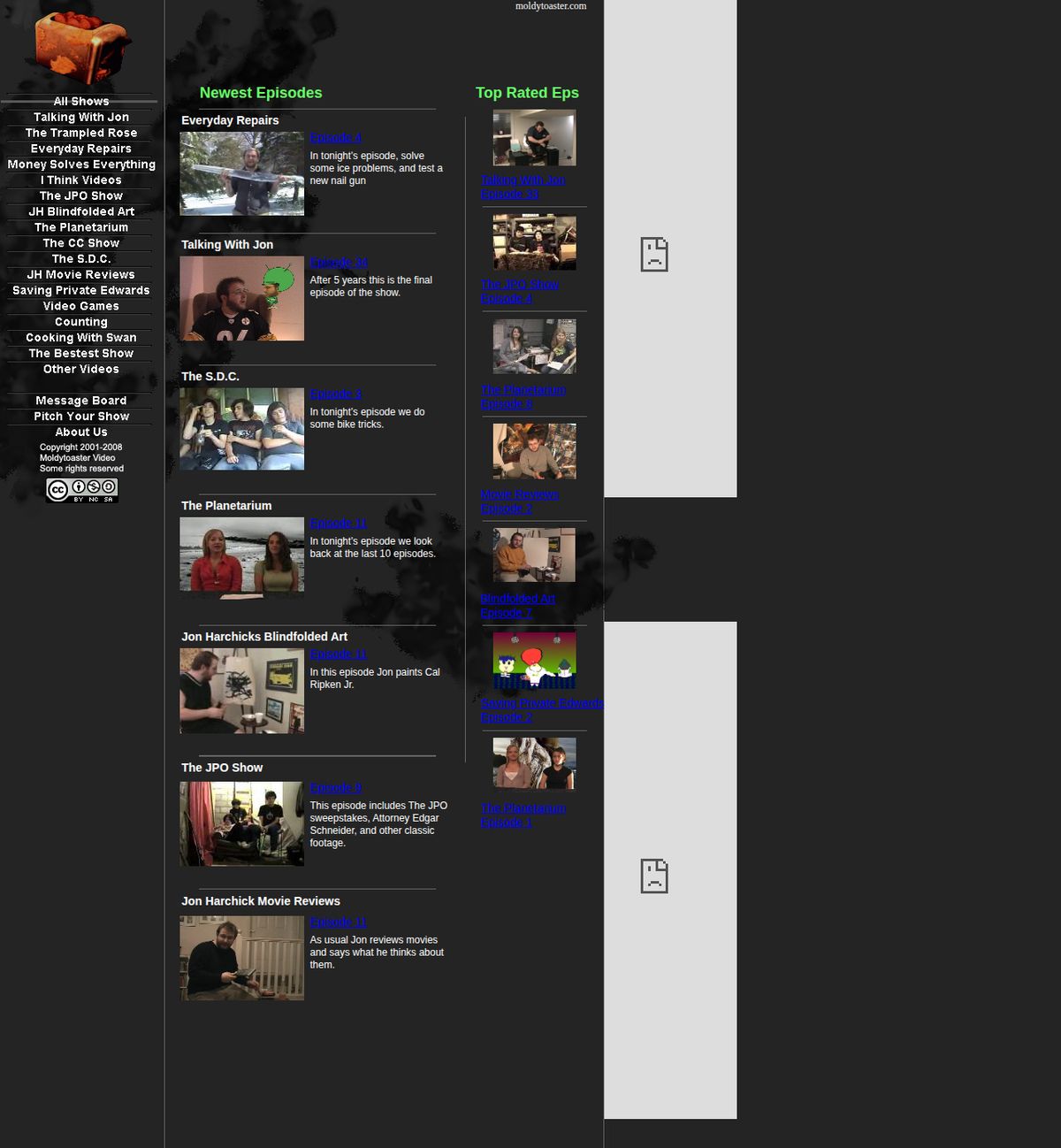
The portal had the full apparatus of a tiny network: advertising from the AdBrite ad network, a Sponsors page, a message board, and tidy episode folders for each show (Episodes/TWJ, Episodes/SDC, and so on). The Talking With Jon entry for the finale read simply: "After 5 years this is the final episode of the show." The flagship had signed off, and the brand carried on without it. That handoff, from show to brand, is the quiet hinge this whole book turns on.
The honest afterlife gets one paragraph, because the book does not hide the boring parts. The talkingwithjon.com domain lapsed: a 2020 capture shows it parked and serving unrelated text, and a 2023 capture shows a fitness blog by a different Jon. That is not his work, and the book will not present it as his. Domains lapse. The work is what survived.
The name on everything
It is worth pausing on what "Moldy Toaster Media" actually was, as a brand, because it was never a company in any formal sense. There were no employees, no office, no logo designed by an agency. It was a screen name that grew into a production banner by sheer repetition. Jonathan put it on the forum posts, on the hit counter, on the website, on the watermarks, and finally on the channel, and each placement made it more real. By the time the MoldytoasterMedia channel existed, the name carried a decade of accumulated meaning: if you saw it in the corner of a video, you knew whose hands had made the thing, and roughly what kind of thing it would be. Homemade, serialized, a little obsessive, funny in a way that assumed you were in on it.
That is why the name mattered when the channel died. Losing MoldytoasterMedia was not like losing a username. It was like losing the sign over the shop. The shop itself, the videos, mostly survived, because he had the masters and the habit of keeping everything. But the sign, the thing that told a stranger stumbling onto episode 29 that there were 28 more where that came from, was gone. The re-uploads gave the shows new rooms. They could not give them the old sign back. This book is, among other things, an attempt to put the sign back up.
The banner that tied it together
For the YouTube years, Moldy Toaster Media was the production banner over the work. The Jason & Pals episodes carry a TV-PG bug as part of the show's faux-broadcast joke, and the channel name on the upload said whose work it was. The channel lived at youtube.com/user/MoldytoasterMedia, and for years it was the archive of record for the early shows, the stunts, the experiments, the livestreams. If you wanted to see the whole shelf in one place, that was the place.
This is the part of the brand story that is hardest to show in a book, because the channel is gone. There are no screenshots of a living page to reproduce, only the title cards and credits burned into the surviving videos, and the re-uploads that carried the work to safety. That absence is the point of this chapter. A production banner is a promise that the work will be there when you come back. For MoldytoasterMedia, the promise was broken by someone else, and kept by Jonathan himself.
A frame from Jason & Pals showing the TV-PG bug in the corner, part of the show's faux-broadcast joke.
What happened: December 2021
Here is the story the way Jonathan tells it. During a livestream on the MoldytoasterMedia channel, someone cut to a video of a naked person. YouTube removed the whole channel afterward. He appealed, and YouTube did not restore it. In a later retelling, he added a detail: it was not a viewer getting naked on camera, but someone cutting to a video clip. That is his account, from his livestreams in 2022, and this book presents it as his account. No villain narrative, no conspiracy, just the facts as he gives them: a livestream, an interloper, a termination, a denied appeal.
The loss was real, and the chat logs from those 2022 streams show people mourning it in real time. A fan in the chat mourned the Talking With Jons that went down with the channel, quoting a line from the show's tsunami sketch in episode 29. Years of work, the archive of record for the shelf this book has been walking, gone in the way things go on the internet: not with a fire, but with a form letter.
Two things need saying plainly here, because the internet is full of wrong versions. First, the terminated channel was MoldytoasterMedia. It was not Let's Tape It. Let's Tape It is live and public, and this book will never suggest otherwise. Second, the termination is not the end of the story. It is the middle.
A restrained, non-sensational spread. A darkened channel page with the termination notice, dated December 2021, beside a simple timeline: the livestream, the removal, the appeal, the denial. No imagery of the incident itself, which was never Jonathan's content.
The re-uploads: the preservation story
What Jonathan did next is the reason several of the shows in this book can be watched at all. He re-uploaded them. All eight episodes of Everyday Repairs went up on the Tech Thursday channel on November 13, 2023. All three Jason & Pals episodes went up on the Let's Tape It channel in November 2023. The episodes survived with their title cards, their joke credits, and their flaws intact. He did not wait for a fan restoration project or a platform amnesty. He moved his own work to his own channels and kept going.
This is the honest framing the book promised at the start of the chapter: the termination is part of the preservation story. It is tempting to tell it as a tragedy, the platform killing the archive. It is more accurate, and more like Jonathan, to tell it as a salvage operation. The work mattered enough to him to move, piece by piece, to new rooms. Some of it made the trip. The shows on the shelf in Chapters 7 and 8 are the ones that did.
There is a coda worth adding, because it is still happening. The re-uploads were not a one-time rescue. The Everyday Repairs animation test, the Jason & Pals animated fourth episode, the ongoing study of the Shows archive folder by folder: the salvage operation turned into a practice. He is not just preserving the old work. He is still building on the same shelf, under new banners, with the same discipline that put an intro and an ending card on a show nobody was watching in 2005. The name on the spine changed. The hands making the shows did not.
And that is part of why this book exists. A coffee-table book is a strange, old-fashioned object to make about internet video: heavy, permanent, printed on paper, the opposite of a channel that can vanish with a form letter. But that is the point. The videos lived on borrowed ground, first on free hosting with bandwidth bills, then on a platform that could remove them. The book is a different kind of ground. It cannot be terminated. The shelf, in these pages, is finally on a shelf that will hold.
The closing spread. A bookshelf, photographed warmly, with handmade DVD-style cases for each show spine-labeled in the Moldytoaster style: Everyday Repairs, Jason & Pals, The Planetarium, The S.D.C., Video Games, Blindfolded Art, Movie Reviews. A small banner across the top reading "Moldy Toaster Media." The caption: the shelf, finally on a shelf that will hold.