
Most people who know Jonathan's work know the big projects: the counting video, the longest-video records, the thousands of water episodes. But before any of that, and alongside all of it, there was a shelf. Not a literal shelf, though if you visit his old websites you can still see the shape of it. It was a roster of shows, each with its own title card, its own intro, its own little world. He made a repair show, a stoner sketch comedy, a gaming rant series, a space documentary, a DVD review show, a blindfolded art show, and a handful of others whose names survive mostly as fond mysteries. Talking With Jon was the flagship, the one that ran for five years and taught him everything. But he was never a one-show person. He was constantly experimenting with formats, the way a musician tries different instruments. This chapter is a walk along that shelf, one or two spreads per show, with a simple plain-language caption for each: what this was, when it was, and what it tells us. Two of the shows get only a brief hello here, because each gets a full case study in the next chapter. The rest get their moment now.
A collage-style spread of show title cards from the Moldytoaster Video portal era, arranged like DVD box art on a wooden shelf. Everyday Repairs hand-drawn intro lettering, the S.D.C. green banner, the Planetarium starfield title, the Blindfolded Art chrome letters, the Video Games rant title, each in its own frame, slightly uneven, homemade.
The two you'll meet in depth
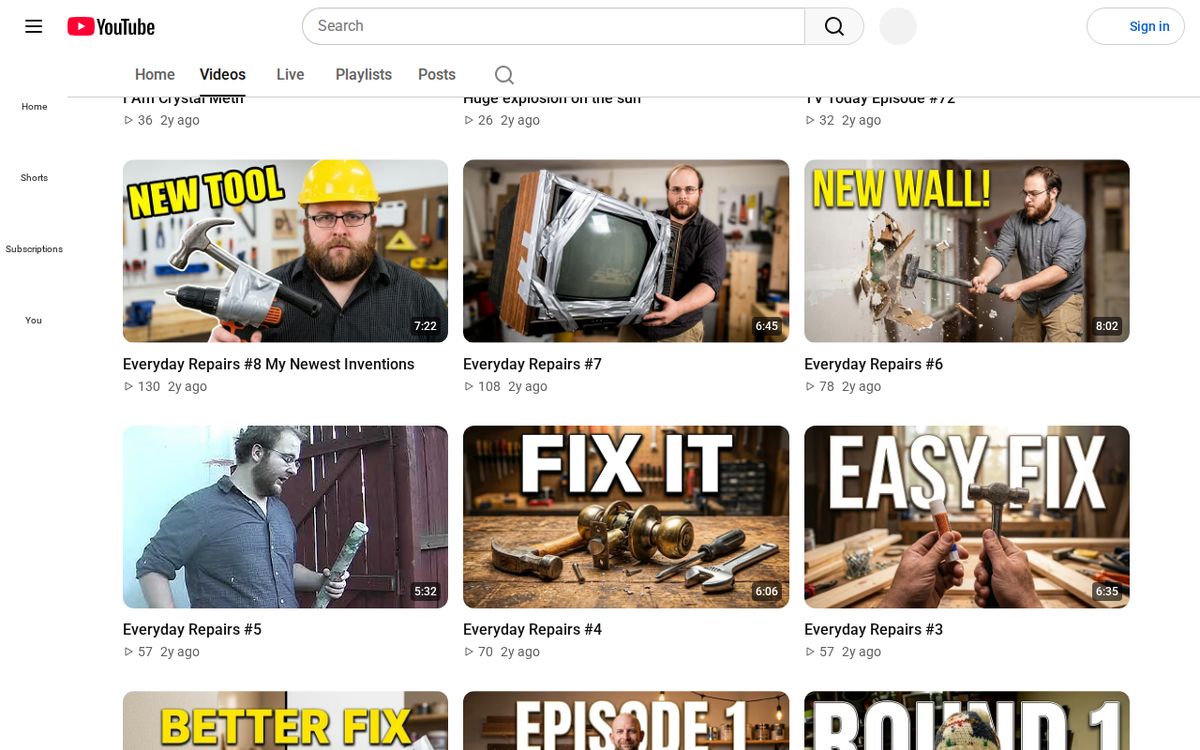
Before we tour the shelf, a note on the two shows that anchor it. Everyday Repairs was Jonathan's repair show: eight episodes made between 2011 and 2013, in which a deeply overconfident handyman demonstrates absurd and dangerous home repairs in the flat, earnest voice of a real how-to program. It was a repair show years before repair content had a name on YouTube. Jason & Pals was something else entirely: a live-action stoner sketch comedy from about 2012, three episodes, a gang of friends playing themselves-as-characters through fake local-TV ads, dream endings, and escalating gags about milk. Both shows lived on the MoldytoasterMedia channel, both went down with it in December 2021, and both survived because Jonathan re-uploaded them elsewhere: Everyday Repairs to the Tech Thursday channel on November 13, 2023, and Jason & Pals to the Let's Tape It channel in November 2023. They are the two directions his work kept pulling, practical how-to formats in one hand and ensemble comedy in the other, so each gets a full case study in Chapter 8. Here, they get a wave as we pass.
Video Games: the rant series (2006 to 2017)
The "Video Games" folder in Jonathan's archive is really a series with a simpler name: "The X Sucks." Across roughly a decade, he and at least one friend sat down in front of the camera and declared, with deliberate overstatement and total commitment, that a piece of gaming hardware was garbage. The titles tell the story of a decade of consoles: "The DS Sucks," "The PSP Sucks," "The Playstation 3 Sucks," "The Nintendo Wii Sucks," "The XBox 360 Sucks," "The Wii U Sucks," "The Xbox One Sucks," "The Nintendo Switch Sucks," plus side entries like "PC Gaming Sucks" and "iPods Suck." Each video follows the same fixed bit: introduce the product, declare "it's a fact," cite absurd evidence ("look it up in the dictionary, look under suck"), and close having proved nothing. The catchphrases repeat across episodes like a ritual: "it's a fact, folks," "check the facts," "look it up on the internet."
What makes the series worth more than a joke is its span. A throwaway line in "The DS Sucks" dates it: the Game Boy has been around since 1987, the ranter says, "it's a 19-year-old system," which pins that entry to 2006. The Switch entry lands in 2017. So this is an eleven-year run of the same joke, told about every console generation that passed through Jonathan's life. Underneath the comedy, it is his first catchphrase system and his first truly serial format: one product, one rant, one verdict, repeated until it becomes a tradition. The opinion-rant shows he would make later grew directly out of this soil.
A split frame showing two eras of the rant series. Left: the 2006-era bedroom setup from "The DS Sucks," two young men to camera, low-resolution. Right: a later HD rant from the Switch era. Between them, big text reading "IT'S A FACT, FOLKS."
The Planetarium: the space documentary (2006-2008 era)
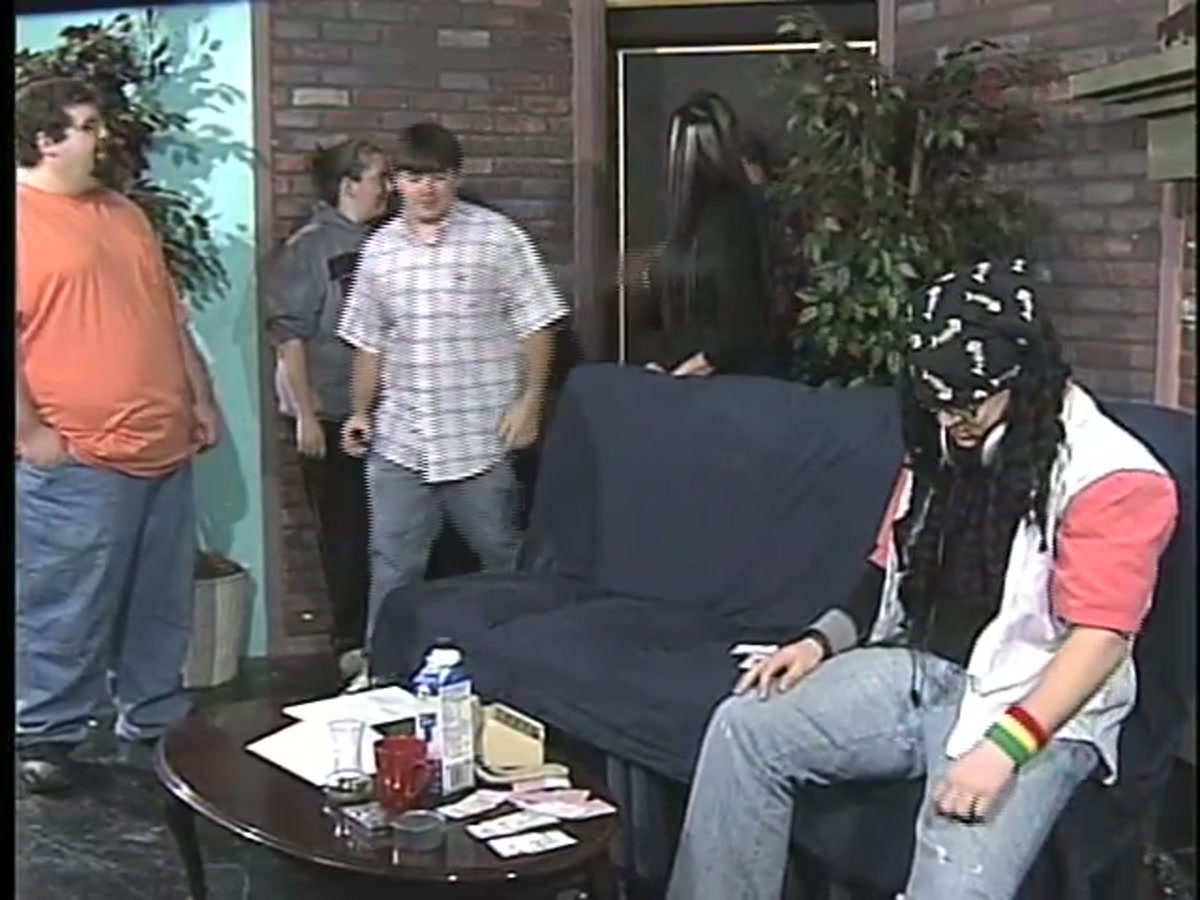
"The Planetarium" is the most produced-feeling of the early shows, and it is also the one Jonathan seems least likely to have made, which is exactly why it belongs on the shelf. It is an eleven-episode space documentary series hosted by two young women who go by the space-named pseudonyms Luna and Venus. Each episode is a countdown of space phenomena, presented like a school science-magazine show: the hosts at a desk in front of a greenscreen starfield, a big caption naming each item, a narrator reading entries over simple graphics. The sign-off became a ritual: "Signing off for the universe, I'm Luna. And I'm Venus."
The archive keeps the full season with unusual care: every episode survives as a DV-tape master (over a gigabyte each) alongside a smaller web encode, plus a dedicated intro and a three-minute reel of episode 4 outtakes showing the hosts cracking up through flubbed takes in front of a blue backdrop. The scripts read like adapted science articles: brown dwarfs, neutron stars ("the walking corpses of the cosmos"), cosmic rays, lunar dust, the sun's hot corona. Nobody in Jonathan's notes mentions Luna and Venus anywhere else, so they were probably classmates or early collaborators, now preserved in amber. The show is pure early evidence of his documentary instinct, the same one that later surfaced in his fact-driven series, and the catchphrase sign-off is an early example of his signature move: give the show a closer, a little branding ritual, right from the start.
The Planetarium desk setup, Luna and Venus at the desk in front of the greenscreen starfield, a big caption reading "BROWN DWARFS!" on screen. Warm, homemade, earnest.
The S.D.C.: the banner show (the Talking With Jon era, 2002-2007)
If The Planetarium is the most produced of the early shows, The S.D.C. is the least, and it is just as revealing. Two teenage hosts sit in front of a hand-painted green banner reading "S.D.C." and ramble: smoking paraphernalia, video games, bike wheelies, a Sega Genesis of unknown origin, and whatever else wanders through. The show's one piece of paperwork is a winking disclaimer card: "No illegal substances were used during the taping of the show. We do not recommend you use marijuana, it is against the law in most areas." The acronym's exact meaning is never clearly spelled out on camera. It plays like an inside joke between friends, because that is what it was.
The show sits squarely in the Talking With Jon umbrella years: both the intro and ending cards read "See more at www.talkingwithjon.com," and the archive keeps the same versioning habit seen across his work, a DV master plus web encodes plus an "under 100mb" cut of episode 1. Episode 2 is five minutes of the host mugging with the Sega Genesis "for no reason," riffing on PVC piping and ending by chanting "Let's make a jump" into the camera. The S.D.C. is the comedy lineage that leads to Jason & Pals: teen friends, a camera, no adults, jokes about smoking gear. The long endurance videos he makes now are solitary, but he learned the camera as a group toy first, in a basement, in front of a hand-painted banner.
The two S.D.C. hosts at the green banner desk, one holding the Sega Genesis up for the camera, both mugging. The disclaimer card shown as an inset.
JH Blindfolded Art: the constraint show (the Talking With Jon era, 2002-2007)
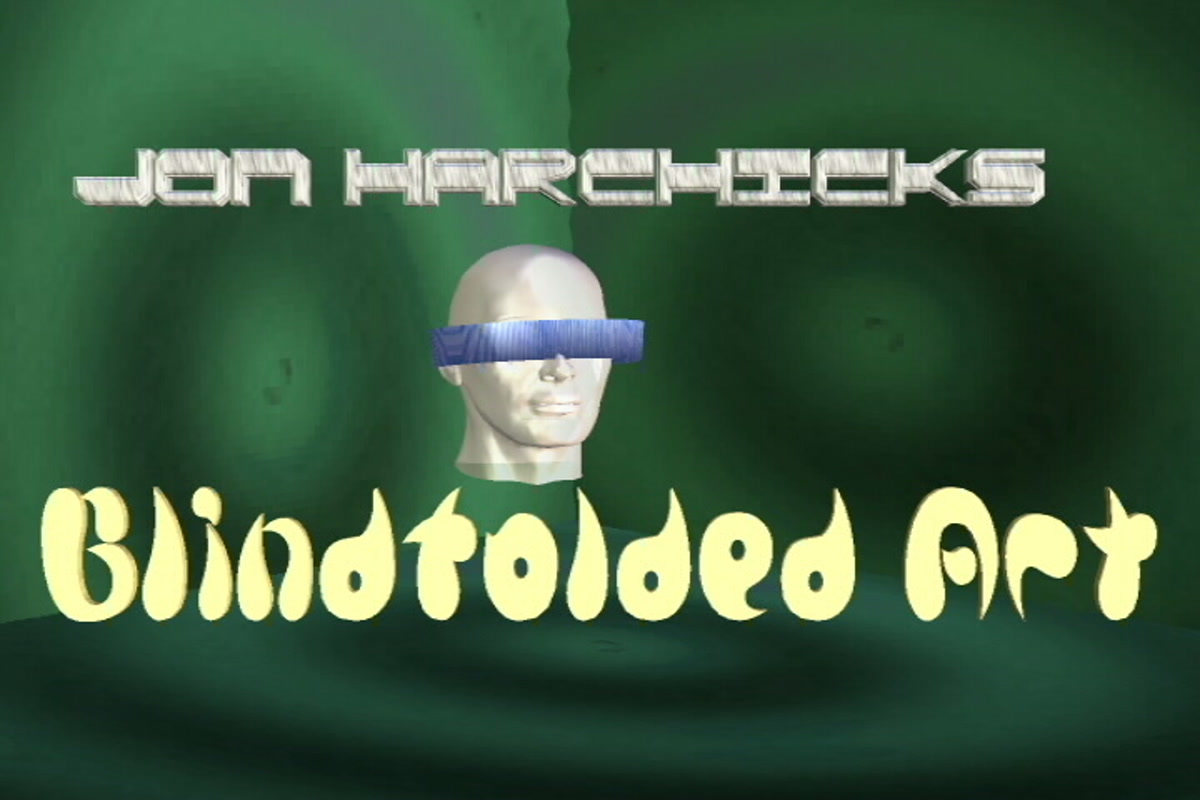
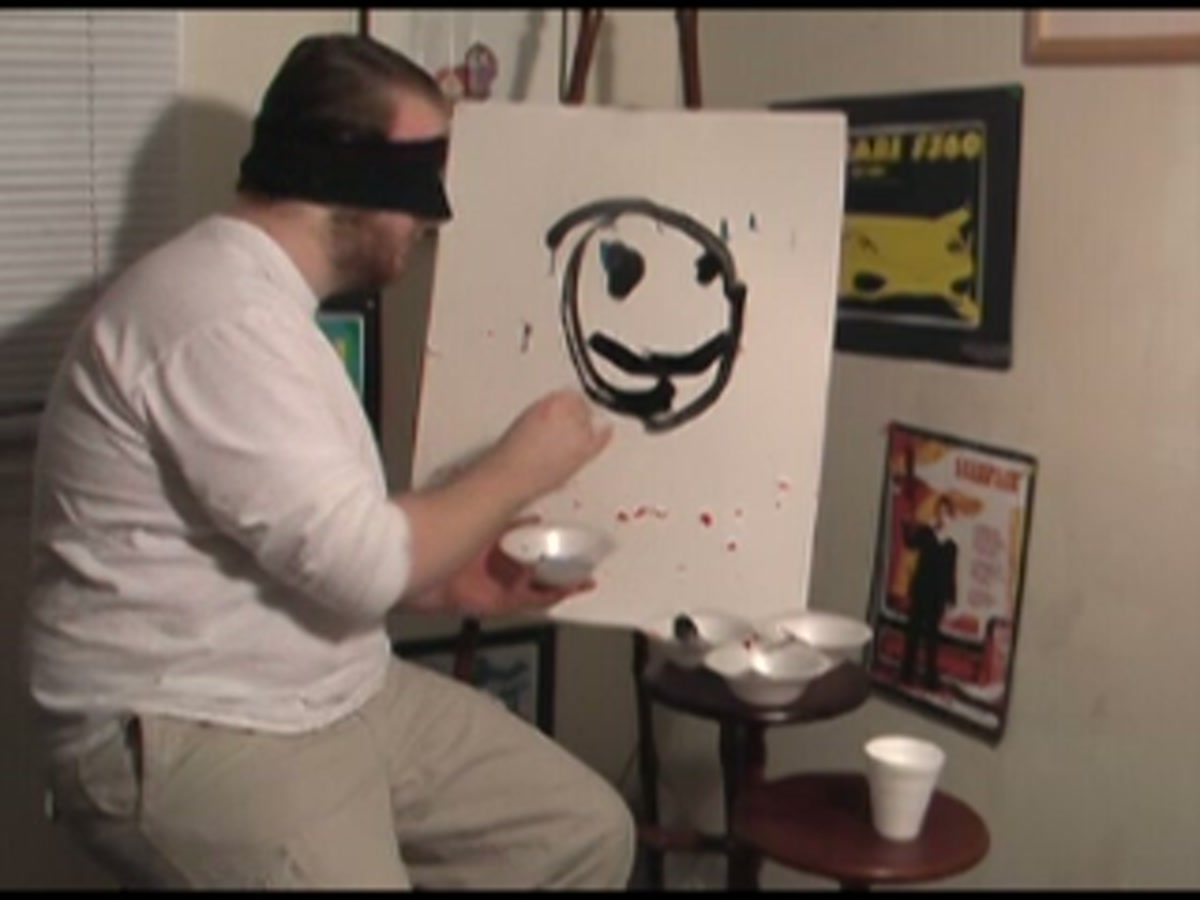
Twelve episodes. One rule: Jonathan makes art while blindfolded, and the camera watches the results. The title card is a small masterpiece of the era: "JON HARCHICK'S" in chrome 3D letters over a green backdrop, then a blindfolded classical head statue with "Blindfolded Art" in big yellow rounded letters. The archive keeps a 22-gigabyte master of all twelve episodes, a blank intro template, and an ending card reading "See more at www.talkingwithjon.com," the same packaging discipline that runs through the whole shelf.
The premise writes itself, and it fits his whole catalog: take one simple constraint and repeat it until repetition does the entertaining. Blindfolded art is Jon Drinks Water with paint instead of water. There is also a deeper layer that only lands once you know Jonathan's story: he is legally blind from a retinal condition, and as a kid he made a show about voluntarily giving up his sight to make art. He was playing with blindness as a concept years before it defined his daily life. That is worth knowing, not as a punchline, but as a window into how long he has been turning his own circumstances into material.
JH Movie Reviews: the collector's show (late 2000s)
Jonathan's DVD review show is exactly what the name says: he sits in front of his DVD shelves, holds up each disc's case to the camera, and reviews both the movie and the DVD release itself, the transfer, the packaging, the booklets, the bonus features, even whether the NTSC disc will play on a European PAL television. Every review closes with a star rating. It is as much a collector's show as a critic's show: he docks a Spielberg Collector's Edition for reusing cover art in the booklet, and he has reviewed editions of movies he cheerfully admits he has not watched.
The episodes are long, forty to fifty minutes of unhurried opinions, and they are full of small cameos of the habits that would define his later work. "Mini water as our drink" gets a shout-out in one episode, a tiny early appearance of the water habit that became Jon Drinks Water. He notes he is going "a little faster than normal because we eat a lot tonight," and there it is, the eating-on-camera habit already forming. His on-camera name here is spelled "John Harchik," no S, a small sign of a young creator still deciding what to call himself, years before he settled into the identity the directional channels would give him.
Jonathan in front of the DVD shelves, holding a disc case up to the camera, mid-review, with a hand-drawn star rating graphic (three and a half stars) overlaid.
Money Solves Everything: the one we know from a caption
Some shows on the shelf survive only as a line in an old webpage. "Money Solves Everything" appears in the 2009 capture of the Moldytoaster portal with this description: "In the premiere episode we show you how to save money and get ready for your retirement." The archive holds a folder of about three gigabytes for it. That is all we know, and the book will not pretend otherwise. But the title alone tells you something about the era: a young man in his early twenties, making a show with the most optimistic title on the shelf, about the least funny subject in the world. It belongs here as a reminder that the shelf has corners we have not fully explored yet.
A recreation-style frame: the 2009 portal page listing "Money Solves Everything" with its one-line description, rendered like an old webpage on an old monitor. Caption notes this is an illustration, not the original page.
Tech Thursday: the channel that became a lifeboat
Tech Thursday needs an honest caption. It is one of Jonathan's four directional channels, the "Up" to Jon Drinks Water's "Left," Let's Tape It "Down," and Jon Eats Carrots "Right." As a show in its own right, the archive study has not yet cataloged its contents, so this book will not invent a description of episodes that have not been verified. What is documented is its second life: on November 13, 2023, all eight episodes of Everyday Repairs were re-uploaded to the Tech Thursday channel (@techthursday9277), giving the repair show a home after the MoldytoasterMedia channel was terminated. A channel became a lifeboat. That is worth saying plainly, because it is the pattern of this whole era: the work outlived the platform it was made for, and Jonathan found it new rooms.
The names on the pending shelf: watchmofo, Copy Cat, and the rest
Every archive has a drawer labeled "later." In Jonathan's Shows folder, two names sit in that drawer: watchmofo and Copy Cat. They exist as folder names and not much else yet; the study pass has not reached them, and this book will not guess what they were. They are here because an honest shelf includes the unopened boxes, and because their names alone tell you something about the era they come from, the anything-goes naming of early-2000s internet video, when a show's title was a dare.
They are not alone. The 2007 portal roster included The JPO Show and The CC Show as full shows, with pages prepared for The Bestest Show, Cooking With Swan, Counting, Video Games, and Saving Private Edwards. Some of those pages may have become shows; some may have stayed aspirations. "Counting" is a suggestive one, given what came later. The point of listing them is not to catalog what we cannot verify. It is to show the scale of the experimenting. At any given moment in those years, Jonathan had several shows running, several more planned, and no particular worry about whether any of them would find an audience. He was not building a brand yet. He was filling a shelf, because the shelf was there and he had a camera.
A dim archive drawer or folder view labeled with the pending names, watchmofo, Copy Cat, The JPO Show, The CC Show, half in shadow. A caption that reads, in effect: these are real, and they are still being studied.
What the shelf tells us
Step back from the individual shows and a pattern appears. Jonathan was never really a YouTuber in the modern sense, a person who finds one format and optimizes it. He was a showrunner without a network, inventing formats the way other people doodle: a repair show, a rant show, a space show, an art show, a review show, a stoner talk show, a sketch comedy. Some ran for years. Some ran for weeks. Some may never have gotten past a title card and a folder name.
Two things carried across all of them. First, the packaging discipline: every show gets an intro, an ending card, a title, a closer, a ritual. He was doing branding before he had anything to brand. Second, the serial instinct: pick a premise, repeat it, let repetition do the work. The one-off was never his unit of thought. The series was.
The shelf also explains something about the later, bigger projects. When people encounter the thousands of Jon Drinks Water episodes, they sometimes wonder how anyone sustains a single idea that long. The shelf is the answer. He had been sustaining ideas for years before the water videos, just smaller ones, on a hand-built website, for an audience he mostly had to find himself. The water series was not a new discipline. It was the old discipline, finally pointed at one thing.
A wide pullback of the whole shelf, all the title cards together, with the Moldytoaster Video portal banner across the top, like the end of a tour.