Sometime after the first two episodes, the camera changed, and with it, everything else.
The family's FireWire DV camera arrived, and Talking With Jon entered its second phase. FireWire was simply the cable that moved video from the camera to the computer, a fast connection by the standards of the early 2000s, the bridge between shooting something and editing it. In Jonathan's house, that bridge kept collapsing. The transfers failed constantly. Footage corrupted. Clips that had been fine on the camera came through the cable broken, glitched, or gone entirely. Every artifact in the episodes from this era, every frozen frame and digital hiccup, is evidence of a kid fighting his tools and refusing to stop. He did not have better equipment. He had the family camera, a flaky cable, and the same determination that had turned a video test into a show.
The show he was making with that camera was no longer really a talk show. By 2003, Talking With Jon had become a variety hour, a container for everything he made: fake commercials, recurring characters, songs, clip compilations, parodies, stunts, contests. The monologue-and-guests format was still in there somewhere, but the show had outgrown it, the way a bookshelf outgrows the first row of books. Whatever he made went on Talking With Jon. The show had no genre because Jonathan had no single genre.
The Hartchick Society grew up, too. In episode three, Jonathan opened by announcing that the show had a new background, and he explained the upgrade the way the show explained everything: the sponsors had paid for it. His imaginary patrons were now funding his production design. It was a joke about money he did not have, and it was also the show documenting its own making, which became one of its most modern qualities. He would keep narrating his own upgrades on the air for the rest of the series, turning real production growth into fiction. The black backdrop of the third episode gave way to a blue one by episode six, and each time he told the audience about it, as if a network executive were briefing the press. The sponsors were pretend. The progress was real.
The show even started declaring its own eras. Episode four opened with an announcement: this was the second season. Nobody at a network had approved a second season. There was no network. But Jonathan understood something that took most creators years to learn, that a show with seasons is a show with a future, and saying the words out loud made them true. Later episodes would get title cards marking the year, golden film-reel graphics announcing that the series had entered its second year, as if Talking With Jon were a long-running broadcast institution rather than a teenager's bedroom project. It was both. The fiction of the institution and the reality of the teenager were the same thing, and the season declarations were the show telling itself, on the air, that it was going to last.
Talking With Jon 18 / Year 2" title card with golden film-reel graphic, the show declaring its own eras.
Nowhere was the variety identity clearer than in the fake commercials, which went from one-off gags to a full serialized campaign. The centerpiece was Dave Braslowski, a self-described representative of Sony, played by Jonathan in full pitchman mode. The first ad had Dave introducing himself and selling the PlayStation 3, which he claimed ran many thousands of times faster than the PlayStation 2, an absurd number delivered with total corporate sincerity. He always closed by asking viewers to mention his name to Sony, as if the company had any idea who he was. One fake ad is a sketch. But Jonathan did not stop at one. A few minutes later Dave was back, this time selling the PlayStation 4, and the pitch had curdled: the PlayStation 3, the very console he had just praised, was now a terrible machine that nobody should ever buy. Then came the PlayStation 5 ad, which trashed both of its predecessors. The same shameless pitchman, believing every new thing completely, disowning every old thing completely. The real target was never Sony. It was the upgrade treadmill itself, the way every new product arrives with a man in a suit telling you the last one was garbage. Dave had no shame, and that was the whole joke, and it kept getting funnier because Jonathan understood that a pitchman who believes his own pitch is a character you can bring back forever.
The commercials around Dave were just as handmade. In episode four, a pizza with a face begged for its life on camera, pleading with a hungry customer named Aaron not to eat it, introducing itself as Bob and insisting, with a straight face, that it was a talking pizza. Another spot featured a guest pitcher named Martin Hart-Jeeck hawking a fake product called Captain John with full infomercial energy, combining, as he put it, the power of the product's own name. These were not polished parodies. They were a kid in his house doing the grammar of television advertising from memory, and the grammar was perfect: the breathless claims, the satisfied customer, the product name repeated until it stuck. He was teaching himself commercials by making them.
The genre parodies worked the same way, one television format at a time. Episode three toured the Hartchick retirement home, a facility Jonathan claimed to run, introducing an elderly resident named Mr. Joe McDuffie and wandering the halls with the brisk confidence of a man giving a promotional tour of an institution that did not exist. The same episode staged a dating-show parody, complete with three handsome young bachelors who lifted weights and did karate, and one of them, a contestant named Rick Hill, proved his credentials by lifting an eighty-pound weight on camera. Another guest appeared with a paper bag over his head and oversized paw gloves on his hands, interviewed as if this were a perfectly normal booking. The joke in every case was the format played straight around people and premises no real show would book, and the straight face never cracked.
The characters multiplied just as fast. Captain Hunt arrived in a parody of the police show Cops, complete with the show's famous disclaimer rewritten into something looser, stalking a suspect through the woods with deadpan law-enforcement seriousness. An old man with a cane shuffled through episodes, one of the easiest costumes to assemble (a coat, a hunch, a cane) and one of the most reusable, and he would keep coming back, growing into the show's lore. In the Christmas episode, the show's narrative ambition took a leap with a full mockumentary, the supposed true story of a man named Carl Schmicks, a poor criminal from Idaho who claimed to have made about thirty thousand dollars before being abducted by aliens who forced him to make a talk show full of subliminal messages. It ended with a deadpan warning to the audience: keep watching, and the rabbits would take over the world. It was the most ambitious story the show had attempted, a little movie with a beginning, a middle, and an apocalypse, and it premiered inside Talking With Jon because that was where everything premiered.
In the kitchen, a chef named Rick hosted a cooking segment built on a single principle: the food had to be disgusting. He mixed every spice in the house with coconut cream, trail mix, and soda, admired his moldy ingredients on camera, declared the results beautiful, and forced a guest to take three bites. The comedy was in the cooking-show format played completely straight around ingredients no cooking show would touch, and in Rick's pride, which never wavered. The wrongness was the point. A bottle of Tabasco stood in for the drugs in a Grand Theft Auto mission parody, because the wrong prop is funnier than the right one and it was what happened to be in the kitchen. Resourcefulness was a comedy engine: whatever was in the house became whatever the sketch needed.
Dave Braslowski in pitchman mode, mid-escalation, selling a console with total corporate sincerity.
The segments stacked up alongside the characters. There was the stunt-clip roundup that started under a rough title and settled, by episode six, into "Stupid things done by stupid people," a franchise in the making. There was the bumper-sticker segment, where Jonathan read real funny bumper stickers off a board he held up to the camera, curating found comedy from the actual world. There was the face-morph machine, a tech gimmick with a personal twist: he fed in photographs of his real teachers, his seventh-grade math teacher, the family consumer science teacher, the librarian, the Latin teacher, the gym teacher, and showed what their children would look like if they had kids together. It was the show at its most mischievous, using the people from his actual school day as raw material, and it worked because the morphs were just plausible enough to be funny. There were man-on-the-street bits, where the crew went out and let random people say whatever they wanted, taking the show out of the bedroom for the first time. Episodes closed on music videos. And the outtakes, the bloopers and flubbed lines, became a standard way to end an episode, which tells you something important: he was showing the seams on purpose. The making of the show was part of the show.
By episode six, the show had earned its first holiday special. The Christmas episode opened with a crooned holiday standard, and Jonathan took a moment, in his hosting voice, to walk the audience through the production situation: same background as the third episode, new camera, the upgrades narrated like a tour. Song parodies and character bits filled the middle, the stunt-clip roundup returned under its settled title, and the whole thing had the loose, celebratory feeling of a show that knew it had survived long enough to have traditions. Seasonal episodes are event television, the thing a real network does when it wants the audience to feel like part of a family, and Jonathan was doing it in his house, at fifteen, with a blue backdrop and a camera that corrupted his footage. The family feeling was real anyway. That was the trick the whole series kept pulling off.
By episode five, the audience stopped being hypothetical. Jonathan announced the show's first-ever viewer contest: guess which clip would open the next episode. The prize structure was pure Talking With Jon. If you picked correctly, he explained, you would win nothing, because it was the first contest and there was nothing to win yet. A second contest followed: watch the music videos, rank them from best to worst, and the winner would get a terrific prize. The show now assumed an audience that wrote back. A website went up, and viewers could vote and enter there. A few years later he would hold votes on that site for the show's own band, letting the audience pick the musicians. He was fifteen and sixteen years old, running audience participation mechanics that real television networks used, with a fraction of a fraction of their resources.
And he went looking for that audience himself. In April 2005, at sixteen, posting under the name Moldytoaster, he put an episode of Talking With Jon up on PbNation, a paintball forum, in the buy/sell/trade section. The forum regulars flamed him as a spammer and told him to get lost. He argued back, politely but with good humor, roasting them right back while insisting he just wanted to post his video and see what people thought. It is a small story, but it is the whole hustle in miniature: a teenager manufacturing his own public, taking the hit, staying funny, and not backing down. He was not making these episodes for a drawer. He burned discs and handed them to people, because YouTube did not exist yet and discs were the distribution network. He wanted to be seen, and he went and found the seeing.
Fake-ad gag card, the show's commercial-parody instinct in typographic form.
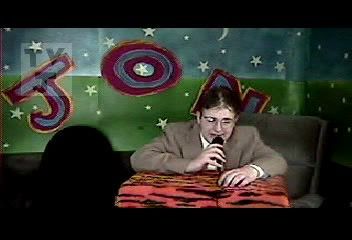
The craft kept climbing, and he kept telling the audience about it. In the fall of 2003, the set reached its most famous form: a wall covered in dozens of hand-lettered JON signs, taped up in a grid, with a Talking With Jon banner and a small television that he called his plasma screen TV thing, the monitor where he showed his clips. He lowered it into frame on camera, mid-episode, so the audience could watch the upgrade happen. He started wearing a blazer to host, the closest thing the show had to a uniform, the visual signal that this was a professional broadcast even though it was a teenager in his house. The handmade universe was getting more elaborate, but it never stopped being handmade. Paper signs, tape, a coat from the closet: the cheapness was the aesthetic, and the confidence was what made it work.
The meta-production comedy matured with the craft. The sponsors kept funding the backdrops, a fiction everyone was in on. The old man with the cane got into a staged backstage fight with the technical people, and the show's verdict was delivered flatly: they had fired the sound guy. It was a joke about a crew that did not exist, which made it a joke about the show's own ambition, which made it the most honest kind of joke. And when a segment ran its course, Jonathan canceled it himself, on the air, in front of everyone. "That was the last ever stupid things done by stupid people." Only someone fully in charge can retire their own hit live, and he did it without sentimentality. The show edited itself. Nothing was sacred, including the bits the audience liked best.
Host in blazer at the desk before the painted starry "JON" backdrop, the definitive talk-show framing.
Look at what he was learning, discipline by discipline, and the variety explosion starts to look like a curriculum. Hosting. Interviewing. Characters. Commercials. Music. Editing. Set design. Audience participation. Distribution. He was running a one-man network and teaching himself every job in the building, one episode at a time. A few years later he would go to Robert Morris University to study TV production, and he would arrive having already run a show for five years. Talking With Jon was the self-directed prerequisite, the film school he built in his bedroom and basement and backyard before he ever set foot in a classroom.
The tools stayed humble the whole way. The FireWire transfers kept failing. The footage kept corrupting. The audio stayed rough, room echo and inconsistent levels baked into every episode, music beds swallowing dialogue. He was pushing consumer software past its limits and losing fights with a cable. None of it stopped him. Each episode taught him something, and the next episode spent it. The test had become a habit, the habit had become a show, and the show had become a variety hour with fake sponsors, a pitchman named Dave, a talking pizza, a chef who cooked with mold, a mockumentary about alien abduction, viewer contests, a website, a band, and a blazer.
The snowball was not rolling anymore. It was an avalanche, and it was heading straight for the craft years, when the kid who had taught himself television in his bedroom would start acting like he owned the place. Because by then, in every way that mattered, he did.
What was coming next was the part of the education no camera could teach. The contests would get bigger. The website would become a real hub, with votes and entries and a band chosen by the audience. He would write his first proper monologue, stand up in front of the camera with election jokes, and admit on the air when the jokes bombed, because honesty was always funnier than pretending. The sets would keep evolving, the characters would keep compounding, and the show would keep documenting its own making, season after season, until the kid who had started it all decided, deliberately and on purpose, that it was time to end it. But that is the next chapter's story. This one ends the way the era felt: loud, crowded, handmade, and just getting started.