
Against the backdrop of the last chapter, here is what one teenager actually did. Not a famous creator. Not a movement. Just Jonathan Harchick, of Pittsburgh, running a show called Talking With Jon from his bedroom, ages 13 to 18, and solving every distribution problem the era put in front of him, by hand, in the order the era presented them.
First, the discs
For the first couple of years, 2002 to 2004, the show traveled the way video traveled when there was no other way: on burned discs, handed directly to people. He has said he used to burn DVDs and hand them to friends. Episode 1 opens like a show made for a living room audience, because that is what it was. You made the thing, you burned it, you gave it to somebody, and maybe you sat there while they watched.
This sounds quaint now, but think about what it meant. Every copy cost a blank disc and a trip to somebody's house. There was no link to share, no view count, no analytics. The audience was whoever he handed a disc to: friends from school, family, whoever was around. And still he kept making them. The archive proves it: all 34 episodes survive in original quality, 41 files totaling about 27 gigabytes, including full-quality DV masters of the later episodes. That survival is remarkable on its own. In an era when most amateur video lived on fragile personal sites and vanished when the hosting lapsed, he kept everything for two decades.
Then, the website
By year three, around 2004-2005, with broadband spreading and the show established, he put Talking With Jon on the internet on his own terms. The site was talkingwithjon.com, and thanks to the Wayback Machine, we can walk through its whole life, era by era, like flipping through a photo album.
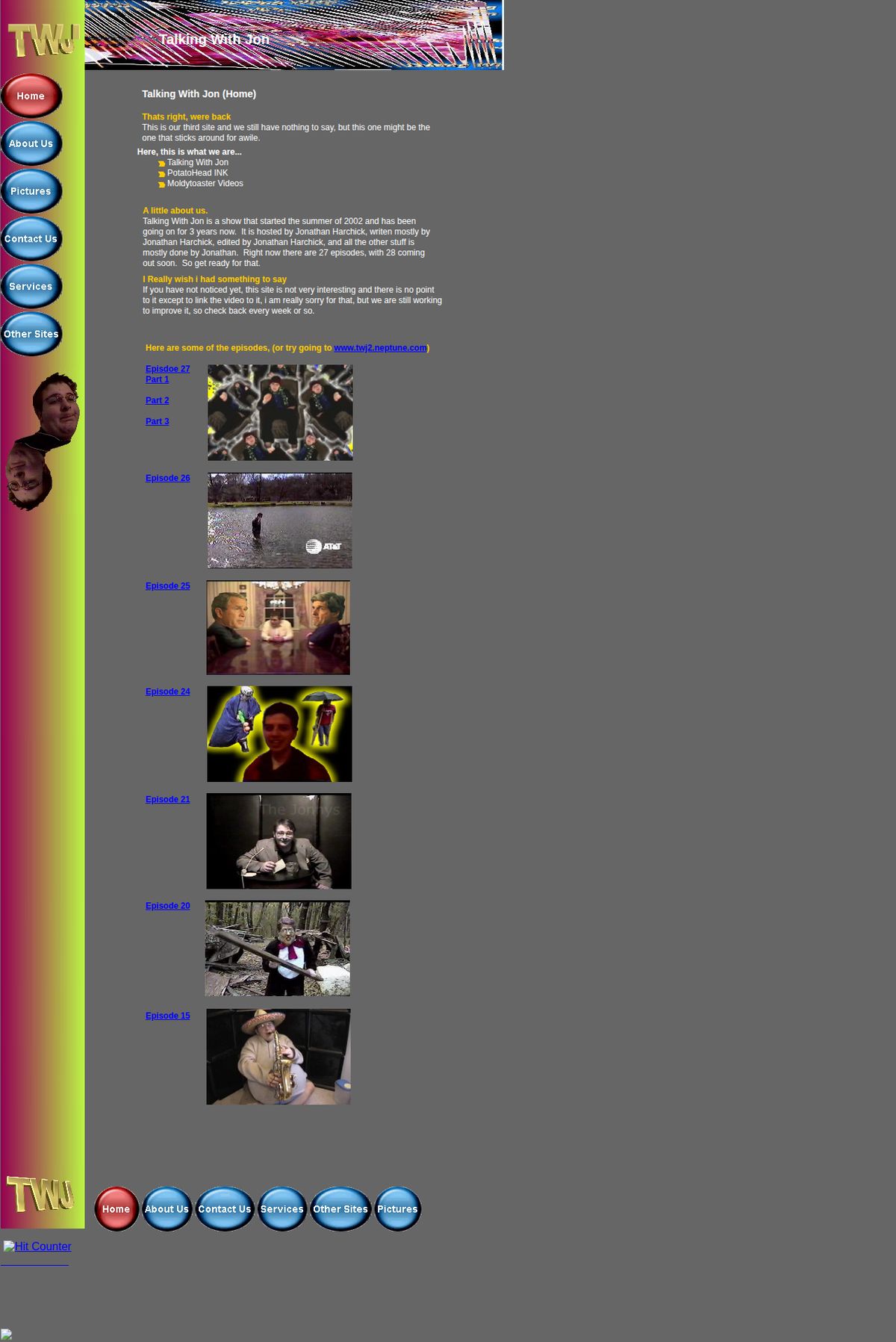
The earliest surviving capture is March 17, 2005. It is a plain, hand-built page, and it reads like a teenager talking directly to you. The top line is worth preserving exactly as he wrote it, spelling and all: "Thats right, were back. This is our third site and we still have nothing to say, but this one might be the one that sticks around for a while." This was already the third attempt at a website, and he expected it might not last either. The about text says the show "started the summer of 2002 and has been going on for 3 years now," and the credits are a small masterpiece of one-person production: the show is "hosted by Jonathan Harchick, writen mostly by Jonathan Harchick, edited by Jonathan Harchick, and all the other stuff is mostly done by Jonathan." Twenty-seven episodes were up. Number 28 was "coming out soon."
The practical details on that page are a perfect specimen of 2005 DIY video distribution. The site lived on free web hosting from a company called Neptune. The episode files were Windows Media downloads, offered in three parts for the big ones, with a mirror address for good measure. The navigation was simple hand-made pages: Home, About Us, Contact Us, Other Sites, Pictures, Services. A free hit counter tracked visitors under the site name "moldytoaster," a sign the two brands were already linked in his head. Note the timing, because it matters for what comes next: this capture is one month before the story this chapter is really about.
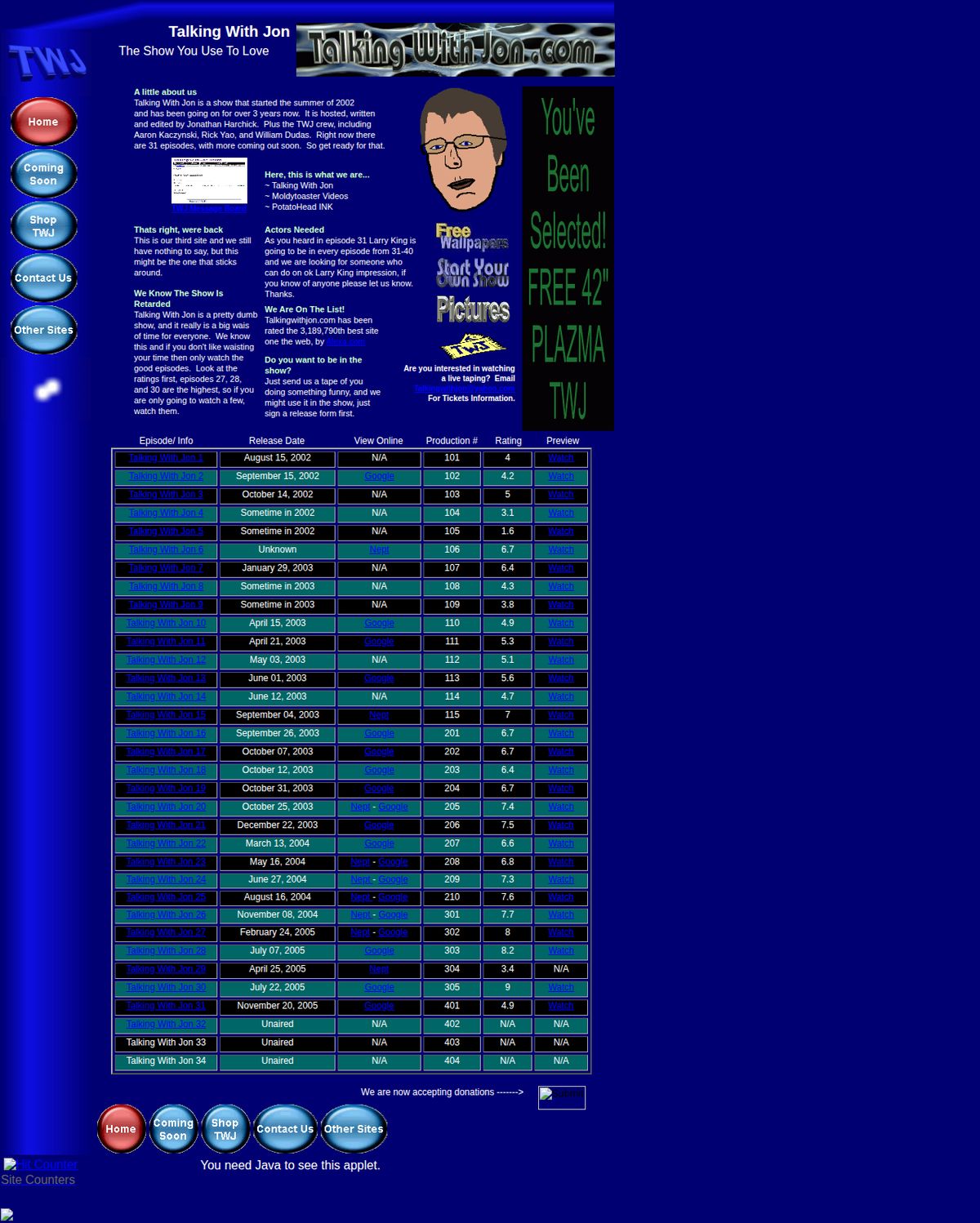
By December 2005, the site had been redesigned into something much more ambitious. The episode count was up to 31, and for the first time there was a real episode table: every episode with its release date, a production number, a viewer rating out of 10, a "View Online" column, and a preview link. The view options tell the distribution story in miniature: "N/A" for not online, "Google" for episodes uploaded to Google Video, and "Nept" for downloads from the Neptune mirror. He was hedging across the new platforms and his own hosting at the same time, exactly the multi-format instinct the last chapter described.
A crew was credited for the first time: Aaron Kaczynski, Rick Yao, and William Dudas, alongside Jonathan. A message board was open. The site even bragged about its web ranking, worn like a badge of honor: the 3,189,790th best site on the web, according to Alexa, the era's rough popularity score. And the audience-participation system was in full swing. Viewers could send in a tape of themselves doing something funny for a chance to appear on the show, with a release form to sign first. Tickets to a live taping were offered by email. A casting call ran on air and on the site, looking for someone who could do an okay Larry King impression, because the storyline had Larry King appearing in every episode from 31 to 40. Contests had started back in episode 5, with viewers guessing which clip would open episode 6, and entries came in by contacting Jonathan directly. The Halloween special in year three ran the show's first monologue, with jokes about the 2004 election, and let the viewers vote on the show's band.
Stop and think about what that is. Polls. Contests. A message board. A casting call. A viewer-picked band. Every one of these is a feature YouTube would later build into its platform. He built them by hand, with poll scripts and an email address, because no platform provided them. He was doing audience participation before the platforms built it in.
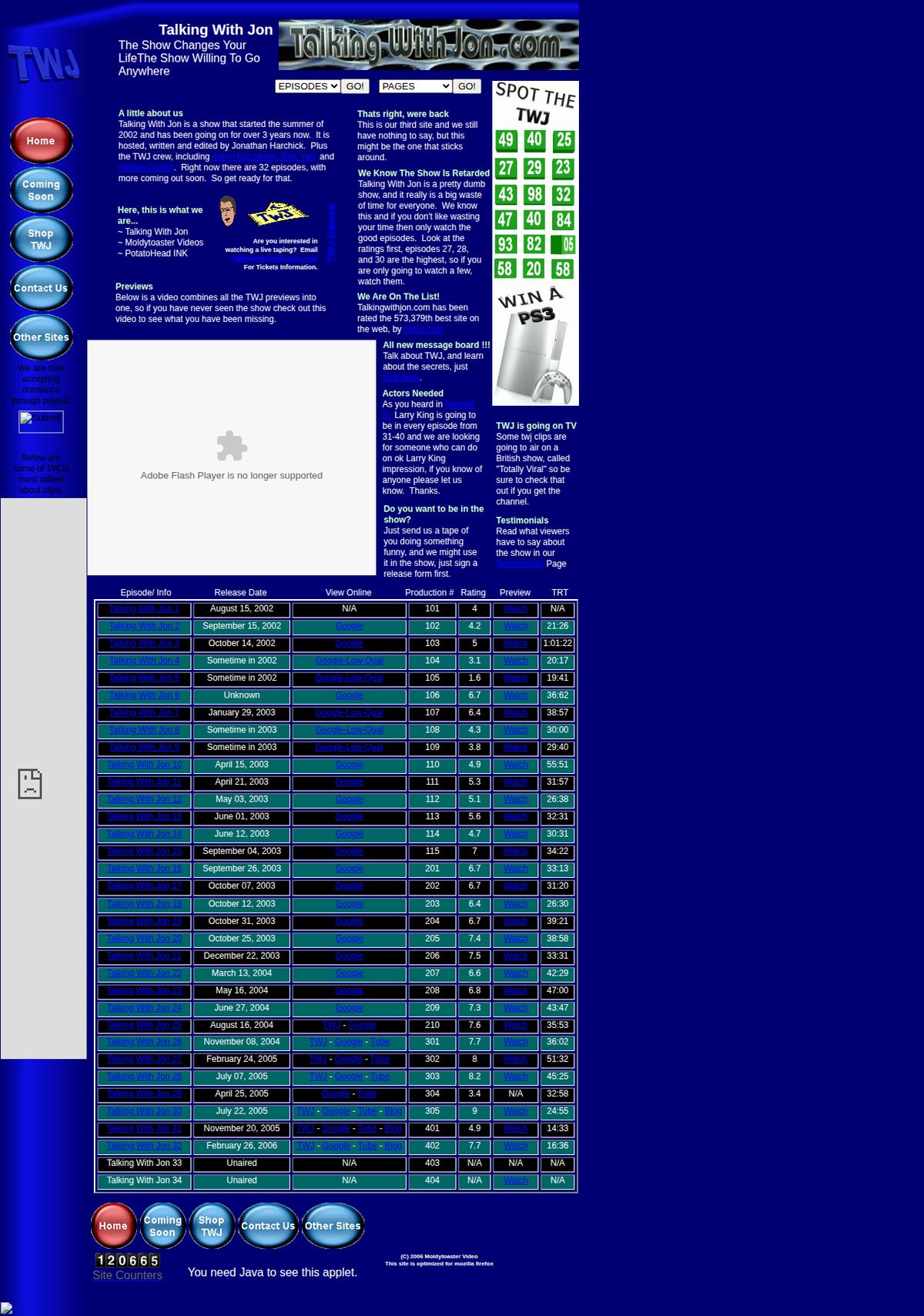
The peak came in 2006. By June the site called itself "Talking With Jon - Official Site," with the tagline "The Show Willing To Go Anywhere" and a navigation listing all 35 episodes, even though only 32 existed. Episode 35 was aspirational; the finale would land on 34. The page list shows how far his ambitions had grown: episode guides, insider info, a shop, wallpapers, a pictures page, a board games section, and "Your Show!," the viewer's corner. The site accepted PayPal donations, ran a brand-new message board, published a testimonials page of viewer comments, and offered one combined video of all the episode previews for newcomers. And then this: the site announced that clips from the show would air on a British program called "Totally Viral." Some of his material had crossed the Atlantic onto actual television. The Alexa rank had climbed to 573,379th.
By December 2006, the episode table's "View Online" column showed the platform migration in progress: episodes linked out to Google Video, to YouTube, which the site called "Tube," just months after Google bought it, and to a free video blog host. Episode 33 carried the highest viewer rating yet, 8.9 out of 10. An ad banner slot read "Your Ad Here." A small note said, "We are testing new layouts for the site right now." The Alexa rank had slid back down past two million. Read honestly, that is the shape of a burst of attention followed by the long tail, and the book will not dress it up as more than it was.
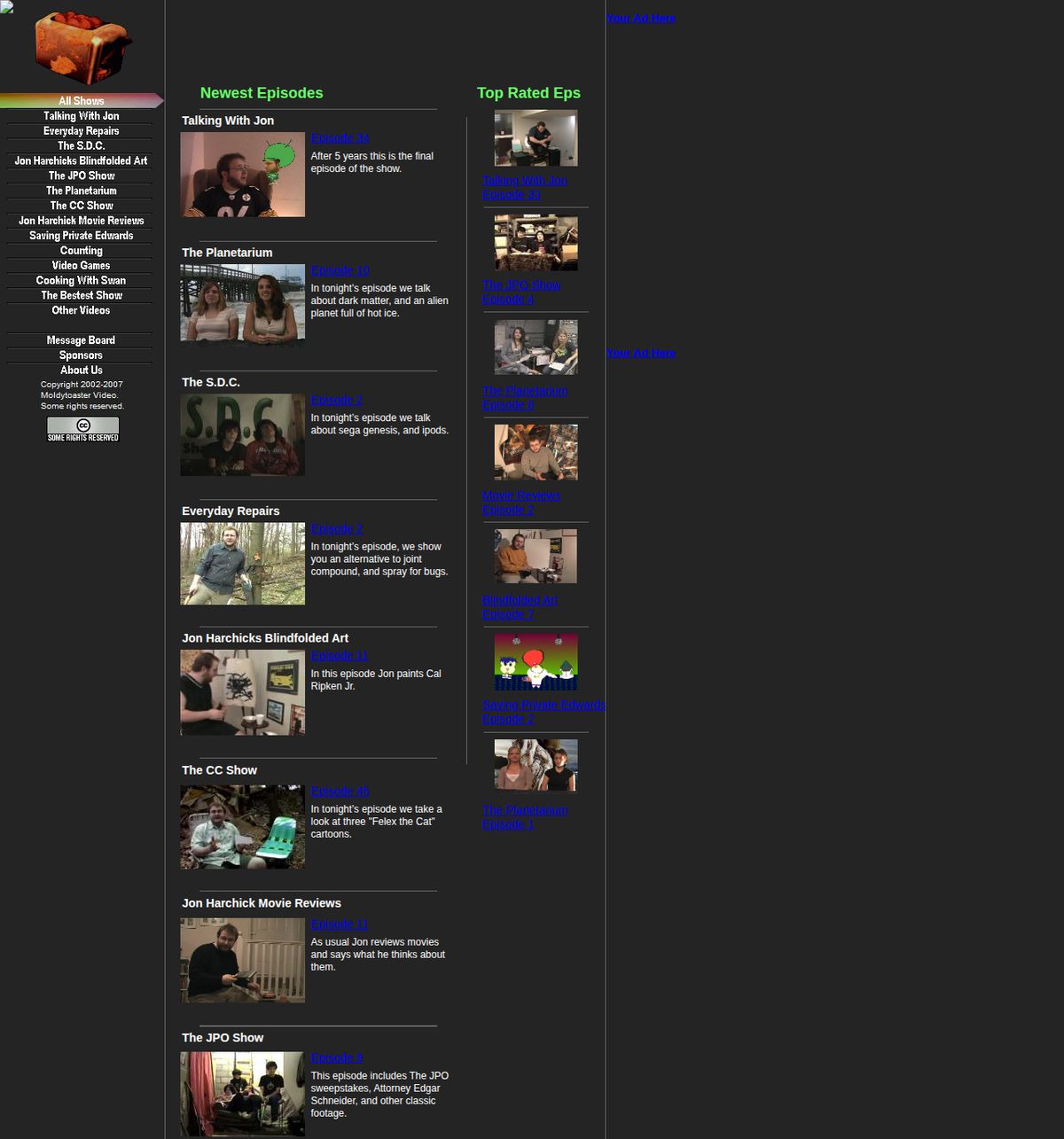
Then the pivot. By June 2007, a month before the finale, the talkingwithjon.com address no longer served the show's site at all. It served Moldytoaster Video, a multi-show video portal. Talking With Jon sat alongside The S.D.C., The Planetarium, Everyday Repairs, Jon Harchick's Blindfolded Art, Jon Harchick Movie Reviews, The JPO Show, and The CC Show, with pages prepared for more. Each show had its own episode folders. The page carried advertising from the AdBrite ad network, a Sponsors page, and a message board. And the TWJ episode entry read, simply: "After 5 years this is the final episode of the show."
The show had become one channel on his own little network. He built the multi-channel video portal himself, on his own domain, with ads, in 2007. If the last chapter's landscape was the problem, this was his answer to it, assembled by hand over five years: hosting, a participation system, promotion, and an archive, a miniature version of what YouTube would later sell as a service.
The two domains' afterlives are worth an honest paragraph. In 2008 the show's address folded into moldytoaster.com, which carried the portal forward: new episodes of the other shows, a 2011 redesign under the slogan "Moldytoaster - TV for an internet generation," and then, from 2016 on, a long stretch as a mere signpost redirecting to his YouTube channel. The last captures, from 2025, show it forwarding to his current home page, still pointing at him nearly twenty years on. The old talkingwithjon.com address had a stranger fate: by 2020 it had lapsed into other hands and served parked-domain gambling text, and its final capture, in 2023, is an unrelated fitness blog by a different Jon. That is the domain's afterlife, not his work, and we say so plainly.
moldytoaster.com, April 21, 2008, Wayback timestamp 20080421183413, beside moldytoaster.com, July 2011, timestamp 20110706002330. The brand absorbing the show, then the redesign as "TV for an internet generation." A paired caption can note the honest ending: the old show domain later lapsed and was repurposed by strangers.
The forum post
Now the story this chapter has been walking toward. April 2005. Jonathan is 16. His show is on its 27th episode. The website is up, the downloads are live, and he needs viewers the way every creator in 2005 needed viewers: one stranger at a time.
So he goes to PbNation, a paintball forum, and posts episode 27 in the miscellaneous buy/sell/trade section, under the name "Moldytoaster." That name, he would later explain, started as his AOL Instant Messenger handle, a random combination of two words with no deeper story behind it. It became his brand for the next twenty years.
What happened next is the single best-documented promotion attempt of the show's original run, because the thread is still live and was re-verified in 2026. His account shows a join date of April 2005. He was brand new. The replies came fast, and they were exactly what forum culture dealt to outsiders: confusion, a report, and an insult aimed at his newcomer status, calling him a "2k5.er," meaning someone who registered in 2005, which in the pecking order of the time marked him as part of a flood of low-quality new users.
He stayed and argued his case. Politely, in complete sentences, with a little bit of roast in it. He did not want any trouble, he wrote; he just wanted to post the video and see what people thought. The exchange ran April 18 to 20, 2005, and he even followed up two days later. He did not slink off. He did not flame back. He stood there, 16 years old, and made his pitch to a room full of strangers who had already decided he was spam.
That is the whole era in one story. The personal website as the destination. The forum as the only town square. The new account, the off-topic section, the hostile regulars. The standard failure mode of pre-YouTube promotion, and the notable part is not that he was flamed. It is that he stayed.
the PbNation "Talking With Jon 27" thread, live page https://www.pbnation.com/showthread.php?s=&postid=12540423, posts dated April 18-20, 2005. Forum-as-distribution captured in one screenshot. Grab a Wayback capture of this URL for the art pass so the book does not depend on a live forum page.
The permanence play
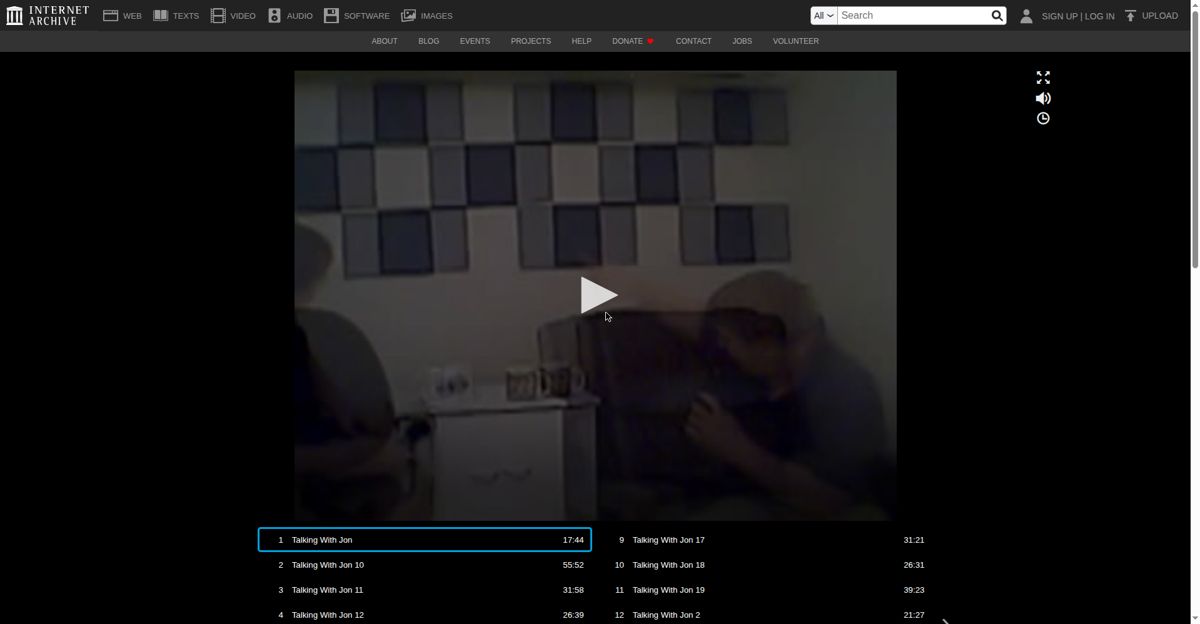
One more move, and it might be the most telling of all. In January 2007, while the show was still running, Jonathan uploaded it to the Internet Archive, the nonprofit digital library that preserves websites, books, and video. The item is called "Talking With Jon," dated January 16, 2007, his eighteenth birthday. Uploading there in 2007 was one of the few free, permanent hosting options in existence.
Think about what that means. The show was not over yet. Episode 34, the deliberate finale, would not arrive until that July. And he was already making sure it would survive him, or at least survive the fragile personal-site hosting it lived on. He had watched enough of the early internet to know how things vanished. He was not going to let his show be one of them.
The honest scale
Now the part this book promised in the foreword. Talking With Jon was not famous. The audience was almost certainly small, dozens to low hundreds of people, not thousands. Nothing in the record suggests wide circulation: no aggregator features, no surviving forum threads beyond PbNation, no press. We do not know how many people watched any given episode. No view counts existed; download counts, if any, are lost.
But small is not the same as nothing, and the book will not pretend it is. The contests drew entries. The band vote happened. The multi-format releases, episode 29 came out as both VCD and DivX five months apart, suggest he was responding to real viewers with real playback problems. The participation system worked well enough that he kept building it across multiple episodes. Somebody was out there, voting and entering and downloading, even if we will never know exactly how many.
And here is the sentence this chapter has to earn: if his audience was a dozen friends and a forum thread, that is not a footnote to the story. That is the story. A kid made 34 episodes of television for whoever would watch, built the whole apparatus to reach them by hand, and kept going for five years with no platform, no revenue, and no guarantee anyone was watching. The longevity is the single most unusual fact about the show. Most bedroom projects died after three episodes. His ran from 13 to 18, through the dial-up years, the YouTube launch, and the YouTube boom, without changing course.
There is one more unusual fact, and it is a question, not an answer. When the platform arrived that solved every distribution problem he had spent five years solving by hand, he finished his show his own way instead of moving it. Episode 34 is a deliberate finale: a toga in the woods, a mock history of the world, a closing song, "where are they now" gags. He knew how to end things. Why he did not bring the show to YouTube, we do not know, and the book will not guess. It is his question to answer.
What came next would be bigger, louder, and stranger: the stunts, the records, the thousands of episodes. But the pattern was already set here, in the bedroom, on the discs, on the hand-built site, in the forum thread where a 16-year-old would not back down. Make the thing. Put it out. Keep going. That is the whole biography, and it starts in his corner of the early internet.
End of Foreword and Part I (Chapters 1-3). Part II continues with Talking With Jon.